 PE Collective
LLM Pricing Per Million Tokens: 2026 Guide
LLM pricing per million tokens starts at $0.10 for input and $0.40 for output with GPT-4.1 Nano. Claude spans a wider range: Claude Haiku 4.5 starts at $1/1M input tokens, while Fable 5 costs $10/$50 per million tokens. Providers quote API usage differently. Some foreground input pricing. Others highlight cache discounts, batch rates, or context-dependent tiers. This page puts the numbers in one unit: cost per 1 million tokens, with input and output separated. That gives you a cleaner way to estimate a provider before your application turns a small prototype into a recurring bill.
TLDR
GPT-4.1 Nano is the price floor at $0.10 input and $0.40 output per million tokens. Claude ranges from Haiku through Fable 5, with output carrying the larger share of the bill. Batch processing and prompt caching can cut real bills below listed prices.
Key Takeaways
- GPT-4.1 Nano is the cost floor in this comparison at $0.10 input and $0.40 output per million tokens.
- Claude Sonnet 4.6 is priced at $3/$15 per million tokens, while Fable 5 is priced at $10/$50 per million tokens.
- Output tokens cost 4 to 8 times more than input tokens.
- One million tokens is roughly 750,000 English words, or about 1,500 pages of plain text.
- Batch processing and prompt caching routinely cut real bills 30 to 60% below sticker price.
How Much 1 Million Tokens Costs on Claude
Claude Haiku 4.5 starts at $1/1M input tokens. Related analysis
Claude Sonnet 4.6 is priced at $3/$15 per million tokens. Related analysis
The Claude Opus 4.x line is priced at $5/$25 per million tokens. Related analysis
Fable 5, the top Claude tier, is priced at $10/$50 per million tokens. Related analysis
The practical answer depends on which Claude model you use and whether your workload generates much text. A support workflow that sends long documents into the model but asks for terse outputs will lean toward input cost. A coding agent, research assistant, or drafting workflow can push far more spend into output.
Claude's range also tells you something useful about model selection. Haiku is the cost-conscious choice when speed and a low input price matter most. Sonnet is a middle ground for teams that want stronger performance without paying premium-tier rates. Opus and Fable 5 belong in workflows where the quality of the answer is worth a much larger bill.
You can compare the full Anthropic lineup in the Anthropic API pricing table. If your decision is specifically about Claude models, the Claude pricing guide is the more focused place to start.
The Cheapest and Most Expensive Models Right Now
The cheapest capable model is GPT-4.1 Nano at $0.10 input and $0.40 output per million tokens. Related analysis
At the other end, Fable 5, the top Claude tier, is priced at $10/$50 per million tokens. Related analysis
That is the spread developers are working with. The floor is cheap enough that many high-volume, narrow tasks are economically viable. Classification, routing, extraction, short summaries, and structured transformations all become easier to justify when the model cost stays close to the floor.
Premium models change the math quickly. They are usually chosen for a reason: harder reasoning, better writing, deeper analysis, stronger tool use, or a higher tolerance for ambiguous instructions. But those benefits have to show up in the product. Paying premium rates for a task that a smaller model already handles is a quiet way to turn healthy gross margins into a literal money pit.
The most expensive model is not automatically the wrong choice. It may be the right model for the last step in a workflow, where the system has already narrowed the task and the output goes directly to a customer, analyst, or executive. It is a poor default for every step that comes before it.
Model routing is where this becomes a product decision rather than a procurement exercise. Use a cheaper model to handle routine work. Send only the uncertain, high-value, or customer-visible cases to the premium tier. The provider with the lowest listed rate does not always win. The winning setup is the one that gets the required quality at the lowest total cost.
Representative Models Compared
The table is useful because it removes the language around each product and leaves the commercial decision sitting in front of you.
GPT-4.1 Nano is the clear price-floor option in this representative set. Claude Haiku gives you a low-cost Claude entry point on input. Sonnet occupies the middle of the Claude range, while Opus and Fable 5 are premium choices with correspondingly higher output prices.
Do not treat the input column as the whole bill. Many applications receive a short response and can mostly budget around input. Others create large outputs. Code generation, long-form drafting, agent traces, detailed analysis, and repeated tool calls can all move the output side from a rounding error to the dominant expense.
The model name matters less than your request pattern. Before choosing a default, inspect what your application sends and what it receives. A system that reads a lot and says little needs a different pricing model from one that produces long answers from compact prompts.
For a wider provider view, use the LLM API pricing comparison. It is easier to compare models after you have decided whether your workload is input-heavy, output-heavy, or split between the two.
What 1 Million Tokens Actually Is
One million tokens is roughly 750,000 English words, or about 1,500 pages of plain text. Related analysis
Tokens are the units an LLM reads and generates. They are not words, characters, or pages, although those comparisons help when you are estimating usage before you have production logs.
The words-and-pages equivalence gives you a rough mental model for volume. A million tokens is a large amount of text. Yet API products can consume that amount faster than expected when they include long source documents, repeated instructions, conversation history, retrieved context, tool results, or large generated outputs.
That is why token budgets deserve the same scrutiny as cloud infrastructure budgets. The first version of an application may use a small prompt and return a compact answer. The production version often accumulates context. Product teams add personalization. Developers add system instructions. Customers upload files. The model sees more of the world, and the bill follows.
The fix is rarely "use less AI." It is usually more specific. Remove context that does not affect the answer. Summarize older conversation history. Keep retrieved passages relevant. Put stable instructions in a cached prompt when the provider supports it. Route simple tasks to lower-cost models.
A million tokens is a useful pricing unit because it makes those choices comparable across providers. It is not a promise about your monthly bill. Your bill comes from the token shape of your product.
Complete Pricing Table: All Major LLM APIs
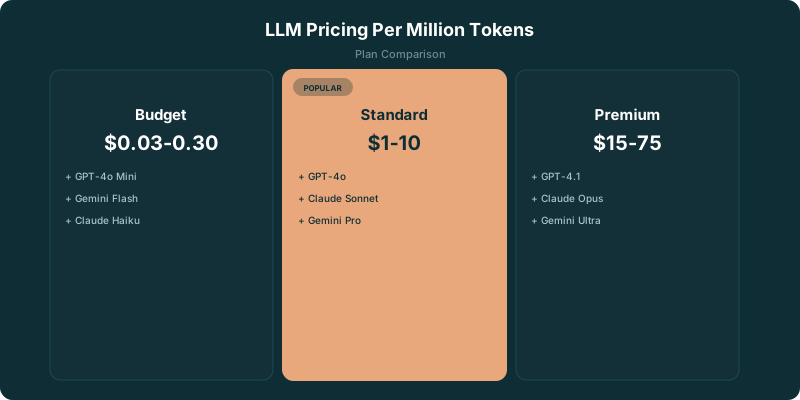
This table covers six providers and 20+ models. All prices are per 1 million tokens. "Input" is what you send to the model (prompts, context, documents). "Output" is what the model generates back. Where a provider offers tiered pricing based on context length, both tiers are listed.
OpenAI
Anthropic
Meta (Llama 4, via inference providers)
Mistral
Cohere
Cheapest Models by Price Tier
Under $0.20 per 1M Input Tokens: Classification and Extraction
GPT-4.1 Nano ($0.10/$0.40), Mistral Small ($0.10/$0.30), Gemini 2.5 Flash ($0.15/$0.60), Llama 4 Scout ($0.15/$0.60), and Cohere Command R ($0.15/$0.60). These models handle classification, entity extraction, data labeling, and simple Q&A. If your task doesn't require specific reasoning, start here. Mistral Small has the cheapest output tokens at $0.30 per million. GPT-4.1 Nano has the best overall quality at this price point. For a chatbot that handles 10,000 conversations a day, Nano costs $39/month. The same traffic on GPT-4.1 costs $780/month.
$0.40 to $2.00 per 1M Input: Production Workloads
GPT-4.1 Mini ($0.40/$1.60), Mistral Medium ($0.40/$2.00), Haiku 4.5 ($1.00/$5.00), o4-mini ($1.10/$4.40), GPT-5 ($1.25/$10.00), Gemini 2.5 Pro ($1.25/$10.00), GPT-4.1 ($2.00/$8.00), and o3 ($2.00/$8.00). This is the production tier. Most real applications live here. GPT-4.1 is the default for coding, content, and general tasks. o4-mini is the best value if you need step-by-step reasoning. GPT-5 and Gemini 2.5 Pro offer flagship capabilities with cheap input but expensive output ($10/1M).
$2.00+ per 1M Input: Hard Problems and Premium Quality
Mistral Large ($2.00/$6.00), Cohere Command R+ ($2.50/$10.00), Sonnet 4.6 ($3.00/$15.00), and Opus 4.6 ($5.00/$25.00). Reserve these for tasks where cheaper models fall short. Opus 4.6 is the most expensive mainstream model at $5/$25 but excels at complex reasoning, specific writing, and difficult coding. Sonnet 4.6 offers 80-90% of Opus quality at 60% of the cost. Mistral Large is worth considering if EU data residency is a requirement.
Why Output Tokens Cost 4-8x More Than Input
Every LLM provider charges more for output tokens than input tokens. GPT-4.1 charges $2 for input but $8 for output. Opus 4.6 charges $5 for input but $25 for output. This isn't arbitrary. It reflects how the models work.
When you send input tokens (your prompt), the model processes them all at once in parallel. The GPU crunches through your entire prompt in a single forward pass. It's fast and computationally efficient.
Output tokens are different. The model generates them one at a time, sequentially. Each new token depends on every token that came before it. The model can't skip ahead or parallelize this step. Token 50 requires tokens 1 through 49 to exist first. This sequential dependency means each output token requires a separate forward pass through the model, using far more compute per token than input processing.
This has a direct impact on your bill. A typical API call with 2,000 input tokens and 500 output tokens on GPT-4.1 costs $0.004 for input and $0.004 for output. Equal cost despite 4x fewer output tokens. If your responses average 1,000 output tokens, output is 67% of your total cost.
The practical takeaway: controlling output length is the single most effective way to reduce costs. Tell the model to be concise. Use structured output (JSON) instead of prose. For classification, request a single label instead of an explanation. Set max_tokens to prevent runaway responses. A 10-class classifier using structured output typically uses 5-20 output tokens instead of 50-200 with free-form text. At scale, that's a 10x cost reduction on your most expensive token type.
How to Calculate Your Monthly Cost: 3 Real Scenarios
Token pricing means nothing in isolation. Here's what three common workloads cost per month across different models, with the math shown.
Scenario 1: Customer Support Chatbot (10K conversations/day)
Each conversation averages 500 input tokens (system prompt + user message) and 200 output tokens. Daily tokens: 5M input, 2M output.
- GPT-4.1 Nano: (5 x $0.10) + (2 x $0.40) = $1.30/day, $39/month
- Gemini 2.5 Flash: (5 x $0.15) + (2 x $0.60) = $1.95/day, $59/month
- GPT-4.1: (5 x $2.00) + (2 x $8.00) = $26/day, $780/month
- Sonnet 4.6: (5 x $3.00) + (2 x $15.00) = $45/day, $1,350/month
For most support chatbots, GPT-4.1 Nano or Gemini Flash provides sufficient quality. Upgrading to GPT-4.1 or Sonnet only makes sense if the chatbot handles complex, multi-turn conversations where reasoning quality directly impacts customer satisfaction.
Scenario 2: RAG Pipeline (50K queries/day)
Each query includes 2,000 input tokens (retrieved documents + question) and 500 output tokens. Daily tokens: 100M input, 25M output.
- GPT-4.1 Nano: (100 x $0.10) + (25 x $0.40) = $20/day, $600/month
- Mistral Small: (100 x $0.10) + (25 x $0.30) = $17.50/day, $525/month
- GPT-4.1: (100 x $2.00) + (25 x $8.00) = $400/day, $12,000/month
- Sonnet 4.6: (100 x $3.00) + (25 x $15.00) = $675/day, $20,250/month
RAG pipelines are input-heavy. Prompt caching helps here because the system prompt and few-shot examples repeat on every query. With 75% cache hits on GPT-4.1, that $12,000/month drops to roughly $5,000/month.
Scenario 3: Batch Document Classification (1M documents, one-time)
Each document averages 1,000 input tokens. Output is a single classification label (10 tokens). Total: 1B input tokens, 10M output tokens.
- GPT-4.1 Nano: (1000 x $0.10) + (10 x $0.40) = $104 total
- GPT-4.1 Nano (batch, 50% off): $52 total
- Gemini 2.5 Flash: (1000 x $0.15) + (10 x $0.60) = $156 total
- GPT-4.1: (1000 x $2.00) + (10 x $8.00) = $2,080 total
Classification is the ideal use case for cheap models. The difference between $52 (Nano batch) and $2,080 (GPT-4.1) is 40x, and for labeling tasks, Nano's accuracy is typically within 1-2% of the larger model.
Batch and Caching Discounts That Change the Math
The per-million-token prices above are sticker prices. Three discount mechanisms can cut your actual costs by 50-90%. Ignoring them means overpaying.
OpenAI Batch API: 50% off everything. Submit requests as a JSONL file and get results within 24 hours. Every token costs half. GPT-4.1 drops from $2/$8 to $1/$4. GPT-4.1 Nano drops to $0.05/$0.20. Use this for any workload that doesn't need real-time responses: data extraction, content generation, nightly processing, bulk classification. It's the single biggest cost reduction available from any provider.
Prompt caching: 50-90% off input tokens. Both OpenAI and Anthropic cache repeated prompt prefixes automatically. If your system prompt, few-shot examples, or document context stays the same across requests, subsequent calls pay a reduced rate on those cached tokens. OpenAI's discounts vary by model: GPT-5 gets 90% off cached reads, GPT-4.1 gets 75% off, o-series gets 50% off. Anthropic offers 90% off cached input tokens across all Claude models. Structure your prompts with stable content first and variable content last to maximize cache hits.
Google's free tier. Gemini 2.5 Flash is free under certain rate limits (roughly 15 RPM and 1M TPM). For prototyping, low-volume internal tools, or development environments, this is zero-cost access to a model that competes with GPT-4.1 Nano in quality. No credit card required.
These discounts stack in some cases. A cached batch request through OpenAI's GPT-4.1 pays $0.25 per million cached input tokens and $4 per million output tokens. That's 87.5% off standard input pricing. The sticker prices at the top of this page are the ceiling, not the floor.
Which Provider Is Cheapest for Your Use Case?
Stop comparing models in isolation. Match the model to your task. Here are clear winners in each category.
Simple classification, extraction, or routing
Pick GPT-4.1 Nano ($0.10/$0.40) or Gemini 2.5 Flash ($0.15/$0.60). For labeling data, extracting structured fields from text, or routing queries to other models, you don't need a $3+ model. Nano handles these tasks with 95%+ accuracy at a fraction of the cost. Gemini Flash is a strong alternative, especially if you want Google's free tier for development. If output cost matters most, Mistral Small ($0.10/$0.30) has the cheapest output tokens available.
General production (chatbots, content, coding)
Pick GPT-4.1 ($2/$8) or Sonnet 4.6 ($3/$15). This is where most teams spend their money. GPT-4.1 is 33% cheaper on input and 47% cheaper on output. Sonnet 4.6 tends to produce higher-quality writing and handles ambiguous instructions better. Test both on your specific prompts. If cost is the priority, GPT-4.1 wins. If output quality on specific tasks matters more, Sonnet 4.6 is worth the premium.
Complex reasoning (math, logic, multi-step analysis)
Pick o4-mini ($1.10/$4.40) or Opus 4.6 ($5/$25). o4-mini is the value play for reasoning tasks. It uses chain-of-thought reasoning at a low price and handles most math, science, and logic problems well. Opus 4.6 is the quality ceiling but costs 5x more on input and 6x more on output. For most reasoning workloads, start with o4-mini and only escalate to Opus when accuracy drops below your threshold. o3 ($2/$8) sits between them as a mid-range option.
Budget-sensitive or experimental
Pick Gemini 2.5 Flash (free tier) or Llama 4 Scout via Groq ($0.15/$0.60). Google's free tier gets you a competitive model at zero cost for low-volume use. Groq's inference of Llama 4 is extremely fast and cheap. Both work for prototyping, internal tools, and development. When you need to move to production, switch to GPT-4.1 Nano or stay on Gemini Flash's paid tier.
Input Output Tokens: What You Pay For and Why They Differ
Every API bill splits into two line items: input tokens and output tokens. Input tokens are everything you send to the model. That includes your system prompt, the conversation history, retrieved documents, few-shot examples, and the user's current message. Output tokens are only the text the model writes back. The split matters because the two are priced differently and behave differently at scale.
A quick worked example. You send GPT-4.1 a 3,000-token prompt and it returns a 700-token answer. Input cost is 0.003 x $2 = $0.006. Output cost is 0.0007 x $8 = $0.0056. Almost a 50/50 split even though the output is four times shorter, because output is priced four times higher. Knowing which side dominates your workload tells you where to optimize. Long-context RAG is input-heavy. Chatty assistants and code generation are output-heavy.
Here is the input output token spread for the models most teams actually deploy, per the maintained table above:
How Much Is 1 Million Tokens (and 2 Million, and 10 Million)?
In plain dollars, the answer depends entirely on the model and whether the tokens are input or output. One million tokens is approximately 750,000 words. On GPT-4.1 Nano, a million input tokens costs ten cents and a million output tokens costs forty cents. On Opus 4.6, the same million input tokens costs five dollars and a million output tokens costs twenty-five dollars. The table below shows the all-in cost for a few round numbers, assuming a typical 80% input / 20% output mix.
The cost per token, then, ranges from about $0.0000001 (GPT-4.1 Nano input) to $0.000025 (Opus 4.6 output). Those numbers are tiny per token, which is exactly why providers quote per million. Confirm the current rate on the provider's own pricing page before you budget, since model lineups and prices shift through the year. See OpenAI API pricing and Anthropic API pricing for the per-provider breakdowns we keep updated.
How to Compare LLM API Pricing Without Fooling Yourself
Start by putting every candidate model into the same unit: cost per million input tokens and cost per million output tokens. That is the normalization layer. Without it, product pages can make similar rates look unrelated.
Then inspect your own workload. What does a typical request contain? How much reusable context is included? How long is the output? Does the workflow call the model once, or does it make repeated calls behind the scenes? Which requests need the highest-quality result?
You do not need perfect production data to make an initial decision. You need an honest request shape. Build from the type of text your product will send and receive, then choose a default model that fits the common case.
Keep the premium option available. The cheapest model can lose when it creates enough errors, retries, or manual review to erase its rate advantage. The premium option can lose when it handles routine work that did not need it. Good model selection is a portfolio decision.
It also changes over time. Product usage evolves. Providers update models. A workflow that starts with simple prompts can grow into a system with retrieval, file uploads, multiple tools, and customer-specific context. Revisit the pricing table when the product changes, rather than only when finance asks why spend moved.
The LLM token pricing guide covers the mechanics behind token billing. Use it alongside this table when you need to turn model rates into a product-level estimate.
The Bottom Line
The cheapest capable model is GPT-4.1 Nano at $0.10 per million input tokens, with Mistral Small and Gemini 2.5 Flash close behind. For production workloads, GPT-4.1 ($2/$8) and Sonnet 4.6 ($3/$15) are the two defaults. For reasoning, o4-mini ($1.10/$4.40) is the value pick. The biggest cost lever isn't which model you pick. It's routing simple tasks to cheap models instead of sending everything through the same expensive one. Combine that with batch processing and prompt caching, and your actual costs will be 30-60% below the sticker prices on this page.
Related Resources
Frequently Asked Questions
What does "per million tokens" mean?
LLM providers charge based on tokens, which are chunks of text roughly 3-4 characters long. "Per million tokens" (per 1M tokens) is the standard pricing unit. One million tokens is approximately 750,000 words. If a model costs $2 per 1M input tokens and you send 500,000 tokens in a month, your input cost is $1. Some older documentation quotes prices "per 1K tokens." To convert, multiply by 1,000. A model priced at $0.002 per 1K tokens costs $2 per 1M tokens.
How many tokens is 1,000 words?
In English, 1,000 words is roughly 1,300 to 1,400 tokens. The exact count depends on word length and punctuation. Code typically tokenizes at a higher ratio because of special characters and syntax. A 10-page report (around 5,000 words) is about 6,500-7,000 tokens. You can use OpenAI's tiktoken library or Anthropic's token counter to get exact counts before sending requests.
Why do output tokens cost more than input tokens?
Input tokens can be processed in parallel because the model reads the entire prompt at once. Output tokens must be generated one at a time, sequentially, because each new token depends on the ones before it. This sequential generation uses more GPU compute per token. That's why output costs 4-8x more than input across every major provider. It also means verbose responses are disproportionately expensive. Controlling output length is the single most effective cost optimization.
Which LLM has the cheapest API?
GPT-4.1 Nano at $0.10/$0.40 per million tokens is the cheapest capable model from a major provider. Mistral Small matches it on input at $0.10 and beats it on output at $0.30. Gemini 2.5 Flash is $0.15/$0.60 but has a free tier for low-volume use. For open-source models, Llama 4 Scout via Groq costs about $0.15/$0.60. With OpenAI's batch API (50% off), GPT-4.1 Nano drops to $0.05/$0.20, making it the cheapest option at scale.
How do I switch providers to save money?
Most LLM APIs follow the same request/response format: a messages array with system, user, and assistant roles. Switching providers usually means changing the API endpoint, API key, and model name. Libraries like LiteLLM and OpenRouter provide a unified interface across providers, letting you switch with a single config change. The hard part isn't the code. It's testing. Different models behave differently on the same prompt. Always run your evaluation suite against the new model before switching production traffic.
Are there free LLM APIs?
Google offers a free tier for Gemini 2.5 Flash with rate limits (around 15 RPM and 1M TPM for free users). OpenAI has a free tier with very limited rate limits (3 RPM for reasoning models). Groq offers free access to open-source models like Llama 4 with rate limits. These free tiers are enough for prototyping and development but won't support production traffic. For serious volume, expect to pay. But the cheapest models ($0.10/1M tokens) make the cost minimal for most use cases.
How much is 1 million tokens in dollars?
It depends on the model and whether the tokens are input or output. As of April 2026: a million input tokens runs $0.10 on GPT-4.1 Nano, $2 on GPT-4.1, $3 on Claude Sonnet 4.6, and $5 on Claude Opus 4.6. Output tokens cost more: $0.40, $8, $15, and $25 per million respectively. A million tokens is roughly 750,000 words, so for most everyday workloads the per-message cost is fractions of a cent. Always confirm the live rate on the provider's pricing page.
What is the cost per token for GPT and Claude?
Divide the per-million price by one million. GPT-4.1 input works out to $0.000002 per token and output to $0.000008 per token. Claude Sonnet 4.6 is $0.000003 input and $0.000015 output. Claude Opus 4.6 is $0.000005 input and $0.000025 output. Nobody quotes prices this way in practice because the numbers are too small to read, which is why every provider standardizes on a per-million-token figure.