 PE Collective
Best AI API Providers for New LLM Apps
Which AI API to build on? Seven providers compared on models, pricing, SDKs, and developer experience.
Last updated: September 2, 2026
The best AI API providers depend on what you're building, but OpenAI is the default choice for most new LLM applications. It has the broadest model lineup, mature tooling, and a flagship price that makes an early production decision less painful than it used to be.
Anthropic is the stronger pick for teams whose product lives or dies on coding quality, careful reasoning, and controllable behavior. Google is hard to ignore when cost and throughput drive the architecture. The rest of the market earns its place through a more specific advantage: open weights, enterprise retrieval, multi-provider procurement, or direct access to the open-source ecosystem.
Choosing badly can leave you rebuilding prompts, evaluations, and observability after the product has customers. Choosing well gives you room to learn what users want before vendor constraints start running the company.
We evaluated all seven on developer experience, model quality, pricing transparency, and production reliability. Here is how they compare.
TLDR
OpenAI is the best default for most new LLM products because GPT-5 is cheap enough to prototype and broad enough to avoid an early corner. Choose Anthropic for coding-heavy work, Google for low-cost volume, and Bedrock when your infrastructure already lives on AWS.
The Short Answer: Which AI API Provider to Build On
Pick OpenAI if you want the safest starting point. The API has a wide model menu, strong developer documentation, and enough production history that most common integration problems already have an answer somewhere. OpenAI's flagship GPT-5 is priced at $1.25 per 1M input tokens Related analysis.
That price anchor changes the default decision. A frontier model no longer has to be treated as a special-purpose luxury reserved for a small set of requests. You can start with GPT-5, learn where quality changes user behavior, then route simpler work to a cheaper model.
Choose Anthropic when your product spends much of its time reading code, writing code, reviewing complex documents, or operating inside workflows where a bad answer creates cleanup work. Claude has built a following with developers for a reason. Its higher-end models give teams a credible alternative when they care more about answer quality than having the widest model catalog.
Choose Google when cost control and throughput are the center of the product, especially if your team already uses Google Cloud. Gemini's lower-cost models make it easier to serve high-volume tasks without turning every active user into a margin problem.
Mistral is the interesting option for teams that want commercial APIs while keeping open-weight models in the picture. Cohere remains focused on enterprise retrieval and internal knowledge use cases. AWS Bedrock is the procurement answer for companies that want several model families under their existing AWS relationship. Hugging Face is where open-source model experimentation becomes much easier.
There isn't one provider that wins every category. There is a sensible default, then a set of reasons to leave it.
Flagship Model Pricing by Provider
The fastest way to compare AI API providers is to start with the model you would put behind a serious feature. Input pricing is only part of the bill, but it gives you a clean first view of the market.
| Provider | Flagship model | Per-1M-token price |
|---|---|---|
| OpenAI | GPT-5 | $1.25 per 1M input tokens |
| Anthropic | Claude Opus 4.6 | $5 / $25 per 1M input / output tokens |
| Gemini 2.5 Pro | $1.25 per 1M input tokens | |
| Mistral | Mistral Large 2 | $2.00 input and $6.00 output per 1M tokens |
| Cohere | Command R+ | $2.50 input and $10.00 output per 1M tokens |
| AWS Bedrock | Multi-provider access | n/a |
| Hugging Face | Open-source model catalog | n/a |
OpenAI's flagship GPT-5 is priced at $1.25 per 1M input tokens Related analysis. Google's Gemini 2.5 Pro costs $1.25 per 1M input tokens Related analysis.
The apparent tie between those models does not make them interchangeable. Your workload determines the real bill. A product that sends long prompts, large documents, or dense conversation histories will care about input rates. A product that generates reports, code, or detailed analysis will care much more about output pricing and how often users ask for another pass.
OpenAI's GPT-4.1 costs $2.00 per 1M input tokens, and GPT-4.1 Nano at $0.10 is one of the cheapest capable models anywhere Related analysis. That gives OpenAI a useful internal routing ladder: a capable low-cost model for routine classification, extraction, and short-form transformations, with stronger models available when the task needs more judgment.
For a broader view of model costs, use this cross-provider LLM pricing comparison. Price pages go stale quickly. Your architecture should make it easy to change the model behind a task without rewriting the application around it.
The Cheapest Way to Start
Budget-driven teams should separate cheap experimentation from cheap production. A free tier can get a prototype working. It cannot tell you whether your product economics survive after users arrive, prompts get longer, and requests become less tidy.
OpenAI's GPT-4.1 costs $2.00 per 1M input tokens, and GPT-4.1 Nano at $0.10 is one of the cheapest capable models anywhere Related analysis. GPT-4.1 Nano is the cleanest place to start for bounded tasks: extracting fields, tagging text, routing support requests, summarizing predictable content, or turning structured inputs into structured outputs.
Google's Gemini 2.5 Pro costs $1.25 per 1M input tokens and Gemini 2.5 Flash costs $0.15 Related analysis. Flash deserves attention when a task needs speed and high request volume more than frontier-level reasoning.
Cheap models work best when you give them narrow jobs. That means clear input formats, constrained outputs, and a failure mode you can detect. It does not mean handing a low-cost model a vague prompt and hoping the savings survive the support queue.
A simple routing strategy is usually enough at the start. Send straightforward tasks to the lower-cost model. Escalate ambiguous, high-value, or user-visible requests to the stronger model. Keep the routing logic in your own application layer. Provider-specific abstractions are convenient until they make a provider switch expensive.
The price difference matters most when your product has repeat behavior. A one-off internal tool can tolerate a premium model everywhere. A customer-facing workflow with frequent requests needs a cost model before it needs a clever demo.
How the Major Providers Differ in Practice
OpenAI wins on breadth. It is the provider most teams can adopt without having a highly specific reason. You get a deep model catalog, familiar SDKs, broad community support, and a path from low-cost utility work to frontier tasks without changing vendors.
OpenAI's flagship GPT-5 is priced at $1.25 per 1M input tokens Related analysis. That makes the provider easier to justify for a new application because the default high-quality choice does not force an immediate pricing tradeoff.
Anthropic wins when the quality of long-form reasoning, code generation, and instruction-following affects the product directly. Claude Haiku 4.5 costs $1 / $5, Sonnet 4.6 $3 / $15, and Opus 4.6 $5 / $25 per 1M input / output tokens Related analysis.
Those tiers make the tradeoff visible. Haiku is for fast, lower-cost work. Sonnet is the practical middle for applications that need stronger reasoning without paying the highest rate. Opus is where you go when failures are expensive and the task merits it.
Google wins on cost-conscious scale and cloud adjacency. Google's Gemini 2.5 Pro costs $1.25 per 1M input tokens and Gemini 2.5 Flash costs $0.15 Related analysis. Teams already committed to Google Cloud may find the operational fit as persuasive as the model pricing.
The big question is not which provider has the strongest benchmark this week. It is which one fits your workload, your team's existing infrastructure, and the degree of model-specific behavior your users will notice.
The Other AI API Providers Worth Considering
Mistral
Mistral is the choice for teams that want to keep open-weight options close while still using a commercial API. That matters when deployment control, regional requirements, or model customization belongs in the product plan rather than the future-maybe pile.
Mistral Large 2 costs $2.00 input and $6.00 output per 1M tokens Related analysis. Its commercial offering gives you a straightforward API path, while Mistral's open-weight work gives technical teams more room to evaluate self-hosted or customized approaches later.
Mistral loses ground when you need the deepest ecosystem, the broadest third-party integration support, or the easiest path for a small team moving quickly. It wins when model control has strategic value.
Cohere
Cohere is built around enterprise language workloads, especially retrieval-augmented generation and internal knowledge systems. It is a serious option when the product's core job is answering questions from a company's own documents, policies, or records.
Cohere Command R+ costs $2.50 input and $10.00 output per 1M tokens Related analysis. That price makes more sense when retrieval quality and enterprise deployment are part of the buying decision, not a side feature pasted onto a general chatbot.
Cohere is less compelling for a founder building a broad consumer application from scratch. Its center of gravity is enterprise search, internal assistants, and workflows where grounding answers in proprietary information matters more than broad experimentation.
AWS Bedrock
AWS Bedrock is for teams that want model choice without adding a new core vendor relationship. It gives AWS customers access to multiple providers through an AWS-native service layer, which can simplify procurement, security review, and infrastructure ownership.
It is not always the fastest path for a small team. Direct APIs from OpenAI, Anthropic, or Google can be simpler when speed of iteration is the only thing that matters. But a larger company already operating inside AWS may prefer Bedrock because vendor management is part of the architecture.
Use the AWS Bedrock pricing guide before treating it as a simple pass-through option. The provider abstraction can help, but it does not remove the work of choosing models, writing evaluations, and understanding the specific behavior behind each endpoint.
Hugging Face
Hugging Face is the open-source gateway. It gives developers a broad catalog of models, tooling for testing and deployment, and a place to compare approaches outside the proprietary API market.
That flexibility comes with more responsibility. You need to understand hosting, model behavior, evaluation, security, and operational tradeoffs. For a team that wants the fastest route to a reliable product feature, a direct managed API is usually easier. For a technical company where model ownership matters, Hugging Face can be the beginning of a more defensible stack.
Our Top Picks
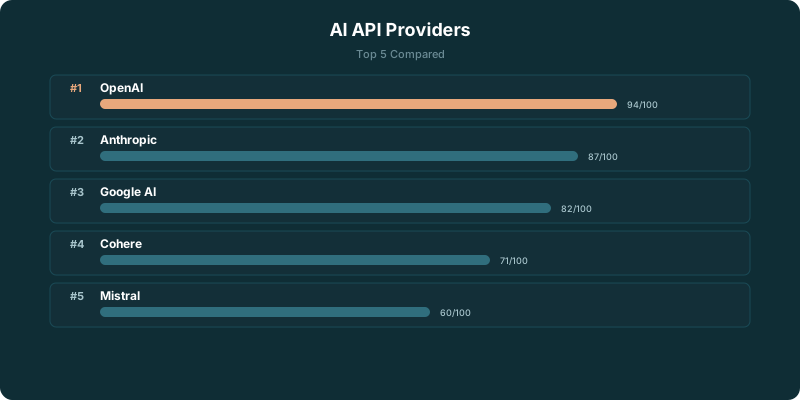
Detailed Reviews
OpenAI
Most ModelsThe largest model lineup: GPT-5, GPT-4.1 family, o-series reasoning models, DALL-E, Whisper, and embeddings. Best SDK, most third-party integrations, and the most battle-tested API. The default choice for most developers.
Anthropic
Best for Coding & SafetyClaude Opus, Sonnet, and Haiku models excel at coding, analysis, and long-form generation. 200K context window standard. The API is clean and well-documented. Tool use and structured output support is excellent.
Google AI
Best Free TierGemini 2.0 Flash is effectively free for most development use cases. Gemini 2.5 Pro competes with GPT-5 and Claude Opus on benchmarks. Google AI Studio provides a generous playground. The SDK is newer but improving rapidly.
Mistral
Best Open-WeightMistral offers both API access and downloadable model weights. Mistral Large competes with GPT-4.1 at $2/$6. Mistral Small at $0.10/$0.30 is among the cheapest capable APIs. Self-hosting option gives full control.
Cohere
Best for Enterprise RAGCohere specializes in enterprise search and RAG. Command R+ handles generation, Embed v4 leads on multilingual retrieval, and Rerank improves search quality. The API is purpose-built for retrieval workflows.
AWS Bedrock
Best Multi-ProviderAccess Claude, Llama, Mistral, and Cohere models through one API with AWS billing. No per-provider contracts. Integrates with AWS infrastructure (Lambda, S3, SageMaker). Good for enterprises already on AWS.
Hugging Face
Best for Open SourceThe largest open model hub with 500K+ models. Free Inference API for testing, dedicated endpoints for production. more than LLMs, covers vision, audio, and NLP. The community and model variety are unmatched.
Evaluation Criteria
Compare each provider on SDK quality, documentation clarity, rate-limit handling, error behavior, model coverage, and measured latency in your own workload. Published documentation supports the feature comparison; production performance should be verified with a representative pilot.
What to Evaluate Before You Commit
Developer experience matters because model integrations are never as small as the first demo. Look at SDK quality, API consistency, documentation, error handling, streaming support, and how easily you can trace failures. The provider with the nicer benchmark chart can still waste weeks if its production tooling gets in your way.
Model quality should be measured against your own task set. Build a small evaluation set from real inputs before you make a large commitment. Include the cases where users will notice failure, rather than only the clean examples that make a demo look sharp.
Pricing transparency matters because usage is rarely stable. Read input and output rates, then test the prompts your application will actually send. Long context, retries, tool calls, and verbose outputs all change the economics.
Production reliability is the final filter. Check rate limits, regional availability, data handling, incident history, and fallback options. A provider can be excellent and still be the wrong single point of failure for your product.
Keep your application portable enough to change course. Store prompts outside provider-specific code. Maintain an evaluation harness. Track quality and cost by task. The company that can switch providers has more negotiating power and fewer excuses when a better model arrives.
Key Takeaways
- OpenAI is the strongest default for a new application that needs model breadth and mature developer tooling.
- Anthropic is a better fit when coding quality, careful reasoning, and controllable behavior shape the user experience.
- Google offers a strong cost path for high-volume tasks through Gemini 2.5 Flash.
- Mistral, Cohere, Bedrock, and Hugging Face each win when open weights, enterprise retrieval, AWS procurement, or open-source control drive the decision.
- Build model routing and evaluations into your application before a provider becomes difficult to replace.
Frequently Asked Questions
What is the best AI API for developers?
OpenAI for breadth, Anthropic for coding quality, Google for free access. Most developers start with OpenAI due to SDK maturity and integrations.
Which AI API is cheapest?
Google Gemini Flash is effectively free for development. Mistral Small ($0.10/$0.30) and GPT-4.1 Nano ($0.10/$0.40) are the cheapest paid options.
Can I switch AI API providers easily?
Most providers use similar chat completion formats. Libraries like LiteLLM abstract provider differences. The main friction is prompt tuning, each model responds differently to the same prompt.
Do I need to pay for an AI API?
Google AI Studio offers free Gemini access. OpenAI gives $5 in credits. Hugging Face has a free inference tier. For production, expect to pay, free tiers have rate limits that block real usage.
OpenAI vs Anthropic, which API is better?
OpenAI has more models and better third-party support. Anthropic's Claude models are stronger for coding and long-context tasks. Price is similar. Choose based on your primary use case.