 PE Collective
Best Open Source LLMs 2026 for Self-Hosting
The best open source llms 2026 give engineers a credible way to run capable models on their own infrastructure, tune them on private data, and avoid building a product around someone else's API roadmap.
Last updated: 2026-09-02
Open source LLMs have caught up to proprietary models faster than anyone predicted. Two years ago, running a local model meant accepting significantly worse quality. Today, the best open models match GPT-4.1 on many benchmarks and beat it on some. The gap hasn't disappeared, but it's narrow enough that the tradeoffs are worth considering.
The case for open source extends beyond about cost, though that matters. It's about control. You pick the hardware. You own the weights. You can fine-tune on your data without sending it to a third party. You can run inference air-gapped if compliance requires it. And if the model vendor decides to change their terms, raise prices, or shut down, your deployment keeps running.
Published MMLU, HumanEval, and MT-Bench results can help narrow the list, but they do not replace task-specific evaluation. Test finalists on the hardware and serving stack you will operate because model quality, latency, memory use, and throughput all affect production fit.
Open weights change the operating model. You choose the deployment environment, keep sensitive data inside it, and decide when a model upgrade is worth the migration pain. That control comes with more responsibility. Someone still has to provision hardware, measure latency, set guardrails, and keep the model useful after launch.
TLDR: Llama 4 Scout leads the current open-weight field, while Mistral, Qwen, DeepSeek, Gemma, Phi, and Command R+ each win a narrower job. Pick for the workload and hardware you have. A model that looks great in a benchmark can become a literal money pit in production.
The Short List: Best Open Source LLMs Right Now
Llama 4 Scout is the best overall choice for teams that want current frontier-level open weights without treating deployment as a research project. Llama 4 Scout (17B active MoE) launched in April 2026 as the new open source leader Related analysis. It belongs at the top of the list because it gives engineers a strong default before they start optimizing for a specialized workload.
Llama 4 Maverick remains the best-for-overall label in our detailed evaluation because it is the broadest option for teams balancing reasoning, general assistant work, and production flexibility. Scout changes the current leadership conversation. Maverick still belongs in the buying process when its deployment profile better matches the systems you already run.
Mistral Large 2 is best for enterprise deployments where model quality, operational maturity, and internal governance all matter. Mistral Large 2 at 123B parameters hits a sweet spot between capability and deployability Related analysis. "Deployable" is relative, of course. The model is serious infrastructure, not a laptop experiment.
Qwen 2.5 72B is best for coding. Qwen 2.5 72B tops HumanEval and MBPP benchmarks at the 72B parameter class Related analysis. If the work is code generation, repository assistance, or developer-facing automation, start here before reaching for a general-purpose model.
DeepSeek-V3 is best for performance per dollar. It is the practical choice when you need strong output but cannot afford to let every request become an expensive event. That matters most for high-volume internal tools, support workflows, and applications where users ask many ordinary questions rather than a few heroic ones.
Gemma 2 27B is best for fine-tuning. Gemma 2 27B is small enough to fine-tune on a single A100 with LoRA in a few hours Related analysis. Teams with useful proprietary examples can turn that into a meaningful advantage, provided their training data is clean enough to deserve the effort.
Phi-4 is best for smaller deployments. Phi-4 at 14B parameters runs on any GPU with 12GB+ VRAM or on CPUs with 16GB RAM using quantization Related analysis. That makes it a sensible option for local tools, edge-adjacent workflows, and prototypes that need to prove value before anyone approves a larger hardware bill.
Command R+ is best for RAG. Its place on this list comes from retrieval work, where response quality depends on how well the model uses the documents in front of it rather than how confidently it fills gaps from memory. If your product lives on private documentation, pair the model choice with strong chunking, retrieval evaluation, and a careful look at best embedding models.
Models Compared by Size and Use Case
| Model | Parameter count | Best for | Deployment view |
|---|---|---|---|
| Llama 4 Scout | 17B active MoE | Current overall leader | Strong default for new open-weight evaluations |
| Llama 4 Maverick | n/a | Overall capability | Broad production workloads |
| Mistral Large 2 | 123B | Enterprise | High-capability systems with substantial GPU capacity |
| Qwen 2.5 72B | 72B | Coding | Developer tools and code-heavy tasks |
| DeepSeek-V3 | n/a | Performance per dollar | High-volume applications |
| Gemma 2 27B | 27B | Fine-tuning | Teams with useful proprietary examples |
| Phi-4 | 14B | Small deployments | Local and constrained environments |
| Command R+ | n/a | RAG | Grounded answers over private knowledge |
A comparison table can make these choices look cleaner than they are. The right model depends on where quality failures hurt, what data must stay private, and what kind of hardware you can keep busy enough to justify.
A coding copilot and a document assistant can share an interface while requiring different models underneath. Qwen earns its place through code performance. Command R+ earns it when retrieved material needs to drive the answer. Gemma is attractive when your organization has enough high-quality examples to fine-tune toward a narrow task.
That distinction saves time. Teams often begin with a favorite model, then bend the use case around it. Start with the failure mode instead. Does the system produce broken code? Miss facts in internal documents? Cost too much at ordinary usage? The answer narrows the field fast.
Our Top Picks
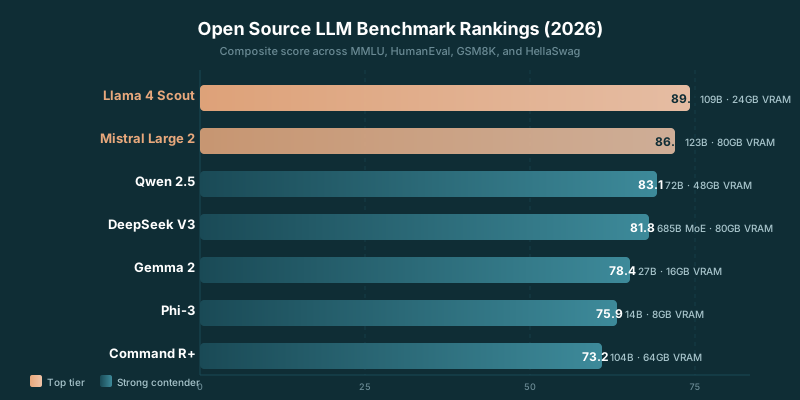
Detailed Reviews
Llama 4 Maverick
Best OverallLlama 4 Maverick is the open source model to beat. The mixture-of-experts architecture delivers GPT-4.1-class performance while running efficiently on a single node. Multilingual support covers 12 languages well, rather than just English. The instruction-tuned version follows complex prompts reliably. Meta's permissive license lets you use it commercially without revenue caps for most companies. The ecosystem is massive: every inference engine, fine-tuning tool, and deployment platform supports Llama 4 on day one.
Mistral Large 2
Best for EnterpriseMistral Large 2 has 123 billion parameters and an Apache 2.0 license. Its model card documents function-calling support. Teams considering it for structured output should test JSON and XML reliability on their own schemas and review the license directly before deployment.
Qwen 2.5 72B
Best for CodingQwen 2.5 from Alibaba's research team is the strongest open model for code generation. It tops HumanEval and MBPP benchmarks at the 72B parameter class. The code-specific training shows: it handles Python, TypeScript, Java, Go, and Rust with accuracy that rivals commercial coding models. The 72B size runs comfortably on a single A100 or dual 4090s. Qwen-Coder, the specialized coding variant, pushes code benchmarks even higher.
DeepSeek-V3
Best Performance-per-DollarDeepSeek-V3 shocked the industry by matching frontier model performance at a fraction of the training cost. The MoE architecture activates 37B parameters per token out of 671B total, which means you get massive-model quality with mid-size-model inference costs. The MIT license is the most permissive available. Reasoning benchmarks (MATH, GSM8K) are particularly strong. For teams that need reasoning capability on a budget, DeepSeek-V3 delivers more intelligence per dollar than anything else available.
Google Gemma 2 27B
Best for Fine-TuningGemma 2 27B is the best model to fine-tune for domain-specific tasks. At 27B parameters, it's small enough to fine-tune on a single A100 with LoRA in a few hours. But the base quality is high enough that fine-tuned versions outperform much larger models on specialized tasks. Google's training recipe produces a model that responds well to instruction tuning and adapts quickly to new domains. The Keras integration makes fine-tuning accessible to ML engineers who aren't LLM specialists.
Microsoft Phi-4
Best Small ModelPhi-4 at 14B parameters proves that data quality matters more than model size. It outperforms many 70B models on reasoning and STEM benchmarks through Microsoft's careful data curation and training methodology. This model runs on a single RTX 4090 at production-viable speeds. Quantized versions run on laptops with 16GB of RAM. For edge deployment, local applications, and any scenario where you can't afford a beefy GPU, Phi-4 is the clear choice.
Cohere Command R+
Best for RAGCommand R+ was built specifically for RAG and tool use. It generates responses with inline citations that point to the retrieved documents, which is something most open models struggle with. The grounded generation capability means it sticks to the provided context rather than hallucinating additional information. Multi-step tool use works reliably. For teams building retrieval-based applications who want an open model that naturally cites its sources, Command R+ is purpose-built for the job.
What Hardware Each Model Needs
Hardware is where open-weight enthusiasm meets a procurement spreadsheet.
The first question is whether you need to serve the model interactively, run occasional batch jobs, fine-tune it, or test it locally. Those are different jobs. A model that is tolerable for an overnight evaluation may be unusable when a customer expects an answer inside the product.
Phi-4 is the cleanest entry point for constrained environments. Phi-4 at 14B parameters runs on any GPU with 12GB+ VRAM or on CPUs with 16GB RAM using quantization Related analysis. Quantization lowers the memory burden, though engineers should test the output on their own tasks instead of assuming every workload degrades the same way.
Gemma 2 27B gives fine-tuning teams a more capable target without forcing them into a large distributed training setup. Gemma 2 27B is small enough to fine-tune on a single A100 with LoRA in a few hours Related analysis. LoRA is useful because it lets you adapt a model without treating every update as a full retraining program.
Mistral Large 2 belongs in a different hardware conversation. Even quantized, Mistral Large 2 needs 40-80GB of VRAM Related analysis. That requirement can still make sense for a business-critical internal application, but it should make you skeptical of casual claims that every team should self-host the biggest model available.
Qwen 2.5 72B also deserves capacity planning before deployment. Its coding strength is valuable only if the system can serve developers at a pace that fits their workflow. A slow assistant breaks concentration. Developers close it, open a browser tab, and the expensive infrastructure becomes background furniture.
Llama 4 Scout changes part of this calculation through its mixture-of-experts design. Its active parameter count helps explain why it deserves attention from teams that want strong capability without treating every inference request like a maximum-size dense model request. That does not eliminate deployment work. It changes the shape of it.
Before picking hardware, build a representative evaluation set from the requests your system will receive. Include short questions, long context, retrieval failures, malformed inputs, and the cases where the wrong answer causes trouble. Then test the model and serving setup together. Model selection without serving measurements is only half a decision.
For the rest of the stack, review the best LLM frameworks before committing to a model server or application architecture. The framework determines how quickly you can change prompts, add retrieval, measure output, and escape a bad deployment choice.
Dense vs Mixture-of-Experts: Why Active Parameters Matter
Parameter count is useful, but it can mislead engineers who compare models as if all parameters are active for every token.
Dense models use their full network for each inference step. The operating model is straightforward: more parameters generally mean more memory and compute demands. That simplicity can be attractive when your infrastructure and performance model are already built around dense serving.
Mixture-of-experts models route work through a subset of specialized components. Llama 4 Scout (17B active MoE) launched in April 2026 as the new open source leader Related analysis. The active parameter figure is the number that should shape an initial serving conversation, because it speaks more directly to what the model activates while generating output.
The tradeoff is operational complexity. Routing introduces its own behavior, and implementation details matter. Your team still needs to test throughput, memory use, batching, long-context performance, and failure patterns on the infrastructure it plans to use.
Dense models remain sensible when you want predictable deployment characteristics or have a strong reason to use a particular model family. MoE models become attractive when the quality and efficiency profile fits the workload. Neither architecture gets a free pass. The evaluation set decides.
This is also why raw leaderboard culture produces so many bad choices. A model can win a broad benchmark yet disappoint in a retrieval application because the retrieval pipeline is weak. Another can look modest in a generic test and become excellent after fine-tuning on the actual task.
Evaluation Criteria
Use model cards and published benchmarks to narrow the list, then test finalists on your own task set and hardware. Measure answer quality, unsupported output, latency, memory use, throughput, license constraints, and deployment effort with the quantization and serving stack you plan to operate.
That mix matters because model quality is not one thing. MMLU tests broad knowledge and reasoning. HumanEval tests code generation. MT-Bench looks at multi-turn assistant quality. The custom retrieval task tests whether a model can work with supplied material rather than drift into plausible nonsense.
The methodology is intentionally broader than a single leaderboard. Engineers deciding between open source llm models need to know whether a model fits the job, rather than merely whether it has a flattering aggregate score.
For RAG systems, retrieval quality can overwhelm the difference between two otherwise capable models. The model only sees what your system retrieves. Weak source documents, poor chunk boundaries, and irrelevant context make the assistant look worse than it is. Read fine-tuning vs RAG before deciding that training is the answer to a knowledge problem.
Fine-tuning has its own role. It is useful for behavior, format, classification, writing style, and repeatable domain tasks. It is less useful as a substitute for current knowledge that changes often. Put changing facts in retrieval. Put durable behavior in training data. That division tends to produce systems people can debug.
Choosing the Model Without Regretting It Later
Start with the workload you can describe in plain language.
Choose Llama 4 Scout when you need a strong current default and want to evaluate an open-weight leader. Choose Llama 4 Maverick when broad capability remains the deciding factor. Choose Mistral Large 2 for enterprise-grade work where its hardware needs are acceptable. Choose Qwen 2.5 72B when code quality is the core product requirement.
DeepSeek-V3 fits teams watching performance per dollar. Gemma 2 27B fits teams that can gain from private fine-tuning. Phi-4 fits constrained deployments. Command R+ fits systems that live or die on retrieved documents.
Then run a small production-shaped trial. Give each candidate the same prompts, documents, tools, and failure cases. Measure what your users will notice: accuracy, useful completion rate, latency, operating cost, and how often the system needs a human to clean up after it.
The winner is rarely the model with the most impressive story. It is the one that does your work well enough to keep, on hardware you can operate, at a cost the business will tolerate. Can your team explain that choice six months after the launch?
Key Takeaways
- Llama 4 Scout is the current open-source leader and a strong starting point for a new evaluation.
- Qwen 2.5 72B is the coding pick, while Command R+ is the RAG pick.
- Hardware requirements should narrow the list before you spend time on broad benchmark comparisons.
- Active parameters matter when comparing dense models with mixture-of-experts designs.
- Fine-tuning and retrieval solve different problems, and mixing them up wastes time.
Frequently Asked Questions
Are open source LLMs as good as GPT-4.1 or Claude?
On specific tasks, yes. Llama 4 and DeepSeek-V3 match or exceed GPT-4.1 on many benchmarks. On broad, general-purpose use, the best proprietary models still have an edge, especially for specific reasoning, creative writing, and complex multi-step tasks. The gap has narrowed from massive to modest. For many production applications, open source models are good enough, and the cost and control advantages make them the better choice.
What hardware do I need to run open source LLMs locally?
Phi-4 (14B) runs on any GPU with 12GB+ VRAM or even on CPUs with 16GB RAM using quantization. Gemma 2 27B and Qwen 2.5 72B need 24-80GB of VRAM depending on quantization level. Llama 4 Maverick and DeepSeek-V3 need multi-GPU setups or cloud instances with A100/H100 GPUs. For local development, a single RTX 4090 (24GB VRAM) runs most quantized models up to 70B comfortably.
What's the difference between model licenses?
MIT and Apache 2.0 (Mistral, DeepSeek, Phi-4) are the most permissive: do whatever you want, including commercial use, no restrictions. Meta's Llama license is permissive for most companies but restricts use by organizations with 700M+ monthly active users. Google's Gemma license is permissive with some use-case restrictions. Cohere's Command R+ is CC-BY-NC for research with a separate commercial license. Always read the actual license, not the summary.
Should I fine-tune an open source model or use a commercial API?
Use a commercial API if: you want to ship fast, your data volume is low, and you don't have ML engineering resources. Fine-tune an open source model if: you have domain-specific data that improves quality, you need to control costs at scale, data privacy is non-negotiable, or you need to run offline. The crossover point is usually around $500-1000/month in API costs, at which point self-hosting becomes cheaper.
How do I actually deploy an open source LLM?
The most common stack: download weights from Hugging Face, serve with vLLM or TGI (Text Generation Inference), put it behind a FastAPI endpoint, and deploy on a cloud GPU instance. For local use, Ollama or LM Studio handle everything with a single install. For production, vLLM gives you the best throughput. Budget time for optimizing batch size, quantization level, and GPU memory allocation for your specific workload.
Will open source models keep improving, or will the gap widen again?
Every trend points toward continued convergence. Meta, Google, Alibaba, and Microsoft are investing billions in open model research. DeepSeek proved that training efficiency improvements can close gaps without matching compute budgets. The open source ecosystem (training tools, data pipelines, evaluation frameworks) is maturing fast. Proprietary models will stay ahead on the frontier, but the gap between frontier and open source will likely keep shrinking.