 PE Collective
Best LLM Frameworks for Building AI Applications
Compare LLM frameworks for RAG, agents, chatbots, and Python applications. Choose between LangChain, LlamaIndex, DSPy, Haystack, and more.
Last updated: 2026-04-07
The best LLM frameworks depend on the application you need to ship. A RAG system, a tool-using agent, and a production chatbot create different problems around retrieval, orchestration, testing, observability, and deployment.
This comparison covers 7 framework picks for developers building with LLMs. The right choice usually comes down to where your application gets difficult, not which library has the loudest community.
TLDR
Choose LangChain for broad orchestration, LlamaIndex for retrieval-heavy systems, DSPy for programmatic optimization, and Haystack for explicit production pipelines. The best LLM framework is the one that makes your application’s hardest part easier to test, inspect, and change.
Choose an LLM Framework by Application Type
Start with the application, then work backward into the framework.
| Application | Best fit | Why | Seniority fit |
|---|---|---|---|
| RAG over private documents | LlamaIndex | Retrieval and data connectors are central to the design | Mid-level to senior |
| Stateful agents with tools | LangChain with LangGraph | Workflow state and tool coordination need explicit control | Senior |
| Prompt optimization | DSPy | Prompts can be treated as programs with measurable outputs | Senior |
| Search and question answering | Haystack | Pipelines make retrieval and generation steps visible | Mid-level to senior |
| AI features inside a web app | Vercel AI SDK | Streaming and interface integration stay close to the product | Junior to mid-level |
| Microsoft-oriented business systems | Semantic Kernel | Connectors and planning fit enterprise application patterns | Mid-level to senior |
| Multi-agent experimentation | AutoGen | Agent-to-agent conversations are easy to prototype | Senior |
The matrix is a starting point, not a procurement checklist. Developers often choose an LLM framework because a tutorial looked clean, then discover that the hard part was evaluation, document parsing, tool failures, or user-specific data permissions.
A framework should reduce the mess in the part of the system you expect to change most.
If your product depends on document retrieval, choose the framework that makes RAG easier to inspect. The underlying comparison used a document application over 10K pages of technical documentation, which is enough material to expose retrieval shortcuts that look fine in a toy demo.
LangChain remains the broadest default when you need to connect models, tools, retrievers, memory, structured outputs, and external services. It has 700+ components, which gives teams plenty of integrations and plenty of decisions.
LlamaIndex is usually the cleaner choice when the application begins with data. Its abstractions focus on ingestion, indexing, retrieval, and query workflows. That focus matters when your quality problems come from source documents, chunking choices, metadata, or vector databases alongside 700+ components.
DSPy takes a different route. It asks developers to define what good output looks like, then optimize the system against examples and metrics. That can feel less intuitive than hand-written prompts, but it gives teams a better path when prompt changes have become a pile of fragile string edits.
Haystack works well for teams that want their pipeline laid out in public. Retrievers, rankers, generators, and evaluators sit in a graph you can reason about. That directness is useful when several people need to debug the same application without turning every investigation into framework archaeology.
How the Frameworks Were Tested
A useful framework comparison has to test an application that can fail in ordinary ways.
The evaluation used a document application over 10K pages of technical documentation. It included document retrieval, citations, filtering, streamed responses, and the normal awkward edges of technical content: repeated concepts, stale pages, partial answers, and sources that sound plausible while answering the wrong question.
That workload puts pressure on the parts that matter in production. Can the framework ingest data without hiding what happened? Can you change retrieval behavior without rewriting the application? Can you show users where an answer came from? Can a developer tell whether a bad response came from retrieval, prompting, a model call, or a tool failure?
The test also considered agent workflows that coordinate tools and recover from errors. This is where framework differences get sharper.
A chatbot that answers from a document index can tolerate a fairly linear flow. An agent that queries a system, checks a result, calls a second tool, receives malformed output, and decides whether to retry needs state. It needs boundaries. It needs a way to stop the model from improvising its way into a bad action.
LangGraph gives LangChain users a more explicit model for that kind of workflow. It is the right direction for teams building agents with branches, approval steps, long-running tasks, or recovery logic. A free-form agent loop is fun until it becomes someone’s production incident.
LlamaIndex can also support agentic patterns, especially where the tools are data sources and retrieval systems. Its strongest argument remains data-centric applications. If the agent is mostly a front end for enterprise knowledge, that is a meaningful distinction.
DSPy earns its place when the core question is quality measurement. You can build the same retrieval flow with several libraries. The harder task is proving that a prompt change, model swap, retrieval update, or tool policy made the application better instead of merely different.
A reproducible evaluation method should keep a fixed set of representative questions, expected facts, required citations, and known failure cases. Run the same set after each material change. Review the answers with the evidence they retrieved, rather than only with a score. A system can produce polished text while pulling from a source that does not support the claim.
Keep the evaluation set close to what users ask. Include straightforward questions, ambiguous questions, questions that should be refused, and questions where the documents contain conflicting guidance. The framework that makes those tests easy to run will save time long after the initial prototype is gone.
RAG, Agent, and Python Recommendations
For RAG, pick LlamaIndex when your application lives or dies on data ingestion and retrieval quality. It gives developers a vocabulary for documents, indexes, query engines, and source-aware responses. That is a better fit than a general orchestration layer when retrieval is the product.
LangChain is still a strong RAG option when the retrieval system must sit inside a larger workflow. A support assistant may need to search internal documents, call a customer system, format a structured answer, and hand off to a human. Its ecosystem helps when that breadth is worth the extra abstraction.
Haystack is the practical choice for teams that want retrieval pipelines to stay legible. Its components make it easier to see what runs before and after generation. That is valuable for search-heavy products where relevance tuning becomes an ongoing job.
For agents, use LangChain with LangGraph when control flow matters. Stateful workflows are easier to inspect than a single prompt instructing a model to “figure it out.” Model-driven planning still has a role, but production systems need a place for rules, retries, approvals, and hard stops.
AutoGen is useful for exploring multi-agent patterns. It makes it easy to set up conversations between specialized agents, but teams should be careful about promoting a clever demo straight into a customer-facing workflow. More agents create more places for unclear responsibility.
For Python applications, the choice is usually narrower than the market makes it sound. LangChain has the largest surface area. LlamaIndex is often the best Python LLM framework for document-grounded products. DSPy is the strongest fit when you have an evaluation discipline and want to optimize model behavior against it. Haystack is a good fit when the engineering team values explicit, composable pipelines.
Semantic Kernel is worth considering when the rest of the organization already lives in Microsoft tooling or when the LLM layer needs to fit established application patterns. Vercel AI SDK is a better match for teams whose primary concern is getting streaming AI interactions into a polished web product.
No framework can fix a vague product boundary. If the system has no clear source of truth, no evaluation set, and no rule for when it should decline an answer, changing libraries will mostly rearrange the confusion.
Open Source and Managed Pricing Context
Most of these LLM libraries are open source. The bill arrives elsewhere: model usage, embeddings, storage, observability, document processing, and the engineering time required to debug an unreliable workflow.
Managed tooling can be worth paying for when it reduces the time between “the answer was wrong” and “we know why.” LangSmith is listed from $39 per month. That price is relevant for teams that want traces, evaluations, and application visibility without building their own internal tooling first.
LlamaCloud is listed from $35 per month. It is most relevant when document parsing and data preparation have become the bottleneck rather than the model call itself.
Those listed starting prices should not decide the framework choice on their own. A small subscription can be cheaper than days spent trying to reconstruct a bad retrieval path from logs that were never designed for LLM behavior. On the other hand, a managed layer that locks you into one workflow can become expensive when the application changes.
Open source gives you control. Managed services give you speed in specific parts of the stack. The sensible split is often mixed: use open-source orchestration where your product needs flexibility, then pay for the operational pieces that your team would otherwise rebuild badly.
Key Takeaways
- LangChain is the broad choice for applications that need many integrations and orchestration options.
- LlamaIndex is the sharper pick for retrieval-heavy products built around private or complex data.
- DSPy fits teams that want to measure and improve model behavior with repeatable evaluation.
- Haystack keeps RAG and search pipelines explicit for teams that expect to tune them over time.
- Framework pricing is only one part of the cost. Evaluation, observability, and data quality decide whether the application holds up.
The best LLM framework is the one that exposes your actual failure modes early. Pick the library that fits your application’s center of gravity, then spend the saved energy testing whether the system deserves to reach users.
Sources
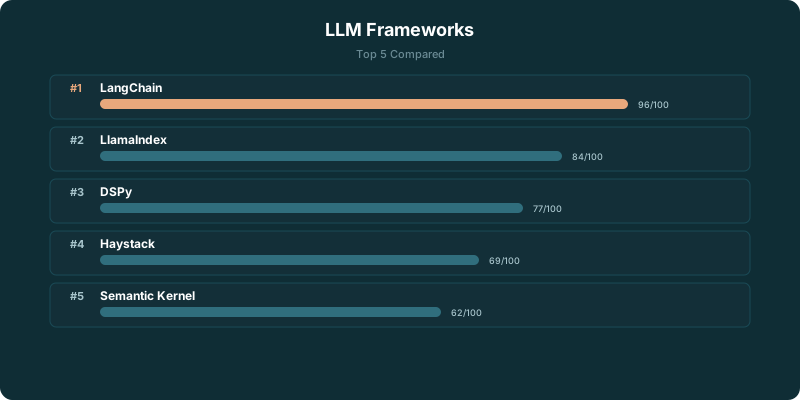
Our Top Picks
Detailed Reviews
LangChain
Best OverallLangChain has the largest ecosystem, the most integrations, and the biggest community of any LLM framework. Version 0.3+ cleaned up the messy abstractions that plagued earlier releases. LangChain Expression Language (LCEL) makes chain composition much more readable than the old sequential chain pattern. The integration list is staggering: 700+ components covering every vector store, LLM provider, and tool you can think of. LangGraph, the agent framework built on LangChain, is now the recommended way to build stateful multi-step agents with human-in-the-loop controls. LangGraph Cloud provides managed hosting for production agent deployments starting at $35/month.
LlamaIndex
Best for RAGLlamaIndex is purpose-built for retrieval-augmented generation and it does that one thing better than anything else. The data connectors handle 160+ file formats out of the box, from PDFs to Notion pages to Slack threads. The indexing strategies (vector, keyword, tree, knowledge graph) give you options that LangChain's retrieval module can't match. If you're building a system that answers questions over your organization's documents, start here.
Haystack
Best Open SourceHaystack takes the most principled approach to framework design. Everything is a component with typed inputs and outputs. Pipelines are directed graphs you can visualize, debug, and test node by node. There's no magic. When something breaks, you know exactly where and why. Haystack 2.x (the full rewrite) has matured significantly through early 2026 with better agent support, streaming pipelines, and an expanding integration ecosystem. The deepset team has added native support for tool calling, structured outputs, and pipeline-level error handling that makes production deployments more reliable.
Semantic Kernel
Best for .NETSemantic Kernel is Microsoft's answer to LangChain, and it's the only first-class option for .NET developers. It supports C#, Python, and Java, but the C# SDK is clearly the most polished. Azure OpenAI integration is native. The plugin architecture maps well to enterprise patterns that .NET developers already know. If your stack is Azure and C#, nothing else comes close to the developer experience here.
DSPy
Best for Prompt OptimizationDSPy takes a radically different approach. Instead of hand-writing prompts, you define what your pipeline should do and DSPy optimizes the prompts automatically. It treats prompt engineering as a machine learning problem: define your metric, provide examples, and let the optimizer find the best prompt configuration. DSPy 2.6 (released early 2026) added support for multi-model optimization, where the optimizer can select the best model for each module in your pipeline. This means DSPy can find that Module A works best with Claude Haiku and Module B needs GPT-4.1, optimizing both cost and quality simultaneously.
Vercel AI SDK
Best for TypeScriptThe Vercel AI SDK has become the default choice for TypeScript developers building AI features in Next.js, React, and Node.js applications. It provides streaming UI components, structured output parsing, tool calling, and multi-step agent workflows in a package that feels native to the JavaScript ecosystem. The SDK supports every major provider (OpenAI, Anthropic, Google, Mistral, and more) through a unified interface, so switching models is a one-line change. For full-stack TypeScript developers, this eliminates the need for Python-based frameworks entirely.
PydanticAI
Best for Type-Safe AgentsPydanticAI brings the type safety and validation that made Pydantic the standard Python data library to LLM application development. Built by the Pydantic team, it uses Python type hints to define agent behaviors, tool signatures, and structured outputs. The result is AI code that your IDE can autocomplete, type-check, and validate at runtime. It supports dependency injection for testing, streaming responses, and multi-model workflows. For Python developers who find LangChain's abstractions too heavy, PydanticAI offers a lighter alternative that stays close to standard Python patterns.
Evaluation Criteria
Compare frameworks with the same representative application. Review implementation effort, documentation, debugging, observability, model portability, release activity, and operational requirements. Repository and package metrics are context, while production readiness depends on your architecture and support needs.
Frequently Asked Questions
Should I use LangChain or LlamaIndex for RAG?
LlamaIndex. It's purpose-built for retrieval and does it better. LangChain's retrieval module works fine for simple cases, but LlamaIndex's indexing strategies, data connectors, and query engine options are more sophisticated. Use LangChain when your application does RAG plus a lot of other things (agents, tool use, complex chains).
Can I switch frameworks later without rewriting everything?
Partially. Your LLM calls, vector store data, and embeddings are portable since they're just API calls and arrays. Your pipeline orchestration code is not portable. Moving from LangChain to Haystack means rewriting how your components connect, how data flows, and how you handle errors. Budget 2-4 weeks for a production migration. The earlier you choose, the less pain later.
Is DSPy ready for production use?
It depends on your team. DSPy is production-ready in the sense that it works and produces reliable outputs. But it requires ML engineering skills that most application developers don't have. If your team includes people comfortable with metrics, optimization, and evaluation datasets, DSPy can outperform hand-written prompts significantly. If you just want to ship features, stick with LangChain or LlamaIndex.
Do I even need a framework, or should I just call the API directly?
For simple applications (single LLM call, basic prompt template), call the API directly. Frameworks add overhead you don't need. Once you're doing retrieval, multi-step chains, tool use, or streaming with error handling, a framework saves you from writing thousands of lines of plumbing code. The breakpoint is usually around the second week of building, when you realize you're reimplementing LangChain badly.