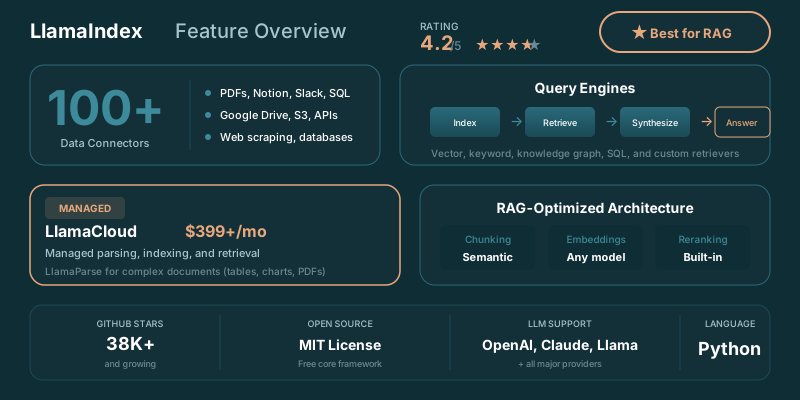
LlamaIndex RAG gives developers a focused way to turn their own documents into retrieval-backed LLM applications. It handles the work between raw data and an answer: ingesting files, shaping them into retrievable chunks, choosing an index, and querying the result with retrieval and reranking controls.
The appeal is straightforward. Your application needs answers grounded in PDFs, database records, web pages, support articles, or internal documentation. LlamaIndex puts that data problem at the center of the build instead of treating it as a side task after the model call works.
The open-source core is free and MIT licensed. Teams that want hosted parsing or managed indexes can use LlamaCloud, which lists a free tier of 1,000 credits per month. Related analysis
TLDR
LlamaIndex RAG gives developers a data-first way to ingest, index, and query their documents for retrieval. The core library is free under MIT licensing, while LlamaCloud adds managed parsing and hosted indexes. Choose LangChain when your hardest problem is agent coordination.
Key Takeaways
- LlamaIndex centers a RAG build on document ingestion, indexing, retrieval, and query control.
- The open-source core is free and MIT licensed.
- LlamaCloud offers managed parsing and hosted indexes with a free tier.
- LangChain makes more sense when agent workflows are the main engineering problem.
What LlamaIndex Does in a RAG Stack
A RAG application has a simple promise and a messy implementation. Give a model access to relevant company knowledge, retrieve the right material for a question, then keep the answer tied to that material.
The hard part usually sits upstream of generation. Documents arrive in different formats. Tables parse poorly. Metadata is inconsistent. A search result can be semantically similar yet useless for the user's actual question. The model only sees what retrieval puts in front of it.
LlamaIndex organizes that path around data. You connect sources, turn source material into documents and nodes, build an index, retrieve candidates, and send selected context into a query engine. That makes it a natural fit for teams building internal search, document assistants, research tools, customer-support systems, or product experiences grounded in private knowledge.
Its quickstart is described as about 10 lines of code. Related analysis That is enough to make a small local experiment approachable, but production quality depends on the choices after the quickstart: chunking, metadata, index design, retrieval settings, evaluation data, and observability.
The framework's data-first approach is why it is often a better starting point than a general workflow library for retrieval-heavy work. If the answer quality rises or falls on whether your source material was parsed and retrieved correctly, the retrieval layer deserves the attention.
LlamaIndex works alongside the concepts behind RAG, and its support for 150+ data connectors gives teams a broad starting point for bringing existing knowledge into that system. Related analysis
A useful way to judge the framework is to ask where your engineering time will go. If your team is spending it on getting documents into a usable shape, selecting the right passages, and tracing why an answer included them, LlamaIndex fits the job. If your team is mostly coordinating tools, handing work among agents, and managing multi-step execution, you may want a different center of gravity.
Data Connectors and Index Choices
LlamaIndex starts with connectors because most RAG projects begin with an awkward fact: the company's knowledge already exists somewhere else.
It may live in a folder of PDFs, a site crawl, a database, a content platform, or a collection of internal tools. Pulling that material into an application is only the first step. You also need a consistent document model, useful metadata, and a way to refresh the data when the source changes.
The project is described as supporting 150+ data connectors. Related analysis That breadth matters less as a trophy count than as a practical reduction in glue code. A connector can spare you from writing a one-off import path before you have even tested whether the retrieval experience is useful.
The page's meta description lists 160+ data loaders. Related analysis The difference in language is worth noticing. A loader gets data into the system. A good RAG implementation still has to decide what belongs together, which fields should become metadata, and what needs special treatment before indexing.
PDFs are the obvious example. A clean text PDF may move through ingestion easily. A document full of tables, scanned pages, headers, and forms can turn into junk context if parsing goes wrong. Database content has a different failure mode: a row can be technically retrievable while lacking the surrounding information needed to answer a human question.
That is where index choices become concrete. LlamaIndex can work with vector retrieval, keyword retrieval, tree indexes, and knowledge-graph approaches. Each one asks a different question of your data.
Vector retrieval is useful when the phrasing of a query differs from the phrasing in a source document. Keyword retrieval earns its place when exact terms, identifiers, product names, or compliance language matter. Tree-style structures can help organize broader document collections. Knowledge graphs help when the application needs relationships between entities rather than isolated passages.
A vector database is often part of the vector-retrieval path, and the 160+ data loaders make it easier to test whether your source data is ready for that approach before committing to a large ingestion project. Related analysis
Do not treat index selection as a one-time architecture ceremony. Start from the questions your users will ask. If users need exact policy clauses, broad semantic similarity may be a weak primary retrieval method. If they ask fuzzy research questions across long reports, keyword-only retrieval will leave useful context on the floor.
The query-engine layer gives you room to configure retrieval and reranking. Retrieval gathers possible passages. Reranking tries to put the most useful passages nearer the top. That distinction matters when your documents contain repeated language, outdated versions, or many passages that look relevant at a glance.
Your evaluation set should reflect those awkward cases. Include questions with exact wording, questions with vague wording, questions where the answer exists in several files, and questions where the answer should be unavailable. A polished demo can survive weak retrieval. A real user will find it by lunchtime.
Free Core and LlamaCloud Credits
The free answer has two parts.
LlamaIndex's core library is open source and MIT licensed, so you can use it without paying for the framework itself. You still pay for the infrastructure and model calls your application uses, of course. Embeddings, vector storage, parsing services, hosting, and LLM inference do not become free because a library is free.
LlamaCloud is the managed layer. It covers services such as parsing and hosted indexes for teams that would rather not own every operational detail themselves. That can be attractive when document quality is uneven or when an internal prototype has become a product that needs reliable ingestion.
LlamaCloud is listed with a free tier of 1,000 credits per month. Related analysis That makes it easy to try the managed experience with real documents rather than evaluating it from screenshots and API references.
LlamaParse pricing is described as 1,000 credits equal to $1. Related analysis Credit systems deserve a close read before you put them behind a high-volume upload flow. The decision depends on whether the headline price looks low. The question is how your document mix consumes credits once users start uploading long reports, scanned material, tables, and repeated revisions.
The split between free core and managed services is sensible for the audience LlamaIndex attracts. Developers can start with local control and add managed components where the operational burden becomes annoying enough to justify the spend.
That does leave you with a design choice. Self-hosting gives you more control over data paths, deployment, and service selection. Managed services reduce the amount of parsing and indexing machinery your team maintains. Neither choice fixes poor source data or vague retrieval goals.
Use the free core when you need flexibility, want to keep the stack close to your infrastructure, or are still proving the application. Consider LlamaCloud when the engineering cost of document parsing and hosted retrieval exceeds the value of doing it yourself.
LlamaIndex or LangChain
LlamaIndex and LangChain overlap because both appear in LLM application stacks. They solve different problems most cleanly.
LlamaIndex is strongest when your application needs to ingest, index, retrieve, and query data. LangChain is worth evaluating when the difficult part is building complex agent workflows: tool calls, branching behavior, state management, orchestration, and multi-step execution.
That does not make the choice mutually exclusive. A team can use LlamaIndex for the data layer and LangChain for a broader workflow. But combining frameworks before you have a proven user need is an easy way to build a small cathedral around a document search feature.
| Team situation | Better starting point | Why |
|---|---|---|
| Early-career developer building a document assistant | LlamaIndex | The data path stays close to the framework's main job |
| Experienced developer tuning retrieval quality | LlamaIndex | Indexing, metadata, retrieval, and reranking get first-class attention |
| Staff-level platform team coordinating tools and agents | LangChain | Workflow orchestration is the central engineering concern |
| Product team with both retrieval and agent work | LlamaIndex plus LangChain | Keep retrieval ownership clear before adding orchestration |
The first decision should be driven by the failure you expect to fight. If users get wrong answers because the application misses or misreads source material, start with LlamaIndex. If users need an agent to decide which tools to call, carry state through a long process, and recover from failed steps, LangChain has more to offer.
The LangChain versus LlamaIndex comparison is useful because the LlamaCloud free tier of 1,000 credits per month gives you room to test a retrieval-first prototype before committing to an agent-heavy architecture. Related analysis
There is a temptation to choose the framework with the larger ecosystem and call it future-proofing. That is usually how a narrow retrieval problem turns into a dependency graph. Start with the job in front of you.
For most teams building answers over their own documents, LlamaIndex is the cleaner default. It gives ingestion, indexing, retrieval, and query control a shared home. LangChain becomes more compelling when the RAG system is one component inside a much larger agent workflow.
Can your team describe the retrieval failure it needs to prevent before it starts choosing orchestration tools?