 PE Collective
Alternatives to OpenAI API: Which Model to Pick
The best alternatives to OpenAI API depend on what you need the model to do. Claude is the strongest choice for instruction following. Gemini is the cheap high-volume option. Open-source models are the answer when vendor lock-in is the problem. Enterprise buyers should start with the provider their procurement and compliance teams can support.
OpenAI remains the default for plenty of good reasons. GPT-4.1 is capable, the documentation is good, and the developer ecosystem is the largest. But default is a weak reason to keep a model in production when another provider better fits the workload.
TLDR
Claude is the best OpenAI alternative for instruction-heavy work. Gemini is cheaper for high-volume input, while open-source models give you more control over deployment. Enterprise teams should judge vendors through procurement, compliance, and support requirements before migrating production workloads.
The Short Answer: Which OpenAI Alternative to Pick
Pick Claude when system prompts, structured outputs, and careful instruction following drive the quality of your application. Claude Sonnet 4.6 costs $3 / $15 per 1M input / output tokens, while Claude Haiku 4.5 costs $1 / $5 per 1M input / output tokens. Related analysis
Pick Gemini when input volume is the bill that keeps climbing. Gemini 2.5 Flash costs $0.15 per 1M input tokens, compared with Gemini 2.5 Pro at $1.25 per 1M input tokens. Related analysis
Pick an open-source model when a single API vendor has too much control over your product, your data path, or your deployment options. You take on hosting, evaluation, and operational work. In exchange, you can run the model where you want and change providers without rewriting your entire application around one proprietary interface.
Pick an enterprise provider when the decision has to survive security review, procurement, legal review, and an architecture meeting where nobody wants to explain why a customer-facing system depends on a consumer-grade account. The model matters. The contract, identity controls, data handling, billing terms, and support path matter too.
Key Takeaways
- Claude is the strongest challenger for applications that live or die on instruction following.
- Gemini 2.5 Flash is the clearest low-cost option for input-heavy workloads.
- Open-source models reduce vendor lock-in but shift more responsibility to your engineering team.
- Enterprise migrations should be evaluated through procurement and compliance requirements, not model quality alone.
How We Evaluated OpenAI Alternatives
A useful OpenAI API alternative has to hold up after the demo.
We evaluated providers on model quality, API design and developer experience, pricing at scale, rate limits, and production reliability. Those criteria sound obvious, but teams routinely over-index on benchmark screenshots and underweight the work required to ship a dependable product.
Model quality means more than whether a model can write a plausible answer. For application teams, it includes reasoning, coding, instruction following, tool use, formatting discipline, and how often the model forces your team to add brittle prompt patches.
API design determines how expensive a migration becomes. A provider can have a good model and still create a miserable integration if authentication, streaming, structured output, observability, error handling, or SDK support are awkward. The closer the interface is to the patterns your team already uses, the less migration work turns into a small internal platform project.
Pricing at scale is where most casual comparisons fall apart. Input and output tokens behave differently. A model with a low input price can be a strong fit for retrieval-heavy workflows, large documents, classification, and batch processing. A model that produces long responses can make output pricing the bigger problem. Measure the workload you have, not the generic chatbot you imagine building someday.
Rate limits and reliability are less glamorous, which is why they tend to arrive late in the evaluation. They decide whether your product keeps working when usage spikes, a provider has an incident, or a new model release changes behavior under the same prompt.
OpenAI API Alternatives Priced per 1M Tokens
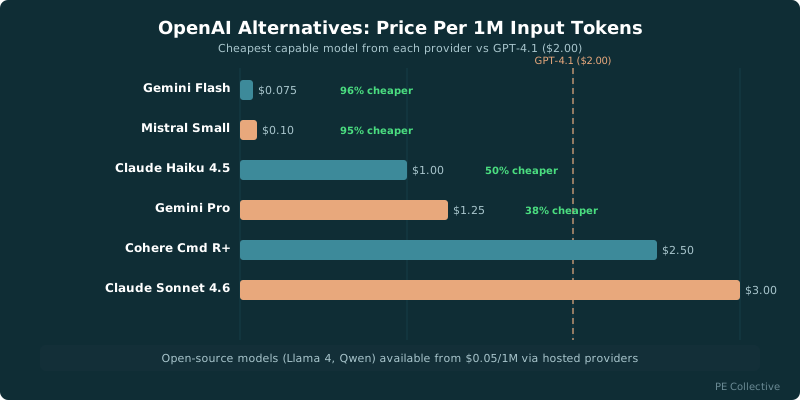
The table below uses the published prices available for direct comparison. Gemini output pricing is marked n/a because the supplied comparison data lists input pricing only.
GPT-4.1, the OpenAI baseline these alternatives are measured against, costs $2.00 / $8.00 per 1M input / output tokens. Related analysis
Claude Haiku 4.5 costs $1 / $5 per 1M input / output tokens. Related analysis
Claude Sonnet 4.6 costs $3 / $15 per 1M input / output tokens. Related analysis
Claude Opus 4.6 costs $5 / $25 per 1M input / output tokens. Related analysis
Gemini 2.5 Pro costs $1.25 per 1M input tokens and Gemini 2.5 Flash costs $0.15. Related analysis
Pricing is only useful when it maps to the workload. A model that looks cheaper in a comparison table can cost more if it needs more retries, produces more output, or fails to follow a format that the rest of your system expects.
That is why the best migration starts with representative traffic. Send the same production-like prompts through each candidate. Compare total token usage, output quality, latency, failure behavior, and the amount of prompt scaffolding each model requires. A small spreadsheet beats a model popularity contest.
See our cross-provider LLM pricing comparison for the broader pricing picture, and keep the OpenAI API pricing page nearby when you need to measure the savings against your current baseline.
The Alternatives
Anthropic Claude API
Haiku 4.5: $1/$5 per 1M tokens / Sonnet 4.6: $3/$15 / Opus 4.6: $5/$25Applications that need precise instruction following and careful reasoning
Better at following complex system prompts. 1M token context window on Sonnet 4.6. More consistent output format.
Claude is the strongest challenger to GPT-4.1. For prompt engineers, the difference is most obvious in system prompt adherence. Claude follows detailed instructions more consistently, which means fewer edge cases in production. Claude Sonnet 4.6 has a 1M context window while Haiku 4.5 has a 200K context window. Related analysis Claude also produces more natural, less formulaic writing. The API design mirrors OpenAI's closely, so migration is straightforward. The main gaps: no image generation, no fine-tuning API (yet), and a smaller third-party ecosystem.
Best OpenAI alternative for instruction following and long-context tasks.
Google Gemini API
2.5 Flash: $0.15 per 1M input tokens / 2.5 Pro: $1.25 per 1M input tokens / 1M token contextHigh-volume applications where cost per token matters
Gemini 2.5 Flash undercuts premium models on input pricing. Free tier available. 1 million token context window.
Google's Gemini API is the cost leader. Gemini Flash delivers 80-90% of GPT-4.1's quality at a fraction of the price, making it ideal for high-volume applications where you're processing thousands of requests per hour. The 1 million token context window on Gemini Pro is the largest available from any major provider. The API is well-designed, though the ecosystem and tooling are smaller than OpenAI's. Google also offers a generous free tier that's useful for development and testing.
Best OpenAI alternative for cost-sensitive, high-volume applications.
Mistral API
Small: $0.10/$0.30 per 1M tokens / Large: $2/$6 per 1M tokensEU-based companies or teams that need competitive models at lower prices
EU data residency. Open-weight models available. Aggressive pricing that undercuts both OpenAI and Anthropic.
Mistral is the European AI lab that punches above its weight. Their API pricing significantly undercuts OpenAI across the board, and the model quality is competitive on most tasks. For companies with EU data residency requirements (GDPR compliance), Mistral is the only major provider that's fully EU-based. Their open-weight models (Mistral, Mixtral) can also be self-hosted if you need complete data control. The ecosystem is smaller and the documentation isn't as polished as OpenAI's.
Best OpenAI alternative for EU compliance and cost-conscious teams.
Cohere API
Command R+: $2.50/$10 per 1M tokens / Embed: $0.10 per 1M tokensEnterprise RAG applications and teams that need embeddings + generation from one provider
Purpose-built for enterprise RAG. Embed, Rerank, and Generate models designed to work together.
Cohere focuses on enterprise search and RAG rather than trying to be a general-purpose ChatGPT competitor. Their Embed model is among the best for creating embeddings, and their Rerank model improves retrieval quality significantly. Command R+ (their generation model) is specifically optimized for RAG workflows, including built-in citation generation. If you're building a production RAG pipeline, Cohere's integrated approach (embed, rerank, generate) can be simpler than cobbling together models from different providers.
Best OpenAI alternative for enterprise RAG and search applications.
Open-Source Models (Llama, Qwen)
Free (self-hosted) / $0.05-1.00 per 1M tokens via providersTeams that need full control over their models, data, and costs
No vendor lock-in. Run locally, fine-tune on your data, deploy anywhere. Zero per-token costs if self-hosted.
Open-source models like Meta's Llama and Alibaba's Qwen have closed much of the quality gap with GPT-4.1, especially for specific tasks where fine-tuning helps. You can run them through hosting providers like Together AI, Fireworks, or Groq at prices well below OpenAI's, or self-host them for zero per-token costs. The tradeoff is operational complexity: you need infrastructure, monitoring, and expertise to run models in production. But for teams with the engineering capability, it eliminates vendor dependency entirely.
Best OpenAI alternative for full control and eliminating vendor lock-in.
AWS Bedrock
Varies by model (Claude, Llama, Mistral available)AWS-native teams that want multiple model providers through one API
Single API to access Claude, Llama, Mistral, and others. VPC deployment. AWS security and billing.
AWS Bedrock isn't a model provider; it's a model marketplace. You access Claude, Llama, Mistral, and other models through a unified AWS API with AWS authentication, billing, and security. For teams already on AWS, this means no new vendor relationships, VPC endpoints for data privacy, and consolidated billing. The pricing is slightly higher than going direct to each provider, but the operational simplicity is worth it for many enterprises.
Best OpenAI alternative for AWS-native enterprise teams.
Claude: The Best Challenger for Instruction Following
Claude is the strongest challenger to GPT-4.1 for teams that care about instruction following.
The difference shows up most clearly in applications with detailed system prompts, constrained formats, multi-step workflows, and outputs that need to remain useful after they leave the chat window. If your product has a long prompt full of business rules, a model that follows those rules without constant correction saves work in places your token bill will never reveal.
The API design also makes Claude a practical migration candidate. Most teams already using a modern chat-completions style workflow will recognize the core patterns. That does not make migration automatic. You still need to retest prompts, tool behavior, streaming, structured output, error handling, and safety assumptions. But the work is bounded.
Claude Sonnet 4.6 has a 1M context window while Haiku 4.5 has a 200K context window. Related analysis
That context difference changes which Claude tier belongs in the architecture. Haiku fits workloads where speed and cost matter more than long-document synthesis. Sonnet is the better fit when the application needs to reason over a much larger body of material without splitting it into awkward chunks. Opus is the premium option when output quality carries enough value to justify the higher rate.
The pricing also forces a real tradeoff. Claude Sonnet 4.6 costs more than GPT-4.1 on the listed input and output rates. If it follows your instructions better, produces fewer unusable responses, or reduces the prompt machinery around the model, that premium can be worth it. If the workload is straightforward classification or lightweight extraction, paying for Sonnet may be a fancy way to burn margin.
Our Anthropic API pricing guide is the useful next stop if Claude has made the shortlist.
Gemini: The Cost Play for High-Volume Workloads
Gemini is the most compelling alternative when your application sends a lot of input to the model.
Gemini 2.5 Flash costs $0.15 per 1M input tokens. That is a sharp contrast with premium models when your system processes documents, retrieval context, support transcripts, logs, or large volumes of repetitive requests. Gemini 2.5 Pro costs $1.25 per 1M input tokens, giving teams a higher-end option without starting at the baseline GPT-4.1 input price. Related analysis
This makes Gemini a natural candidate for routing. A team does not need to pick one model forever and force every task through it. Use a cheaper model for work where the answer is bounded and easily checked. Route harder prompts to a model that earns its higher cost through better reasoning or instruction adherence.
The trap is treating cheap input as the whole answer. Model evaluation still decides the architecture. If a cheaper model misses formatting rules, mishandles tool calls, or adds review work, the apparent savings can disappear inside your application code and support queue.
Gemini is a better fit for teams willing to evaluate models by task rather than by brand loyalty. That sounds banal until you see how many products still send every request through the same expensive endpoint.
For a provider-specific view, see Gemini alternatives.
Cheapest OpenAI API Alternatives
The cheapest alternative is often not an alternative at all.
GPT-4.1 Nano at $0.10 per million input tokens is one of the cheapest capable models available. Related analysis
If your goal is lower cost rather than leaving OpenAI, Nano may solve the immediate problem without a migration. That matters for classification, routing, extraction, tagging, and other workloads where the model does not need to write polished long-form output or navigate a complicated system prompt.
Gemini 2.5 Flash costs $0.15 per 1M input tokens. Related analysis
The gap between Nano and Flash is small enough that cost alone should not decide the choice. Evaluate them against the real task. If Flash handles the prompt better, the extra spend can be trivial compared with retries or post-processing. If Nano does the job cleanly, migration buys you little.
Claude Haiku 4.5 costs $1 / $5 per 1M input / output tokens. Related analysis
Haiku belongs in a different part of the conversation. It costs more on input than the cheapest choices listed here, but its instruction-following strengths may make it cheaper at the application level for tasks where a bad response is expensive to fix. The right question is not “Which model has the lowest posted price?” It is “Which model produces the lowest cost per accepted result?”
That is a more annoying evaluation question. It is also the one that protects your margin.
Open-Source Models: The Vendor Lock-In Escape Hatch
Open-source models remove vendor lock-in entirely.
That advantage becomes meaningful when your product cannot tolerate abrupt pricing changes, API policy shifts, regional availability issues, or a single provider deciding that a workflow is outside its preferred use case. You can run an open model in infrastructure you control, use a managed host, or move between hosts as your requirements change.
The cost is responsibility. Your team owns more of the stack: deployment, scaling, model updates, observability, security, evaluation, and incident response. A hosted proprietary API gives you a cleaner operational path. An open model gives you more control and more work.
Open source is strongest when control is a product requirement rather than an ideological preference. Teams handling sensitive data, building domain-specific systems, or operating in constrained environments may have good reasons to accept the operational burden. A small product team that wants to ship fast may have good reasons to avoid it.
The middle ground is worth considering too. Build your application behind a provider abstraction, keep prompts and evaluation data portable, and use hosted models while preserving the option to change later. You do not need to self-host a model to stop writing your entire product around one vendor’s quirks.
Enterprise and Azure OpenAI Alternatives
Enterprise buyers are not choosing a model in isolation. They are choosing a vendor relationship that has to pass procurement.
Azure OpenAI is attractive when the organization already has Azure contracts, identity systems, security processes, and cloud governance built around Microsoft. But an Azure-flavored deployment does not remove the need to compare alternatives. It changes the criteria.
Claude and Gemini can be strong enterprise alternatives when their model behavior better fits the application. The practical questions are more mundane: Can the provider meet your data-handling requirements? Can legal agree to the terms? Does the procurement team have a path to buy it? Can your engineers get support during an incident? Can your security team audit the access controls without turning the project into a months-long exception process?
Those questions decide more enterprise deals than an incremental benchmark win.
A sensible enterprise evaluation separates model choice from vendor choice. First, test which models perform best on representative workloads. Then assess whether the provider can support the commercial and compliance requirements around that workload. A model can win the technical evaluation and still lose the procurement review. That is not bureaucracy getting in the way. It is part of the product decision.
Open-source options add another path for enterprise teams that need deployment control. They can reduce dependence on a third-party inference API, though the organization then inherits infrastructure and governance work that a hosted service would otherwise handle.
The winner is the provider that lets your team ship a dependable system without creating a procurement fight or an operational liability. If Azure is already the path of least resistance, that may be the answer. If another provider gives the application better outputs and can clear the same requirements, staying with Azure out of habit is expensive conservatism.
How to Migrate Without Rebuilding Your Application
Treat a model migration as an evaluation project, not a prompt-copying exercise.
Start with the workflows that make or save money. Pull examples from production-like traffic, including the strange edge cases your team already knows about. Include expected outputs, failure cases, tool calls, long inputs, and prompts that have accumulated a little too much history.
Run each candidate through the same set. Review quality blind where possible. Track token use and output behavior alongside the human judgment. You are trying to find the model that performs best for the work, not the one that produces the prettiest demo.
Keep provider-specific code at the edge of the application. Your business logic should not care whether the response came from OpenAI, Anthropic, Google, or an open model. That separation gives you room to route requests, test new models, and negotiate with vendors from a position of strength.
Do we really think any API provider will hold pricing, rate limits, and model behavior still forever? Build as if you will need options, because eventually you will.
The Bottom Line
For the best model quality, Anthropic's Claude API is the closest competitor to GPT-4.1 and better for instruction-following tasks. For cost savings, Gemini Flash and Mistral offer strong models at a fraction of OpenAI's price. For enterprise RAG, Cohere's integrated stack is purpose-built. And for full independence, open-source models with providers like Together AI give you GPT-4.1-class performance without vendor lock-in.
Related Resources
Frequently Asked Questions
Is Claude's API better than OpenAI's?
For instruction following, long-context tasks, and natural writing, Claude is typically better. For ecosystem size, fine-tuning options, and third-party integrations, OpenAI is ahead. Most production teams test both and choose based on their specific use case.
What's the cheapest OpenAI API alternative?
Gemini Flash at $0.075 per 1M input tokens is the cheapest high-quality option from a major provider. Mistral Small is also very affordable. Open-source models via providers like Together AI or Groq can be even cheaper. Self-hosting eliminates per-token costs entirely.
How hard is it to migrate from OpenAI to another provider?
Anthropic's API is structurally similar to OpenAI's, so migration is straightforward. Gemini and Mistral have their own API formats but most LLM frameworks (LangChain, LlamaIndex) abstract away the differences. The hardest part is usually re-tuning your prompts, since each model responds differently to the same prompt.
Can I use multiple API providers at once?
Yes, and many production systems do. A common pattern is using a cheaper model (Gemini Flash, Mistral Small) for simple tasks and routing complex requests to GPT-4.1 or Claude. AWS Bedrock and LangChain both make multi-provider setups easy to implement.
Do open-source models match GPT-4.1 quality?
For general reasoning, GPT-4.1 and Claude still have an edge. But for specific tasks where you can fine-tune, open-source models like Llama 3 and Qwen 2.5 come very close. The gap shrinks further every few months. For many production applications, the quality difference doesn't justify the cost difference.
What are the best alternatives to the OpenAI API in 2026?
April 2026 alternatives: Anthropic Claude (Opus 4.6, Sonnet 4.6, Haiku 4.5) for reasoning quality and largest context. Google Gemini (Pro, Flash) for the most generous free tier. Mistral La Plateforme for European data residency. AWS Bedrock for unified access to Claude, Llama, and others with enterprise compliance. Cohere for embeddings and reranking with strong RAG features. DeepSeek V3 for ultra-low-cost inference at $0.14/$0.28 per million tokens. Pick by use case: Anthropic for reasoning depth, Google for cost-sensitive workloads, Bedrock for enterprise compliance, DeepSeek for high-volume budget-constrained inference.
OpenAI API alternatives 2026: which is cheapest?
Cheapest April 2026: Google Gemini 1.5 Flash at $0.075/$0.30 (lowest absolute), DeepSeek V3 at $0.14/$0.28, Mistral Small at $0.20/$0.60, Claude Haiku 4.5 at $1/$5. For embeddings, Voyage AI and Cohere both undercut OpenAI text-embedding-3 pricing. Cheapest absolute is Gemini Flash. Best price-quality at sustained high volume: DeepSeek V3. For workloads needing stronger reasoning: Claude Haiku 4.5 at $1/$5. Always benchmark your specific tasks before optimizing for absolute cheapest.
OpenAI alternative for RAG and embeddings in 2026?
For RAG specifically in 2026: Voyage AI (purpose-built for retrieval, voyage-3-large competitive with text-embedding-3-large at lower cost), Cohere (embed-v3 plus rerank-v3 for end-to-end retrieval), Google Gemini embeddings (text-embedding-004 with strong multilingual support), Anthropic Claude for generation paired with any embedding provider. For pure embedding cost optimization: Voyage AI. For integrated retrieval (embed + rerank + chat): Cohere. For multilingual: Google Gemini embeddings.
Why would I switch from OpenAI to an alternative in 2026?
Top reasons in 2026: cost reduction at high volume (DeepSeek, Gemini Flash, Mistral cut inference costs 50-80% for compatible workloads), reasoning quality (Claude Opus 4.6 outperforms GPT-4.1 on many benchmarks), data residency (AWS Bedrock, Mistral La Plateforme for EU, Azure OpenAI for enterprise compliance), context window needs (Claude 1M-token context exceeds OpenAI flagship), or vendor concentration risk (multi-provider inference reduces single-vendor dependency). Most production AI systems in 2026 use 2-3 providers strategically.
OpenAI Alternative Landscape Update Tracker (2026)
The OpenAI alternative landscape changes constantly. We track every new model launch, pricing change, and capability shift across major providers. Last reviewed: April 2026.
- April 2026: No major pricing changes from Anthropic, Google, or Mistral. Claude 4.6 family rates hold. Google Gemini Flash still undercut on absolute cost.
- Q1 2026: Anthropic 1M-token context GA on Sonnet 4.6 and Opus 4.6 (exceeds OpenAI flagship context). DeepSeek V3 confirmed at $0.14/$0.28 per million tokens.
- Q4 2025: Claude 4.6 family launch at same pricing as 4.5 family. Google Gemini 2.0 Flash GA at competitive pricing. AWS Bedrock added newer Claude and Llama variants.
- Q3 2025: Mistral La Plateforme expanded EU data residency options. Voyage AI voyage-3-large launched as a strong RAG-optimized embedding alternative to OpenAI text-embedding-3.