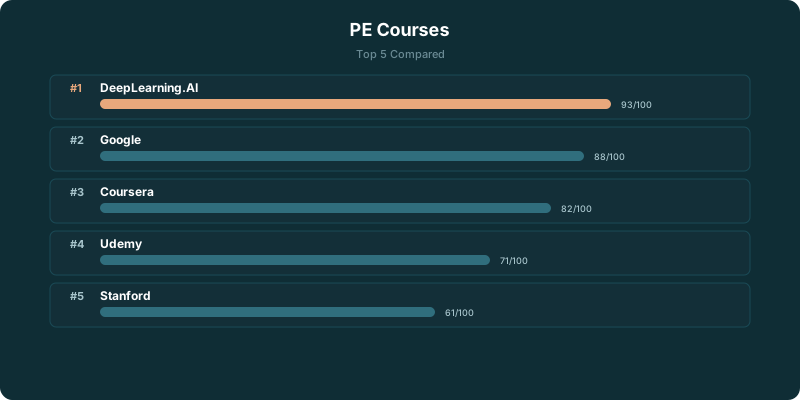
For the full structured course directory with filters and ratings, see our Best Prompt Engineering Courses tools page. This article is the editorial guide.
The best prompt engineering course depends on what you need it to do for you. A working developer should start with DeepLearning.AI. A complete beginner who wants a structured introduction should take Vanderbilt. If a credential matters, Vanderbilt gives you a clearer path than a short practical class.
I've gone through the courses on this list personally or had community members from our 1,300+ person collective report back after taking them. The editorial standard is simple: did the course help someone do better work with language models, or did it turn familiar advice into a glossy video series?
A lot of course pages sell the same fantasy. Take a few lessons, learn a few prompt templates, become an AI expert. Prompt engineering does not work that way. Good instruction teaches you how to frame a task, inspect a bad output, revise the prompt, and decide when a prompt is the wrong fix.
For a wider catalog, use the prompt engineering course directory. It is built for browsing. This guide is for choosing where to spend your time.
TLDR
Developers should take DeepLearning.AI's short, practical course. Beginners and certificate seekers should start with Vanderbilt's more structured option. Pick a course that makes you write, test, and revise prompts, then use real work to build judgment.
Which Prompt Engineering Course Should You Take?
Start with your goal. The right first course becomes obvious once you stop treating every learner as the same person.
If you are a developer, take DeepLearning.AI's ChatGPT Prompt Engineering for Developers. It gets to the useful part quickly: prompting in a workflow where you can test the output, change the instruction, and see what happened. DeepLearning.AI's ChatGPT Prompt Engineering for Developers takes about 1 hour and is free Related analysis.
That compact format is a feature. Developers do not need a long introduction to why AI is interesting. They need a better feel for where prompting fits into software, where it breaks, and how to turn a vague request into an instruction a model can follow.
If you are a complete beginner, take Vanderbilt's Prompt Engineering for ChatGPT. It gives you more runway and makes space for the concepts that short courses tend to skip: task framing, iteration, context, evaluation, and the limits of polished-looking output. Vanderbilt's Prompt Engineering for ChatGPT takes about 18 hours, free to audit with a certificate around $49 Related analysis.
If you need a certificate for a résumé, an internal learning requirement, or a career transition, Vanderbilt is the cleaner choice. The certificate does not replace a portfolio or prove you can build production systems. It does give a hiring manager or manager one concrete signal that you completed structured work rather than watched a handful of videos.
If you are trying to change careers, do not spend weeks collecting course badges before you have built anything. Take one course, then make the work public in some form: a prompt library for a real workflow, a small evaluation set, a before-and-after analysis of outputs, or a project that shows where your judgment improved the result.
The people who get good at this are not the ones with the most saved prompt templates. They are the ones who can look at a model failure and explain what information, constraint, example, or evaluation step was missing.
The Free Courses Compared
| Course | Time commitment | Certificate cost |
|---|---|---|
| DeepLearning.AI: ChatGPT Prompt Engineering for Developers | about 1 hour | n/a |
| Vanderbilt: Prompt Engineering for ChatGPT | about 18 hours | around $49 |
Both are free to begin. The difference is what you get from the time.
DeepLearning.AI is the better first move when you already work in code or have a concrete use case waiting for you. It is brief enough that you can finish it, open your own project, and apply the lesson before the ideas turn into trivia.
Vanderbilt is better when you want more structure or when prompt engineering is your first serious attempt to work with generative AI. It asks for more attention. In return, it gives beginners more room to understand why prompts fail instead of memorizing a few lines that worked in someone else's demo.
There is no prize for choosing the longer course. A course earns its place when it changes how you work the next time you sit in front of a model.
That is also why free courses often beat expensive ones at the beginning. You are still testing whether the field holds your attention and whether the work suits you. A free course with exercises is enough to answer that question. Pay for depth, feedback, or a credential when you know which of those things you need.
How We Ranked These Courses
Four factors mattered most:
- Practical depth: Does the course teach you to build things, or just explain concepts?
- Current content: Does it cover 2025-2026 models and techniques, or is it stuck in the GPT-3.5 era?
- Time-to-value: How quickly can you apply what you learned to real work?
- Honest signal: Does this actually help you get hired or deliver better work?
What Makes a Prompt Engineering Course Worth Taking?
Practical depth comes first. You should leave a lesson having written prompts, compared outputs, and revised an instruction after it failed. Theory helps, but prompt engineering is learned through the uncomfortable gap between what you asked for and what the model gave you.
Current content comes next. The tools change quickly, but the best lessons do not depend on a particular product screen. They teach transferable habits: give the model relevant context, state constraints clearly, provide examples when examples help, split complicated work into manageable tasks, and check the answer against a standard.
Time-to-value matters because many learners are busy. A strong course creates an immediate opening to use the material in your own job, project, or research. If the course leaves you with a collection of abstract terms and no obvious next experiment, it has taken more than it gave.
Then there is the honest signal. Some instructors show the failure cases. They explain when a prompt technique did not improve the result, when a model needs tools or retrieval instead of a longer instruction, and when a human should stay in the loop. That honesty is rare, and it is worth more than a polished promise of mastery.
A course should also make you skeptical of one-shot prompting. The best result often arrives after you define the task, create a first draft, inspect what went wrong, and revise the setup. That loop is the work. A course that presents prompting as a bag of magic phrases teaches the wrong instinct.
DeepLearning.AI: The Best Start for Developers
DeepLearning.AI's course remains the best first stop for developers because it respects your time and points toward practical work. It does not ask you to become a prompt theorist before you can make something useful.
The lesson is particularly good for someone who has already found a task they want to automate, improve, or prototype. Think support summaries, content drafts, information extraction, internal research, document transformation, or a feature inside an application. The decision depends on whether a model can generate text. It is whether you can define the job well enough to make the output dependable.
Use the course as a launchpad. Finish it, then take one repetitive task from your own work and build a small test around it. Save a few representative inputs. Write down what a good answer looks like. Try a prompt. Inspect the weak outputs. Change one thing at a time.
That exercise will teach you more than another afternoon of passive course browsing.
Vanderbilt: The Better Structured Path for Beginners
Vanderbilt's course is the stronger choice for beginners because it creates more space for the ideas behind effective prompting. New learners often need help seeing that a prompt is more than a request. It is an interface for defining a task.
That distinction changes how you work. Instead of asking a model to "make this better," you start naming the audience, the source material, the format, the constraints, the desired tone, and the standard for a usable answer. You learn to notice ambiguity before the model has a chance to exploit it.
The extra time also helps when you are deciding whether this work belongs in your career. Prompt engineering is adjacent to writing, research, product work, operations, software, design, and analysis. It rewards domain knowledge. Someone who understands a real business process can often create a better AI workflow than someone who has only studied generic examples.
If your goal is employment, pair the course with the how to become a prompt engineer guide. Courses give you a foundation. Evidence that you can solve a real problem does the heavier lifting.
Best Free Courses
1. DeepLearning.AI: ChatGPT Prompt Engineering for Developers
Price: Free
Time: 1 hour
Taught by: Andrew Ng + Isa Fulford (OpenAI)
Best for: Developers who want to use AI APIs effectively
Level: Beginner to intermediate
This is the single best hour you can spend learning prompt engineering. Andrew Ng and Isa Fulford (from OpenAI) walk through practical prompting techniques with live code examples. You'll learn summarizing, inferring, transforming text, and building chatbots using the OpenAI API.
The catch: it's from 2023 and uses GPT-3.5 Turbo in the examples. The principles still apply perfectly to GPT-4.1 and Claude, but you'll need to mentally update the model references. It also assumes basic Python knowledge.
Our take: Start here if you have any programming background. It's free, it's short, and the teacher-student dynamic between Ng and Fulford makes the concepts click fast. Our community members who took this course before interviewing reported feeling noticeably more prepared for technical prompt engineering questions.
2. Google Cloud: Introduction to Generative AI
Price: Free
Time: 45 minutes (core) + optional labs
Platform: Google Cloud Skills Boost
Best for: Non-technical people who want foundational understanding
Level: Absolute beginner
If you don't have a technical background, start here instead of DeepLearning.AI. Google's introductory course explains what generative AI is, how large language models work at a conceptual level, and where prompt engineering fits into the picture.
It's not deep. You won't walk away ready to write production system prompts. But you'll have the mental framework needed to get more from every other course on this list.
Our take: Think of this as the prerequisite course. It fills in gaps that other courses assume you already know. People who skip foundational concepts and jump straight into advanced techniques tend to hit walls later. This 45 minutes prevents that.
3. Coursera: Prompt Engineering for ChatGPT (Vanderbilt University)
Price: Free to audit (certificate costs ~$49)
Time: 18 hours
Taught by: Dr. Jules White, Vanderbilt University
Best for: Anyone wanting a thorough, structured foundation
Level: Beginner to intermediate
This is the most thorough free prompt engineering course available. Dr. Jules White covers everything from basic prompting patterns to advanced techniques like chain-of-thought reasoning, persona patterns, and prompt chaining. The university context means the material is well-organized and builds logically.
At 18 hours, it requires a real time commitment. But the depth is worth it. Unlike most beginner courses, this one covers the "why" behind techniques, rather than just the "how." You'll understand why few-shot prompting works, rather than just how to format examples.
Our take: This is the gold standard for free, complete prompt engineering education. The certificate costs ~$49 if you want it, but the course content is identical whether you pay or not. Members in our community who completed this course rated it higher than several paid alternatives that cost $200 or more.
4. Anthropic's Prompt Engineering Interactive Tutorial
Price: Free
Time: 3-5 hours
Platform: docs.anthropic.com
Best for: Developers working with Claude models
Level: Intermediate
Not technically a "course," but Anthropic's interactive prompt engineering tutorial is better than most paid courses. It includes hands-on exercises where you write and test prompts directly in the browser. The material covers all major techniques with Claude-specific guidance on what works best.
The standout feature is the evaluation section. It teaches you to measure prompt quality systematically, which most courses skip entirely. If you're building anything with Claude's API, this is required reading.
Our take: Anthropic's documentation team has produced some of the best prompt engineering educational content available. The interactive exercises make this feel like a course even though it's technically documentation. Pair it with the DeepLearning.AI course for a strong free foundation.
5. OpenAI's Prompt Engineering Guide
Price: Free
Time: 2-3 hours to read thoroughly
Platform: platform.openai.com
Best for: Developers working with OpenAI models
Level: Intermediate
OpenAI's official guide is concise and practical. It covers six core strategies with clear examples: write clear instructions, provide reference text, split complex tasks into subtasks, give the model time to "think," use external tools, and test changes systematically.
It's a reference document, not a video course, so you need to be self-directed. The upside is that it's always current because OpenAI updates it when they release new models.
Our take: Read this after taking one of the structured courses above. It works best as a reference you return to regularly, not a one-time learning resource. Bookmark it.
Best Paid Courses
6. DeepLearning.AI: AI Agentic Design Patterns with AutoGen
Price: Free
Time: 1.5 hours
Platform: DeepLearning.AI
Best for: Engineers building multi-agent AI systems
Level: Advanced
This short course covers agentic design patterns: reflection, tool use, planning, and multi-agent collaboration. It's technically free, but I'm putting it in the paid section because you need intermediate Python skills and prior prompt engineering knowledge to get value from it.
The course teaches you how to design prompt architectures where multiple AI agents work together. This is where the industry is heading. Companies building AI products in 2026 are increasingly using agentic patterns rather than single-prompt designs.
Our take: Don't take this first. Take it after you've completed at least one foundational course and built a few projects. The agentic patterns covered here are what separate mid-level prompt engineers from senior ones. Based on our analysis of 1,300+ job postings, agentic AI experience is now mentioned in roughly 35% of senior prompt engineering roles.
7. Coursera: Generative AI with Large Language Models (AWS + DeepLearning.AI)
Price: Free to audit (~$49 for certificate)
Time: 16 hours (3 weeks)
Platform: Coursera
Best for: People who want to understand the technology behind the prompts
Level: Intermediate to advanced
This course goes deeper than pure prompt engineering. It covers the full LLM lifecycle: pre-training, fine-tuning, RLHF, and deployment. The prompt engineering section is excellent because it's grounded in understanding of how models actually process your inputs.
The AWS labs give you hands-on experience with model deployment, which is valuable if you're moving toward AI engineering. Understanding how models work under the hood makes you a better prompt engineer because you stop guessing about model behavior and start predicting it.
Our take: This is the course to take when you want to level up from prompt writing to prompt architecture. It bridges the gap between prompt engineering and AI engineering. The time commitment is real (16 hours), but the depth justifies it.
8. Udemy: The Complete Prompt Engineering Bootcamp (2026)
Price: $14.99 - $84.99 (Udemy sales happen constantly)
Time: 12 hours
Platform: Udemy
Best for: Self-paced learners who want structured content cheap
Level: Beginner to intermediate
Udemy's prompt engineering courses are a mixed bag. The top-rated ones (4.6+ stars with 10,000+ reviews) provide solid structured learning at a low price point. The content typically covers all major prompting techniques, includes practice exercises, and provides lifetime access.
The downside: Udemy courses don't carry the same credential weight as Coursera/DeepLearning.AI. The quality varies significantly between instructors. And "updated for 2026" sometimes means they added one new video to a 2024 course.
Our take: Never pay full price on Udemy. Wait for a sale (they happen every 2-3 weeks) and pay $14.99. At that price, even a mediocre course has positive ROI. Look for courses with recent reviews (last 3 months) that specifically mention current models. The best Udemy courses are comparable to the Vanderbilt Coursera course in content, just less polished in production quality.
9. Learn Prompting (learnprompting.org)
Price: Free (core), paid certification available
Time: 10-20 hours (self-paced)
Platform: learnprompting.org
Best for: People who prefer reading to watching videos
Level: Beginner to advanced
Learn Prompting is an open-source textbook covering prompt engineering from basics to research-level techniques. It's community-maintained, which means it stays current. The coverage is impressively wide: basics, intermediate techniques, advanced methods (Tree of Thought, ReAct), applied prompting (coding, writing, data), and prompt hacking/security.
The text-based format is either a strength or weakness depending on your learning style. There are no videos, no instructor walking you through examples. It's closer to a technical textbook than a course.
Our take: Excellent reference material. Use it alongside a video-based course, not as a replacement. The advanced sections (prompt injection, jailbreaking, defensive prompting) cover topics that most other courses skip entirely. If you're building production AI systems, the security content alone is worth reading.
10. LinkedIn Learning: Prompt Engineering for Business Professionals
Price: Included with LinkedIn Premium (~$30/month)
Time: 3-4 hours
Platform: LinkedIn Learning
Best for: Managers, marketers, and business users
Level: Beginner
If you already have LinkedIn Premium, this is a no-brainer. The course focuses on using AI effectively in business contexts: writing better emails with AI, analyzing data, creating reports, and automating repetitive tasks. It's not technical. There's no coding, no API work, no system prompt design.
That's fine for its target audience. Not everyone needs to build AI applications. Many professionals just need to use AI tools better in their existing workflow.
Our take: This won't qualify you for a prompt engineering role. It will make you 2-3x more productive with AI tools at your current job. If you're a manager evaluating whether prompt engineering skills matter for your team, take this course to understand what's possible. Then point your team toward the more technical courses above.
11. Cohere's LLM University
Price: Free
Time: 15-20 hours
Platform: Cohere (llm.university)
Best for: People who want deep technical understanding of language models
Level: Intermediate to advanced
Cohere's LLM University covers language models from the ground up: text representation, transformer architecture, attention mechanisms, and then prompt engineering in context. It's more academic than the other courses on this list, but the depth pays off.
Understanding how transformers process your prompts makes you a fundamentally better prompt engineer. You stop using techniques because "someone said they work" and start using them because you understand the mechanism. That understanding compounds over time.
Our take: The best course on this list for long-term career growth. The NLP foundations taught here differentiate prompt engineers who plateau at mid-level from those who reach senior roles. It's free, which makes the recommendation easy. The time investment is substantial (15-20 hours), but this is the kind of knowledge that stays relevant even as specific models and techniques change.
12. Maven: Applied LLMs (Hamel Husain)
Price: $750 - $1,500
Time: 8 weeks (live cohort)
Platform: Maven
Best for: Working professionals who want hands-on feedback
Level: Intermediate to advanced
This is the most expensive option on the list, and it's the only one where I'd say the premium price might be justified. Hamel Husain (former GitHub, Airbnb) teaches applied LLM techniques in a live cohort format. You get direct feedback on your work, interaction with peers who are also building AI systems professionally, and access to a network of practitioners.
The content goes beyond prompting into evaluation, fine-tuning decisions, and production deployment. It's closer to "how to be an effective AI practitioner" than "how to write good prompts."
Our take: Only worth it if you're already working in AI and want to level up significantly. The live format and peer network are the real value. Self-paced learners who are disciplined can get 80% of the technical content from the free courses above. The 20% you're paying for is feedback, community, and accountability. For people at the right career stage, that 20% can be career-changing.
The Learning Path We Recommend
Don't try to take every course. Here's the sequence that works, based on feedback from our community of 1,300+ AI professionals.
If You're a Complete Beginner (No Technical Background)
- Google Cloud: Intro to Generative AI (45 min, free) for foundations
- Coursera: Prompt Engineering for ChatGPT (18 hrs, free to audit) for complete learning
- Build 3 portfolio projects using what you learned
- Learn Prompting as ongoing reference
If You Have a Technical Background
- DeepLearning.AI: ChatGPT Prompt Engineering for Developers (1 hr, free) for quick foundations
- Anthropic's Interactive Tutorial (3-5 hrs, free) for hands-on practice
- Build 3 portfolio projects using APIs
- Coursera: Generative AI with LLMs (16 hrs, free to audit) to deepen understanding
- DeepLearning.AI: AI Agentic Design Patterns (1.5 hrs, free) for advanced patterns
If You're Already Working in AI
- Cohere's LLM University (15-20 hrs, free) if you lack NLP foundations
- Maven: Applied LLMs ($750+) if you want structured feedback and peer network
- Contribute to open-source AI projects for portfolio building
What About Prompt Engineering Certifications?
Let's be direct: certifications in prompt engineering carry less weight than in established fields like cloud computing or project management. The field is too new for any certification to be universally recognized.
That said, the Vanderbilt/Coursera certificate and any DeepLearning.AI credentials are recognized by AI hiring managers. They signal that you invested time in structured learning, which differentiates you from people who claim prompt engineering skills based on casual ChatGPT usage.
Our recommendation: get one certificate from a recognized platform (Coursera or DeepLearning.AI), then invest the rest of your time building portfolio projects. A strong portfolio with one certificate beats five certificates with no projects. See our certification guide for more details.
Courses to Avoid
I won't name specific bad courses, but here are the red flags:
- "Become a 6-figure prompt engineer in 7 days" promises are lies. Nobody goes from zero to job-ready in a week.
- Courses over $500 with no live component. Pre-recorded content at that price is overcharging. The free and low-cost options cover the same material.
- "Secret prompts" or "prompt templates that make millions." There are no secret prompts. Prompt engineering is a skill, not a cheat code.
- Courses that don't mention evaluation or testing. If a course only teaches you to write prompts but not to measure whether they work, it's incomplete.
- Any course still using GPT-3.5 as its primary model without acknowledging newer options is outdated.
Free vs Paid: The Honest Assessment
For prompt engineering specifically, free courses cover 90% of what you need. The field is new enough that the best educators (Andrew Ng, Anthropic's team, Google's team) are still giving away foundational content to grow the ecosystem.
Paid courses are worth it in three specific situations:
- You need accountability. Some people learn better with deadlines, cohort pressure, and someone grading their work. That's not a weakness. Know yourself.
- You want feedback on your work. Free courses don't review your prompts. Live cohort courses do. Feedback accelerates learning, especially for intermediate practitioners who've hit a plateau.
- You need a specific credential. If you're applying to companies that filter resumes by certifications, having a Coursera or LinkedIn Learning certificate can get you past the initial screen.
For everyone else, the free path (DeepLearning.AI + Vanderbilt/Coursera + Anthropic docs + portfolio projects) is sufficient. Don't let anyone convince you that you need to spend $2,000 on a bootcamp to learn prompt engineering.
Check our career roadmap for the full step-by-step path from beginner to hired, including how to structure your portfolio projects. And browse the job board to see what skills employers are actually asking for right now.
What a Prompt Engineering Course Is Worth
A course will not hand you a job. It can help you develop a skill that is showing up in more roles, across more functions, and inside work that did not used to have an AI component.
Job postings mentioning prompt engineering have grown 300% since early 2024 on the PE Collective job board Related analysis.
That growth does not mean every company is hiring a person whose title is "prompt engineer." Many are looking for product people, developers, analysts, marketers, operators, and researchers who can use language models with better judgment than the average employee. The skill is becoming part of the job, which is a different proposition from a neat new profession with a tidy career ladder.
A course is worth the effort when it helps you produce work that would otherwise take longer, require more back-and-forth, or remain outside your reach. That might mean building a research workflow, improving an internal tool, designing a content process, or creating an evaluation method for AI outputs.
Salary questions follow quickly, and they should. But the pay story depends heavily on the role around the skill: engineering, product, operations, consulting, research, or another specialty. Read the prompt engineering salary guide with that in mind. Prompting pays best when it is attached to useful domain expertise and a record of shipping work.
The career payoff comes from judgment. Companies can buy access to the same models. They cannot buy your understanding of their customers, their data, their risk, or the messy process their team has never written down.
How These Reviews Were Made
These are editorial reviews, not a course directory with affiliate-style praise for every option. Course picks were tested personally or reported back by members of a 1,300+ person collective Related analysis.
That gives us a useful filter. A course can sound impressive on a landing page and still fail in practice because it is too generic, too dated, too slow to reach the useful material, or too dependent on an instructor's scripted examples.
We look for reports from people who tried to use the lesson after the course ended. Did it help a developer build? Did it give a beginner a workable mental model? Did the certificate seeker get a credential that felt proportionate to the cost? Did the learner understand where prompting ends and a fuller system begins?
The answer matters more than the brand name.
Community feedback also keeps the guide honest. People report when a course felt padded. They report when the examples were stale. They report when an instructor made a difficult concept easy to apply. That is the material an editorial guide should surface.
The directory remains useful if you want to browse formats, providers, and options. This page makes a narrower promise: start with a course that has a clear reason to exist in your learning path.
How to Get More From the Course You Choose
Pick one real task before you begin. It can be modest. Rewrite a recurring email, classify feedback, summarize research notes, extract information from documents, or turn a rough brief into a draft you can edit.
Keep a simple record of the prompt versions you try. Save the input, the instruction, the output, and what you changed. You will start to see patterns quickly. Perhaps the model needed an example. Perhaps it needed less context, not more. Perhaps the task required a rubric. Perhaps no prompt would fix a missing source of truth.
That record becomes useful evidence of your learning. It also protects you from the common trap of assuming a fluent answer is a good answer. Language models are persuasive by default. Your job is to make the output useful, accurate enough for the task, and easy to verify.
When you finish a course, build one small project from it. Do not try to make it impressive. Make it concrete. A narrow workflow that works is a better learning artifact than a grand prototype nobody can test.
The decision depends on whether you can write a prompt that looks clever. Can you make a model reliably useful for a task someone already cares about?
Key Takeaways
- Developers should begin with DeepLearning.AI for a practical, fast introduction.
- Beginners and certificate seekers should choose Vanderbilt for a more structured path.
- Free courses are enough to test your interest before paying for depth or credentials.
- Build a small project after the course, because applied judgment is the skill employers can see.
- Use the directory to browse options and this guide to make the first choice.
Sources
- PE Collective course reviews, 1,300+ person collective
- DeepLearning.AI course review, about 1 hour
- Vanderbilt course review, around $49
- PE Collective job board, 300% growth
Frequently Asked Questions
What is the best free prompt engineering course?
DeepLearning.AI's ChatGPT Prompt Engineering for Developers is the best free option for people with some technical background. It's only 1 hour, taught by Andrew Ng and Isa Fulford, and covers API-level prompt engineering with real code examples. For non-technical learners, Google's Introduction to Generative AI on Coursera (free to audit) provides a broader foundation before diving into prompting specifics.
Do I need a prompt engineering certification to get hired?
No. Most hiring managers in AI don't weight certifications heavily. A portfolio of documented prompt engineering projects demonstrates your ability far better than a certificate. That said, certifications from recognized institutions (Vanderbilt on Coursera, DeepLearning.AI) can help get past HR filters at larger companies. They're a nice addition to a strong portfolio, not a replacement for one.
How long does it take to learn prompt engineering?
The fundamentals take 1 to 2 weeks of focused study (10-15 hours). Becoming job-ready takes 2 to 3 months, including building portfolio projects and learning to work with AI APIs. You can accelerate this by taking a structured course (15-30 hours for core content) and immediately applying what you learn to real projects. The biggest mistake is spending months on courses without building anything.
Are paid prompt engineering courses worth the money?
It depends on the course and your situation. Free courses from DeepLearning.AI and Coursera cover the fundamentals well. Paid courses are worth it when they offer hands-on projects with feedback, access to a community, or deep specialization (like prompt engineering for healthcare or legal). Courses over $500 rarely provide proportional value unless they include mentorship or job placement support.