 PE Collective
Best Prompt Engineering Courses for 2026
Seven courses and resources organized by skill level and format. Free university courses, paid bootcamps, and hands-on labs. For editorial picks with detailed reviews, see our Best Prompt Engineering Courses guide.
Last updated: September 2, 2026
Prompt engineering courses can teach you useful habits fast, provided you choose a resource built around actual practice instead of recycled prompt templates. Start with the free material, then pay only when a certificate, curriculum, or deadline gives you something you need.
Job postings mentioning prompt engineering have grown 300% since early 2024 on the PE Collective job board PE Collective course directory. The skill moved quickly from novelty to hiring requirement because companies need people who can write clear instructions, test outputs, work with system prompts, and evaluate whether an AI workflow holds up outside a demo.
Some courses teach fixed tricks that break when the model changes. Better resources teach task definition, context, examples, evaluation, and revision. The seven entries here are editorial selections for comparing format, depth, prerequisites, and commitment.
This page is a directory for comparing formats and commitment. If you want long editorial reviews of each pick, read our editorial course reviews. If you are choosing a credential for a résumé or job application, use the prompt engineering certifications directory.
TLDR
Start with DeepLearning.AI, Anthropic, and OpenAI if you want free practice without a long commitment. Vanderbilt offers a fuller university-style path. Paid courses make sense when a certificate, structure, or deadline will keep you working through the material.
Free Resources to Learn Prompt Engineering
Free learning is where most people should begin. You do not need a bootcamp before you have written prompts, compared outputs, and seen where a vague instruction falls apart.
DeepLearning.AI's ChatGPT Prompt Engineering for Developers is the easiest entry point for people who learn by building. It uses short lessons and practical exercises rather than trying to turn the subject into a semester-long academic discipline. DeepLearning.AI's ChatGPT Prompt Engineering for Developers takes about 2 hours PE Collective course directory.
That short format works because early progress comes from repetition. Write an instruction. Change the context. Add an example. Watch the output improve or get worse. You start to see that prompt engineering is less about clever phrasing than task design.
Vanderbilt's course is a stronger choice if you want a broader foundation and prefer formal lessons. Vanderbilt's Coursera course is free to audit, with a certificate for $49 PE Collective course directory. The audit option makes it a sensible first stop for learners who want university instruction without deciding up front that they need a credential.
The course demands more patience than the developer-focused option. Vanderbilt's course runs about 18 hours of material PE Collective course reviews. That length gives it room to cover prompting as a general skill, including work that applies beyond writing code or building a single chatbot.
Anthropic's interactive tutorial is a good fit for learners who want feedback from the material itself. Interactive lessons force a useful question: did the prompt solve the stated problem, or did it merely produce an answer that looked polished? That distinction separates a reliable workflow from an entertaining demo.
OpenAI's guide works best as a reference you revisit while doing real work. Documentation can feel dry when you are starting out. It becomes valuable once you have a prompt that needs repair. You can look up patterns for instructions, delimiters, examples, and output formats, then apply them to the problem in front of you.
Free resources also protect you from a common mistake: paying for motivation disguised as expertise. A paid program cannot make generic material more useful. Complete a free course, build a small project, and notice what still feels unclear. That will tell you whether a paid option has a job to do.
The Full Course Directory Compared
The directory below compares the core options by how they teach, who they fit, what they cost, and the time commitment. These are structured listings, not rankings disguised as a table. Your best choice depends on how you learn and what you need to show afterward.
| Course | Format | Level | Cost | Time |
|---|---|---|---|---|
| Vanderbilt Coursera | University course | Beginner | Free to audit, certificate paid | About 18 hours |
| DeepLearning.AI ChatGPT Prompt Engineering for Developers | Video course with exercises | Beginner to intermediate | Free | About 2 hours |
| Anthropic interactive tutorial | Interactive tutorial | Beginner to intermediate | Free | n/a |
| OpenAI prompt engineering guide | Reference documentation | Beginner to advanced | Free | Self-paced |
| Udemy prompt engineering bootcamp | Video bootcamp | Beginner to intermediate | Paid | n/a |
Vanderbilt belongs at the top of the list for learners who want a structured path and a recognizable course provider. It gives you a broader survey of the field, which helps when you are still figuring out where prompting fits into your work. Someone moving toward product, marketing, operations, research, or general AI work will likely get more from this route than from a narrowly technical tutorial.
DeepLearning.AI is the better first pick for a developer who wants to start applying concepts the same day. The course focuses your attention on the mechanics that matter in practice: instructions, examples, iteration, and output handling. It is compact enough that you can finish it before curiosity turns into another abandoned browser tab.
Anthropic's tutorial earns its place because interactivity reveals weak reasoning quickly. Reading about a technique can create a false sense of mastery. Working through a prompt and seeing a bad output gives you something concrete to fix. That is the habit worth building.
OpenAI's guide has a different role. It is not trying to be a complete course, and that is fine. Treat it like a workshop manual. Keep it open when you are building a workflow, rewriting a system prompt, or trying to make an output more consistent.
The Udemy bootcamp is for people who need a longer, instructor-led sequence. Quality varies heavily across marketplace courses, so inspect the curriculum before buying. Look for exercises, examples of evaluation, and material that teaches revision. Skip a course built around an endless list of prompt formulas.
Course picks draw on reports from a 1,300+ person collective PE Collective course reviews. That perspective is useful because prompt engineering crosses job functions. A marketer, analyst, developer, and operations lead may use different tools, but each needs a way to turn a fuzzy request into a repeatable process.
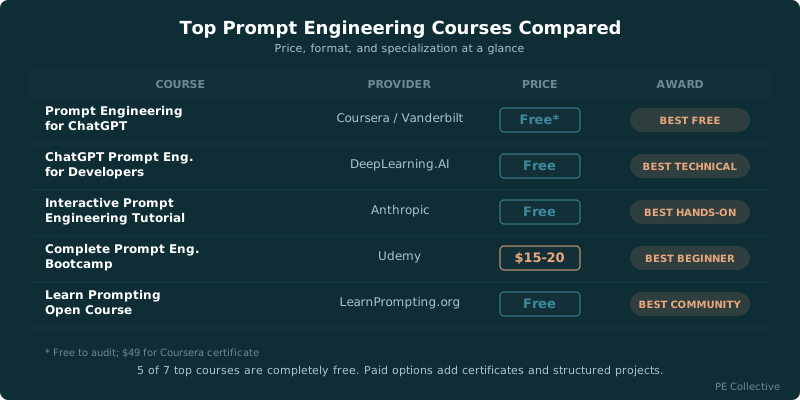
Our Top Picks
Detailed Reviews
Coursera: Prompt Engineering for ChatGPT (Vanderbilt)
Best Free CourseDr. Jules White's Vanderbilt course is the best structured introduction to prompt engineering available. It starts with the fundamentals and builds to advanced patterns like persona prompting, flipped interactions, and chain-of-thought. The production quality is high. Each concept gets a clear explanation followed by worked examples. You can audit the entire thing for free.
DeepLearning.AI: ChatGPT Prompt Engineering for Developers
Best TechnicalAndrew Ng and Isa Fulford (OpenAI) built this course for developers who already know how to code. It skips the basics and goes straight to API-level prompt engineering: system messages, temperature tuning, structured output, iterative refinement, and building with the completions API. The Jupyter notebook exercises let you run real API calls. At about 2 hours, it's dense but doesn't waste your time.
Anthropic's Prompt Engineering Interactive Tutorial
Best Hands-OnAnthropic built an interactive tutorial that lets you practice prompt engineering directly in your browser. Each lesson has a specific technique (role prompting, XML tags, chain of thought, few-shot examples) with a challenge you solve by writing and testing prompts in real time. The feedback loop is immediate: write a prompt, see the output, iterate. This is how prompt engineering actually works in practice.
OpenAI's Prompt Engineering Guide
Best ReferenceThis isn't a course in the traditional sense. It's OpenAI's official documentation on prompt engineering best practices, and it's one of the most useful references in the field. Each technique (write clear instructions, provide reference text, split complex tasks, give the model time to think) gets a concise explanation with before/after examples. It's the kind of doc you bookmark and revisit monthly.
Udemy: The Complete Prompt Engineering Bootcamp
Best for BeginnersThis Udemy bootcamp is the most thorough paid option for true beginners. It covers everything from what an LLM is to advanced techniques like tree-of-thought and self-consistency. The video format with on-screen demonstrations makes abstract concepts concrete. At Udemy's perpetual sale price of $15-20, the cost per hour of instruction is hard to beat.
LearnPrompting.org
Best Community ResourceLearnPrompting is an open-source curriculum maintained by the community. It covers everything from basic prompting to advanced research techniques like Constitutional AI and RLHF. The breadth is unmatched: no single course covers as many techniques. New patterns and research findings get added regularly. The written format with embedded examples makes it easy to skim or deep-dive as needed.
Google Cloud: Introduction to Generative AI Learning Path
Best for Enterprise AIGoogle's generative AI learning path on Cloud Skills Boost is a structured series of courses covering LLM fundamentals, prompt design, and responsible AI. The prompt engineering modules cover Gemini-specific techniques including multi-modal prompting (text + images), grounding with Google Search, and structured output generation. The 2026 update added modules on agentic AI patterns and tool use. Each module includes hands-on labs in Google Cloud Console. For professionals targeting roles that use Google Cloud or Vertex AI, this learning path provides both the skills and the credential recognition.
Evaluation Criteria
Compare courses on technical depth, practical exercises, instructor credibility, update cadence, prerequisites, format, and current cost. Favor material that teaches task definition, examples, evaluation, and revision over fixed prompt recipes tied to an older model.
Paid Courses and When They Are Worth It
Paid prompt engineering courses are worth the money when they provide structure you will use. A certificate can help when an employer expects formal evidence of learning. A cohort can help if deadlines force you to finish. A good instructor can save time by explaining why a prompt failed instead of merely showing a polished final version.
The price alone does not predict quality. Marketplace bootcamps often package accessible material with better production value and a stronger promise. That can be useful if it gets you through the work. It can also be a literal money pit if the course relies on screenshots of old model interfaces and broad claims about secret prompt frameworks.
Look for a curriculum that teaches evaluation. Prompting without evaluation produces brittle work because a good-looking response can still miss the task, invent details, or fail when the input changes. A course should make you test edge cases, set constraints, compare alternatives, and decide what an acceptable answer looks like before the model gives you one.
Paying makes more sense once you know your use case. A developer may want API examples and structured outputs. A marketer may need research workflows, editing processes, and brand controls. An analyst may care about extracting information from messy material and checking the result. The course should match the work you plan to do next.
Certificates deserve a narrower view. They can signal initiative, especially early in a career transition, but they do not replace a portfolio. A small project with a clear prompt, a documented process, and an explanation of how you tested it gives a hiring manager more to inspect.
If your goal is a prompt engineering role, pair coursework with the practical roadmap in how to become a prompt engineer. The people who stand out can describe a real workflow, explain the tradeoffs, and show how they improved the output over time.
Which Format Fits You
Video courses fit learners who want a guided explanation before they start experimenting. They are useful when a topic feels unfamiliar and you want someone to show the workflow in sequence. The risk is passive watching. Keep a blank document or a small project open while you learn, then test each idea immediately.
Interactive tutorials fit people who learn by doing. You get less narrative and more friction, which is often a good trade. A prompt that looks obvious in a lesson can become complicated when you have to decide what information belongs in the instruction and what belongs in the input.
Reference documentation fits people who already have a problem to solve. It is the least entertaining format and often the most useful over time. Documentation rewards specificity. You arrive with a task, find the relevant pattern, make a change, and see whether the result gets better.
University-style courses fit learners who want the whole map before choosing a path. They can be slower, but they give context that a short tutorial skips. That matters if you are moving into AI work from another field and need language for concepts, methods, and limitations.
Bootcamps fit people who need external pressure. The schedule, exercises, and sense of progression can help you finish. Still, do not confuse completion with competence. You need to use the material on something that has consequences beyond the course platform.
A good learning plan mixes formats. Start with a short practical course. Use an interactive tutorial to reinforce the ideas. Keep reference material nearby when you build. Then choose a longer course or certificate only if it fills a specific gap.
What You Should Be Able to Do After a Course
A useful prompt engineering course should leave you with more than a folder of templates. You should be able to describe a task clearly enough that another person could understand what the model is meant to do. You should know what context changes the answer, what examples remove ambiguity, and what constraints protect the final output.
You should also be comfortable revising. The first prompt is usually a draft. If the output is too vague, you need to identify whether the task was vague, the context was thin, the format was unspecified, or the model needed an example. That is a more durable skill than memorizing a prompt pattern with a catchy name.
Build a small project while you learn. It could summarize customer calls, create a research brief, extract fields from documents, draft an internal report, or classify support requests. Pick something with messy inputs and a clear definition of success. Clean examples teach less because they rarely expose the awkward cases.
Write down what changed between versions. Keep the original prompt, the revised prompt, a sample input, and the output you accepted. This creates a record of your judgment. It also helps when a workflow breaks later and you need to understand which change caused the problem.
The strongest learners develop an editor's instinct. They do not ask whether the AI wrote something fluent. They ask whether it followed the instruction, used the right evidence, handled uncertainty honestly, and produced a format someone can use.
Choosing Your Starting Point
Start with DeepLearning.AI if you want a fast, practical introduction. Choose Vanderbilt if you want more structure and a credential option. Use Anthropic's tutorial when you want hands-on practice, and keep OpenAI's guide nearby once you start building your own workflows.
The paid bootcamp route works when you know that a fixed curriculum will get you to finish. It is a poor substitute for practice. No course can make the judgment calls for you when an output is plausible but wrong.
Prompt engineering is becoming part of ordinary knowledge work. The people getting ahead are not collecting prompt libraries. They are learning how to define a problem, test a system, and improve it when the first answer misses. Which format will get you doing that work this week?
Key Takeaways
- Free courses and guides are enough to build a strong foundation before paying for anything.
- Vanderbilt suits learners who want structure, while DeepLearning.AI suits learners who want to move quickly.
- Interactive tutorials build better instincts for testing and revising prompts.
- Paid courses earn their place through structure, feedback, or a credential, not flashy prompt formulas.
- Practical projects show more than course completion when you are building toward a role.
Which Course Type Matches Your Career Stage
Prompt engineering courses range from 2-hour introductions to 40-hour professional certificates. Picking the wrong depth wastes both time and money.
If you're brand new to AI, start with the free options. DeepLearning.AI's ChatGPT Prompt Engineering for Developers takes about 2 hours and covers the fundamentals: system prompts, temperature settings, few-shot examples, and chain-of-thought reasoning. Google's Generative AI Learning Path is another strong free option. These give you enough to start experimenting.
Mid-career professionals who already use AI daily should skip the introductory material. Look for courses that cover advanced techniques: multi-turn optimization, evaluation frameworks, and domain-specific prompting. Coursera's Prompt Engineering Specialization hits this level. So does the Vanderbilt certificate program, though it requires a larger time commitment.
For engineers building LLM applications, the courses above won't go deep enough. You need to understand token economics (token pricing varies 750x across models), embedding strategies, and how prompting connects to RAG pipelines. The best path here is combining a fundamentals course with hands-on framework experience.
The career payoff is real. Our salary data shows roles requiring prompt engineering skills pay $90K to $170K+ depending on seniority. The courses themselves cost $0 to $500, making the ROI straightforward if they help you land or advance in one of these positions.
Frequently Asked Questions
Do I need a paid course to learn prompt engineering?
No. The free resources on this list (DeepLearning.AI, Anthropic's tutorial, OpenAI's guide, Google's learning path, and LearnPrompting) cover everything most professionals need. Paid courses add structure and certificates, but the core knowledge is freely available. Start with the free options and only pay if you specifically want a credential or prefer video-based learning.
How long does it take to learn prompt engineering?
You can learn the fundamentals in a weekend. The DeepLearning.AI course takes about 2 hours. Anthropic's tutorial takes 2-3 hours. Getting good at prompt engineering takes longer since it's a practice skill, like writing. Budget 2-4 weeks of daily practice to build real proficiency. Advanced techniques like evaluation frameworks and production prompt management take months to master.
Is prompt engineering a real career or just a trend?
It's real, but evolving. Pure 'prompt engineer' titles are declining as the skill gets absorbed into broader AI engineering roles. However, prompt engineering skills are showing up as requirements in AI engineer, ML engineer, and even product manager job postings. The skill is durable even if the specific job title isn't. Check our job board for current listings.
Which course should I take first?
If you're a developer: start with the DeepLearning.AI course (about 2 hours, free, code-focused). If you're non-technical: start with the Coursera Vanderbilt course (structured, beginner-friendly). If you learn by doing: go straight to Anthropic's interactive tutorial. You can always come back to the others later.
Should I learn prompt engineering for one specific model or all of them?
Start with one model and learn its patterns deeply. The fundamentals (clear instructions, few-shot examples, chain-of-thought) transfer across all models. The model-specific differences (XML tags for Claude, system message behavior in GPT, grounding in Gemini) are easier to pick up once you have a strong foundation. Most practitioners end up working with 2-3 models in production anyway.