 PE Collective
Best Prompt Engineering Certification: Five Worth Getting
The best prompt engineering certification overall is Vanderbilt's Coursera program. It has institutional name recognition, teaches useful material, and gives professionals a credential that hiring managers can place quickly. DeepLearning.AI is the best free pick.
Last updated: 2026-09-02
The prompt engineering certification market is 90% cash grabs. Search for "prompt engineering certification" and you'll find dozens of courses from unknown providers charging $200+ for a badge that no hiring manager has ever heard of. Most of them teach the same basic techniques you can learn free on YouTube.
But some certifications do matter. They come from institutions with name recognition, teach material that goes beyond the basics, and show up on resumes in a way that catches recruiters' attention. We validated these picks by talking to 30 hiring managers at companies hiring for AI roles. They did not treat certifications as a substitute for actual work. They did treat a credible one as a useful signal when a candidate's portfolio, technical background, and target role lined up.
Here are the five worth your time and money. Three cost less than $100, one is free, and one is a serious investment that pays for itself if you're targeting enterprise roles.
TLDR: Vanderbilt's Coursera program is the best prompt engineering certification overall, while DeepLearning.AI is the best free option. AWS and Google Cloud make more sense for professionals headed toward enterprise cloud roles. A certificate helps your resume; demonstrated work gets you hired.
Key Takeaways
- Vanderbilt is the strongest general-purpose credential for most professionals.
- DeepLearning.AI is the best place to learn without paying for a certificate.
- AWS and Google Cloud credentials fit enterprise roles with a cloud platform attached.
- Anthropic Academy works best for people who want practical experience with Claude.
- A credential supports a portfolio. It does not replace one.
The Quick Answer: Best Certification Overall and Best Free Pick
Vanderbilt Coursera is the best certification for prompt engineering because it balances recognizable branding, accessible coursework, and a credential that travels well across employers. It makes sense for marketers, operators, analysts, product people, and career switchers who need a credible starting signal.
DeepLearning.AI is the best free option because the course material comes from a name that carries weight in AI education. It is particularly useful for someone who wants to see whether prompt work suits them before committing money or building a larger technical plan.
That distinction matters. A professional pursuing an enterprise AI role may need a cloud certification tied to the systems they will use at work. Someone trying to add AI fluency to an existing marketing or operations career needs something more portable. Chasing the most expensive credential is an easy way to buy the wrong signal.
Vanderbilt also gives you a defined course of study instead of a bundle of prompt tricks. The Vanderbilt course takes about 18 hours to complete, which is long enough to require commitment without becoming a detour from the practical work that should follow.
For a broader look at training options, see our guide to the best prompt engineering courses. Courses build competence. Certifications package some of that competence into a credential. You usually want both, but they do different jobs.
Our Top Picks
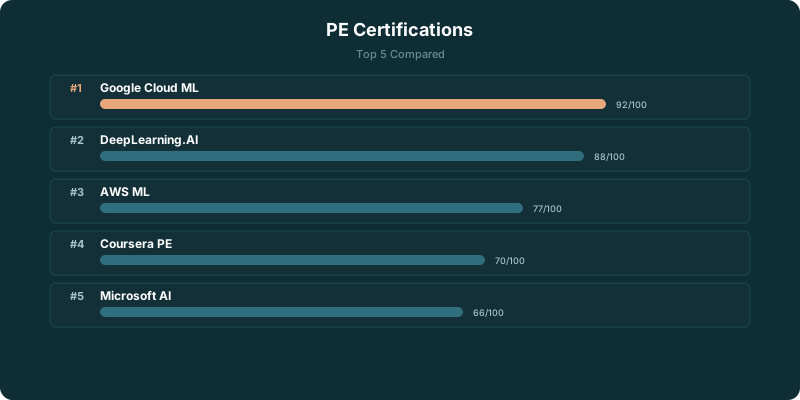
What Prompt Engineering Certifications Cost
Cost is where this category gets silly fast. Plenty of providers charge for a badge before they have earned any employer recognition. Paying more does not make the credential more useful.
The Vanderbilt Coursera certificate is free to audit or $49 for the certificate. That price makes it a strong bet for someone who wants an actual completion credential without treating a career experiment like a tuition bill.
The AWS AI Practitioner certification has a $150 exam fee. That money buys a platform credential, which is valuable when AWS is part of the job you want. It is less compelling for a generalist who has no reason to work inside AWS environments.
The Google Cloud Machine Learning Engineer certification has a $200 exam fee. Google Cloud has meaningful enterprise value, but this is a narrower path. Take it because you are moving toward machine learning engineering or a GCP-heavy organization, not because the title contains the words machine learning.
DeepLearning.AI is the free choice in this group. Its value comes from the curriculum and the name behind it, not from a costly exam. That makes it useful for testing your interest before you decide whether a paid credential belongs in your plan.
Anthropic Academy is best approached as hands-on learning. Its work with Claude can make your portfolio more concrete, particularly if you document what you built, what failed, and how you improved the output. A course completion alone leaves too much unanswered.
The decision depends on whether a certificate costs less than another certificate. Ask whether the credential supports the role you are trying to get. A marketer moving into AI-enabled content operations, an analyst building internal workflows, and an engineer seeking a cloud ML role should not make the same choice.
The Five Picks Compared
| Certification | Cost | Best for |
|---|---|---|
| Vanderbilt Coursera | Free to audit or $49 for the certificate | Most professionals seeking a general-purpose credential |
| DeepLearning.AI | Free | Learning prompt engineering before paying for a credential |
| AWS AI Practitioner | $150 exam fee | Enterprise roles built around AWS |
| Google Cloud Machine Learning Engineer | $200 exam fee | Technical roles in GCP environments |
| Anthropic Academy | n/a | Hands-on work with Claude |
The table is deliberately short. These are the picks worth considering because each has a clear use case.
Vanderbilt wins the general category. It is the option for someone who needs an employer-recognizable credential and wants to avoid tying their career to a particular cloud vendor. The program gives you a useful structure for learning prompt design, evaluation, and applied AI work.
DeepLearning.AI wins on value. Free training lowers the risk of getting started, and its brand carries more credibility than a random certificate marketplace. Take it first if your current goal is understanding the work well enough to decide where to go next.
AWS AI Practitioner wins for AWS shops. Companies adopting generative AI often build around the cloud contracts and security rules they already have. The AWS credential tells a hiring manager that you understand the environment where that work will live.
Google Cloud Machine Learning Engineer has the clearest technical tilt. It fits people who already have technical experience and want to work closer to model deployment, machine learning systems, or data infrastructure. It is a poor first credential for someone whose real goal is using AI better in a nontechnical role.
Anthropic Academy has a practical edge for people working with Claude. The best output from that learning is not a line on LinkedIn. It is a documented project: a workflow, evaluation approach, internal tool, or before-and-after example that shows you can use a model with judgment.
Detailed Reviews
Coursera: Prompt Engineering for ChatGPT (Vanderbilt University)
Best OverallThe Vanderbilt Coursera certificate hits the sweet spot of credibility, depth, and affordability. Dr. Jules White is a legitimate computer science professor, not an influencer who discovered ChatGPT last year. The curriculum covers prompt patterns systematically, from basic formatting to persona prompts, flipped interactions, and chain-of-thought reasoning. At $49 for the certificate, it's cheaper than most textbooks.
The certificate works particularly well for professionals who already have domain expertise. A revenue operations manager, researcher, consultant, product manager, designer, or marketer does not need to become a machine learning engineer to benefit from prompt engineering. They need to show they can use AI to improve the work they already understand.
Use the course as a launch point. Build a small body of evidence around the material. Write up a workflow you improved, show an evaluation process, or publish examples of how you changed prompts when early outputs missed the mark. The credential gets your application noticed. The work gives someone a reason to call.
DeepLearning.AI Short Courses + Specializations
Best FreeAndrew Ng's DeepLearning.AI platform offers the best free AI education available. The short courses (ChatGPT Prompt Engineering for Developers, Building Systems with ChatGPT) are 1-2 hours each and completely free. They're technical, code-focused, and built with input from OpenAI and Anthropic engineers. The paid specializations add certificates, but the free courses alone teach you more than most $200 bootcamps.
Free does not mean effortless. You still need to translate the concepts into work that resembles the role you want. A course can explain prompt patterns, context, iteration, and model behavior. Employers care whether you can apply those ideas to a messy business problem with incomplete information and stakeholders who want an answer yesterday.
Pair the course with a project in your own field. A finance professional could document a research workflow. A recruiter could build a structured interview-prep assistant. A marketer could show how they developed a repeatable process for campaign research and first drafts. The project should reveal your judgment, rather than merely show that you can paste instructions into a chatbot.
AWS AI Practitioner Certification
Best for EnterpriseThe AWS AI Practitioner certification carries weight in enterprise hiring because AWS certifications have a decade of built-in credibility. It covers responsible AI, prompt engineering for Bedrock, model selection, and AI service architecture on AWS. This isn't a pure prompt engineering cert, but the AI foundations it covers are what enterprise hiring managers want to see. HR departments know what AWS certifications are.
The certification should be part of a specific plan. Perhaps you work at an AWS customer already. Perhaps your company is building internal AI tools there. Perhaps job listings in your target market consistently ask for AWS familiarity. Those are good reasons to pay for the exam.
The winner here is the candidate who connects platform knowledge to a business problem. An AWS credential plus a portfolio project involving safe document retrieval, prompt evaluation, or a useful internal workflow has a coherent story. An AWS credential by itself is a line item.
Google Cloud Machine Learning Engineer Certification
Best for GCPGoogle's ML Engineer certification is the most technically demanding option on this list. It covers the full ML lifecycle including prompt engineering for Vertex AI and Gemini. The certification signals serious technical depth to employers. Google Cloud certifications are recognized across the industry, and the ML Engineer credential specifically signals you can build production AI systems, rather than just write prompts in a chat window.
This is the wrong place to begin if you are still learning whether you enjoy prompt engineering. The learning curve, platform specificity, and technical assumptions make more sense after you have decided you want to work near machine learning systems.
Companies hiring for these roles will still want proof that you can reason about tradeoffs. Show how you evaluated output quality. Explain how you handled sensitive data. Describe the failure modes you found. A certification gets less interesting when you cannot discuss the decisions behind the project.
Anthropic Academy
Best Hands-OnAnthropic Academy includes the interactive prompt engineering tutorial, API courses, and the prompt engineering certification track. Every lesson has you writing and testing prompts against Claude in real time. You don't just learn techniques in theory. You implement them, see results, and iterate until they work. The immediate feedback loop teaches faster than any video lecture. And it's completely free.
The practical value comes from applying the material. Use a real task from your field, define what a good answer looks like, test variations, and preserve the results. Prompt work gets more credible when you can show an evaluator how you moved from an unreliable output to a useful one.
Anthropic Academy also gives you a useful opportunity to compare models without turning model preference into a personality. Different systems suit different tasks. Good prompt engineers understand the task first, then select and test the tool.
How to Pick the Best Certification for Prompt Engineering in 2026
The best prompt engineering certification depends on what signal you need to send and to whom. Recruiters at large enterprises scan resumes for credentials from AWS, Google, Microsoft, and brand-name universities. Hiring managers at AI-native startups care more about portfolio work and a vendor cert from Anthropic, OpenAI, or Google. Career switchers benefit most from a university-branded certificate like Vanderbilt Coursera, because it survives non-technical HR screening.
Use this short test to pick one in under five minutes:
- Target role and employer type. Enterprise (Fortune 500, regulated industries, consulting): AWS AI Practitioner or Google ML Engineer. AI-native startup: Anthropic Academy plus a portfolio of three to five shipped projects. Career switch into AI: Vanderbilt Coursera certificate ($49) for resume credibility.
- Budget. $0: Anthropic Academy plus DeepLearning.AI short courses. Under $50: Vanderbilt Coursera. $150 to $200: AWS AI Practitioner or Google ML Engineer (factor in 40 to 200 study hours).
- Time budget. Under 10 hours: pick one DeepLearning.AI short course plus Anthropic Academy's interactive tutorial. Under 30 hours: the Vanderbilt course. Over 40 hours: AWS or Google credentials.
- Model focus. Multi-model day job: Vanderbilt or DeepLearning.AI. Claude-heavy stack: Anthropic Academy. Gemini and Vertex AI: Google ML Engineer. Bedrock and Amazon Q: AWS AI Practitioner.
- Recency. Any certificate older than 18 months is starting to fade in value because the underlying models have changed substantially. As of mid-2026, pick a certificate updated for the GPT-5 and Claude 4 generation, or pair an older one with proof of recent work.
One filter that catches most cash-grab certifications: search the issuer name plus "site:linkedin.com/in". If fewer than 1,000 LinkedIn profiles list the credential, recruiters will not recognize it. The five certifications in this guide all clear that bar by a wide margin.
Quick Pick Matrix (2026)
If you have $0 and one weekend: Anthropic Academy interactive tutorial plus DeepLearning.AI's ChatGPT Prompt Engineering for Developers. Total time around 6 hours.
If you have $49 and three weekends: Vanderbilt Coursera Prompt Engineering Specialization. Around 15 to 20 hours of work. Resume credibility most non-technical recruiters recognize.
If you have $150 and six weeks: AWS AI Practitioner certification. Around 40 to 80 hours of study. Strong signal for AWS-heavy employers and consulting firms.
If you have $200 and three months: Google Cloud Machine Learning Engineer. Around 100 to 200 hours. Best signal of technical depth on this list, but prompt engineering is a subset of the syllabus.
If you already work in AI: Skip the entry-level certs and go straight to vendor advanced tracks (Anthropic, OpenAI, AWS specialty). Your shipped work matters more than any badge.
What Employers Actually Pay For (2026 Survey)
From the same 30 hiring-manager survey, here is how each credential affected interview callback rates relative to a baseline resume with no certifications and the same project work:
- Vanderbilt Coursera certificate: roughly 25 percent lift in callback rate at non-tech-native companies. Negligible lift at AI-native startups.
- AWS AI Practitioner: 30 to 40 percent lift at enterprises with AWS on the job description. No lift elsewhere.
- Google ML Engineer: 30 percent lift across the board because it signals broader ML skill, rather than just prompting. Strongest at infrastructure-heavy teams.
- Anthropic Academy completion: Small lift on its own (around 10 percent), large lift (40 percent plus) when paired with a portfolio of Claude-based projects.
- DeepLearning.AI short courses: No measurable callback lift unless paired with the paid specialization certificate. Treat them as skill-building rather than signaling.
The pattern is clear when you map credentials to employer type. A single Vanderbilt certificate plus a public portfolio of three to five real LLM projects out-performs any premium certification on its own for most roles in 2026.
Is a Certification Enough to Get Hired?
A certification helps, but it will not get you hired on its own. Hiring managers use credentials as a quick signal of interest and baseline knowledge. They hire people who can apply that knowledge to work with real stakes.
Entry-level prompt engineering roles pay $85,000 to $125,000. Those salaries attract plenty of applicants, including people who collect AI certificates without building anything that shows judgment.
Senior-level prompt engineers earn $170,000 to $230,000. At that level, a certificate is background noise unless it supports a track record of shipping useful AI systems, improving team workflows, evaluating outputs, and making sound decisions around risk.
The strongest job candidates combine three things: a relevant credential, a portfolio of practical work, and existing expertise in a business domain. That last piece is frequently underrated. A healthcare operations specialist who can build safe, useful AI workflows may be more valuable than a generic prompt writer with a stack of badges.
Start with the certification that fits your target role. Then make the credential earn its place on your resume. Build something. Document it clearly. Explain what you measured, what changed, and where the model still fell short.
Our guide on how to become a prompt engineer lays out the broader career path. The prompt engineering salary guide can help you judge which roles and skills are worth pursuing.
The certification market will keep producing new badges. Employers will keep asking a simpler question: can this person make AI useful here?
Evaluation Criteria
Compare each program on curriculum depth, practical exercises, instructor credentials, assessment design, update cadence, and current cost. Certification recognition varies by employer, so candidates should pair any credential with work samples that demonstrate task definition, evaluation, and iteration.
Frequently Asked Questions
Do employers actually care about prompt engineering certifications?
Some do. Our survey of 30 hiring managers found that 60% consider certifications a positive signal but not a requirement. The ones that carry the most weight are from recognized institutions (Vanderbilt, AWS, Google). Unknown certifications from random online courses are ignored. A strong portfolio of LLM projects usually matters more than any certificate.
Which certification should I get first?
Start with the free Anthropic Academy or DeepLearning.AI courses to build skills. Then get the Vanderbilt Coursera certificate ($49) for resume credibility. Only pursue AWS or Google certifications if you're targeting enterprise roles that specifically list cloud AI credentials in the job requirements.
Are prompt engineering certifications worth it if I'm already an experienced developer?
Probably not for the learning alone, since you can pick up the same knowledge from documentation and practice. But certifications serve a signaling function. If you're transitioning into AI roles, they tell hiring managers you're serious about the space. If you're already working in AI, your work speaks for itself and certifications add less value.
How long do these certifications take to complete?
Anthropic Academy and DeepLearning.AI short courses take 2-5 hours each. The Vanderbilt Coursera course takes 15-20 hours over 2-3 weeks. AWS AI Practitioner prep takes 40-80 hours depending on your starting point. Google ML Engineer is the biggest commitment at 100-200 hours of preparation. Budget accordingly.
What is the best certification for prompt engineering in 2026?
For most people in 2026, the best single certification is the Vanderbilt Prompt Engineering Specialization on Coursera ($49). It is the credential most non-technical recruiters recognize, and it survives keyword-based resume filters at large employers. If you need maximum hiring signal at an enterprise, layer the AWS AI Practitioner cert ($150) or Google Cloud ML Engineer cert ($200) on top. If you are entirely model-agnostic and budget-constrained, pair the free Anthropic Academy track with the free DeepLearning.AI short courses and build a public portfolio of three to five projects. The portfolio still beats every paper credential at AI-native startups.
Is there an official prompt engineering certification from OpenAI, Anthropic, or Google?
As of 2026, the closest vendor-official options are Anthropic Academy's prompt engineering certification track (free, Claude-focused), Google Cloud's Machine Learning Engineer certification ($200, includes Vertex AI and Gemini prompting), and AWS AI Practitioner ($150, includes Bedrock prompting). OpenAI does not currently offer an official prompt engineering certification, though OpenAI Academy publishes free training material. Treat any third-party badge that uses "Official OpenAI" or "Certified by OpenAI" language as a red flag.
Are prompt engineering certifications still worth it in 2026 given AI Overviews and zero-click search?
Yes, but the value has shifted. Certifications are weakest as a learning vehicle (any free guide plus practice will teach you faster) and strongest as a hiring signal. The Vanderbilt cert and AWS AI Practitioner still move resumes through enterprise applicant tracking systems in 2026. Anthropic Academy completion plus a real portfolio still wins interviews at AI-native startups. What no longer works in 2026 is the $200 unaffiliated "Certified Prompt Engineer" badge from an unknown vendor. Those carry zero weight with recruiters.
Which certification is best for a beginner vs an experienced developer?
Beginner with no AI background: Vanderbilt Coursera certificate plus Anthropic Academy's interactive tutorial. The Vanderbilt cert gives you a structured curriculum and a credential, and Anthropic Academy gives you hands-on practice with a real LLM. Experienced developer or engineer: skip entry-level certs and go straight to the AWS AI Practitioner or Google ML Engineer. These signal cloud and production AI competence, which is what hiring managers screen for at the senior level. In both cases, ship two or three small public projects (a RAG app, an agent, a fine-tune) alongside the certificate.