LangChain the framework is open source and free. This page covers LangSmith's paid tracing plans (5K traces free, $39/seat for Plus). For the full LangChain + LangSmith combined pricing picture, see LangChain Pricing.
LangSmith pricing starts free for individual builders, then moves to a paid plan when your application needs more trace volume, longer data retention, or a shared workspace. The Developer tier includes 5,000 traces per month, while Plus costs $39 per user/month and includes 100,000 traces per month. Related analysis
The decision depends on whether LangSmith has a cheap entry point. It does. The question is whether your team will treat tracing as a debugging tool you visit when something breaks, or as part of how you build and evaluate an LLM application every day.
LangSmith is LangChain's observability and evaluation platform for LLM applications. It records what happened inside an application run: model calls, prompts, retrieved context, tool use, outputs, latency, and errors. That record is a trace.
A trace is one end-to-end execution of your LLM pipeline. For a simple chatbot, one user message can equal one trace. A production workflow might put several model calls, retrieval steps, guardrails, and tools inside the same trace. The pricing math depends on how often that workflow runs and how many people need access to the workspace.
TLDR
LangSmith pricing starts with a free Developer tier for individual experimentation. Plus costs $39 per user/month and includes 100,000 traces per month. Extra Plus traces cost $0.50 per 1,000, so trace volume becomes the main budgeting variable after your team adopts it.
Key Takeaways
- The Developer tier is free for individual builders working within its included trace allowance.
- Plus costs $39 per user/month and adds a much larger monthly trace allowance.
- Trace overages are usage-based, so product traffic can matter more than seat count.
- LangChain is the framework. LangSmith is the paid observability and evaluation layer around an LLM application.
- Data retention changes what your team can investigate after an issue reaches production.
Is LangSmith Free?
Yes. The LangSmith Developer tier is free and includes 5,000 traces per month. Related analysis
The free Developer tier comes with 14-day data retention and 1 user. Related analysis
That makes the Developer tier a reasonable place to prototype an application, inspect a new chain, test a prompt change, or learn how your retrieval and tool calls behave in practice. You can see the execution path instead of guessing from a final answer that may look plausible while hiding a messy route underneath.
The limits shape the job it can do. A short retention window works when you are actively developing and can inspect an issue soon after it occurs. It is less useful when your team needs to compare behavior over a longer stretch, revisit a production incident after the fact, or share observations across a larger group.
The single-user limit is equally important. One engineer can build a useful habit around traces. A team needs a common view of the application’s behavior. Without that shared record, debugging turns into a familiar ritual: someone posts a screenshot, someone else asks for the prompt, another person tries to recreate the failure, and nobody can quite agree on what the model saw.
For an individual developer, free access gives LangSmith room to prove its value before it becomes a line item. Build something real with it. Send enough traffic through it to see the traces get complicated. Then decide whether the application has become important enough that short retention and a solo workspace start getting in the way.
That distinction matters more than the label on the plan. “Free” can mean a generous product surface or a sample spoon at Costco. Here, it gives you a real tracing workflow with a clear ceiling.
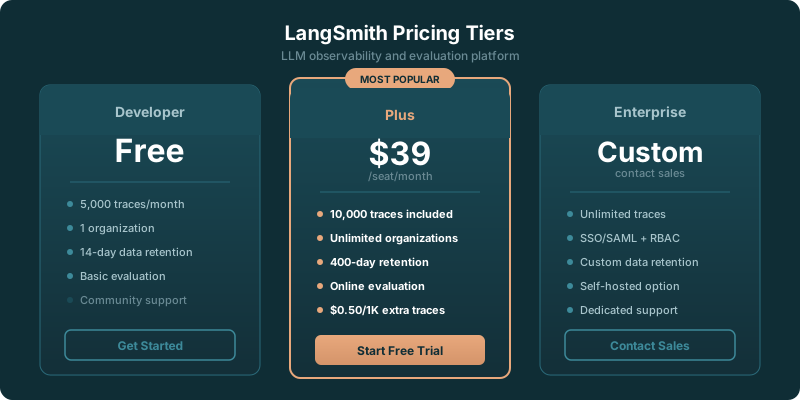
LangSmith Pricing Tiers
| Plan | Price | Traces Included | Extra Traces | Seats | Data Retention |
|---|---|---|---|---|---|
| Developer | Free | 5,000/month | Not available | 1 | 14 days |
| Plus | $39/seat/month | 100,000/month | $0.50 per 1,000 traces | Unlimited | 400 days |
| Enterprise | Custom | Custom | Custom | Unlimited | Custom + SSO, SLA |
The Developer details come from LangSmith's current pricing information: the tier is free, includes 5,000 traces per month, has 14-day data retention, and includes 1 user. Related analysis
LangSmith Plus costs $39 per user/month with 100,000 traces per month included. Related analysis
Plus includes 400-day data retention. Related analysis
The table looks simple because the pricing model is simple. The practical decision is less tidy. Your team has to decide what it wants to preserve, who needs to inspect it, and how much application activity will pass through the platform.
Trace volume gets most of the attention because it is easy to count. Retention can be the sharper constraint. An LLM app can behave differently after a model update, a prompt change, a new retrieval source, a tool failure, or a shift in user behavior. A short history makes those comparisons harder. You may know an issue appeared. You may not have the record needed to understand when the pattern started.
The longer retention on Plus changes the role LangSmith can play inside a team. It supports a more durable record of how the product behaved, rather than a temporary debugging feed. That is useful for teams that want to investigate regressions, compare evaluation results over time, or make prompt changes with more confidence.
The seat price is predictable. Trace usage is the part that follows your product. A quiet internal tool and a customer-facing assistant can use the same stack while creating very different billing pressure. That is why a good LangSmith budget begins with application behavior, not a generic software-budget template.
Developer Plan (Free): What You Get
The free Developer plan is designed for individual builders prototyping and testing LLM applications.
Included Features
- 5,000 traces per month. A trace is a single end-to-end execution of your LLM pipeline, which can include multiple LLM calls, tool uses, and retrieval steps. For a simple chatbot, one user message equals one trace.
- Full tracing and debugging. View every step of your LLM chain: inputs, outputs, latency, token usage, and errors.
- Prompt playground. Test and iterate on prompts directly in the LangSmith UI with side-by-side comparison.
- Basic evaluation. Run evaluations against datasets with built-in and custom evaluators.
- 14-day data retention. Traces older than 14 days are deleted.
Developer Plan Limitations
- Single seat (no team collaboration)
- 5,000 trace cap with no overage option (traces beyond 5K are dropped)
- 14-day retention makes historical debugging impossible
- No organization-level features (SSO, audit logs, RBAC)
Is the Free Plan Enough?
For prototyping and personal projects, yes. 5,000 traces handles roughly 150-200 traces per day. You'll outgrow it when you deploy to production (even moderate traffic exceeds 5K/month) or when you need team access.
Plus Plan ($39/seat/month): The Production Tier
Plus is where most teams land. It removes the Developer plan's constraints and adds production features.
What Changes from Developer
- 100,000 traces included per month, with overage at $0.50 per 1,000 additional traces. No hard cap.
- 400-day data retention. Over a year of trace history for debugging, compliance, and performance trending.
- Unlimited seats. Every team member can access traces, run evaluations, and collaborate on prompt development.
- Annotation queues. Structured workflows for human review of LLM outputs.
- Advanced monitoring. Dashboards, alerts, and performance metrics for production deployments.
- Online evaluations. Run evaluators on production traffic in real-time.
What Extra Traces Cost as You Scale
Additional traces on Plus cost $0.50 per 1,000. Related analysis
That rate makes trace volume the main variable once your application moves beyond the included Plus allowance. The useful planning exercise is to identify what creates a trace in your product, then watch how that behavior changes as usage grows.
A customer-facing chat interface may generate a trace for each message. A background workflow may create traces without a person sitting at a screen. An agentic process can generate traces as it selects tools, retries steps, or works through a longer task. The application architecture affects what shows up in your usage, and it can change as the product evolves.
This is why trace budgets should sit close to product metrics. If a feature drives more user interactions, it may also drive more observability usage. If your team adds evaluation runs, testing itself can create meaningful trace volume. That is not waste. It is part of the cost of seeing how the system behaves before customers find the failures for you.
The strongest reason to watch traces is not billing anxiety. It is operational clarity. A sudden change in trace activity can reveal a product behavior worth investigating: more users are engaging, a workflow is looping, a tool is failing and retrying, or a new feature has added complexity that did not appear in a happy-path demo.
The price of extra traces also creates an architectural incentive. You want traces that help answer a question. Capture enough context to debug and evaluate the run, but avoid treating observability as an indiscriminate data landfill. A useful trace has a job: explain output quality, locate failure, measure a workflow, or support a decision about what to change.
For teams with uncertain demand, this is a better approach than trying to predict every future application interaction from a spreadsheet. Start with the included allowance, measure actual usage patterns, and connect them to the product behavior creating them. You will learn more from that than from a theoretical estimate assembled before users touch the feature.
Enterprise Plan: Custom Pricing
Enterprise adds security, compliance, and deployment flexibility.
Enterprise-Only Features
- SSO / SAML authentication for enterprise identity management
- RBAC with custom roles and permissions
- Dedicated infrastructure options for data isolation
- SLA with uptime guarantees
- Audit logs for compliance
- Custom data retention policies
- Volume discounts on traces
- Priority support with dedicated account management
Enterprise pricing isn't published. Based on market positioning, expect $1,000-5,000/month minimum depending on team size and trace volume.
LangChain vs LangSmith: What You Actually Pay For
LangChain and LangSmith are closely related, which creates unnecessary confusion when someone asks about LangChain pricing.
LangChain is the framework. It gives developers components and patterns for building LLM applications: prompt handling, model integrations, retrieval workflows, agents, tools, and orchestration. You can use it to build an application without paying a LangSmith subscription.
LangSmith is where tracing, testing, evaluation, and monitoring enter the picture. It records the application’s behavior so a developer or team can inspect the path from input to output. The framework helps produce the application. The observability layer helps explain what the application did.
That separation is useful because an LLM application can work well in a local test and still create a mess in production. A user receives a wrong answer. The model may have followed weak instructions, retrieved the wrong source, selected an unsuitable tool, or received incomplete context. Final output alone rarely settles the argument.
A trace gives your team a record to inspect. You can see the sequence that produced the response and work backward from the failure. That becomes more valuable as the system gains moving parts.
If you are deciding whether to pay for LangSmith, avoid framing the choice as “LangChain costs money.” The framework is one part of the stack. LangSmith is an operational tool around that stack. Its price belongs next to other costs tied to running and improving the application: models, infrastructure, vector storage, monitoring, and the engineering time spent figuring out why an AI feature behaved strangely.
The same distinction applies if you use LangGraph or another LLM framework. LangSmith’s value depends on whether you need the visibility it provides, not on whether every component in your application came from LangChain.
Our LangChain pricing guide covers the broader product and ecosystem context. If you are comparing observability tools rather than deciding whether to add one, see LangSmith vs Weights and Biases.
LangSmith vs. Alternatives
LangSmith isn't the only LLM observability platform. Here's how it compares.
LangSmith vs. Weights & Biases (W&B)
| Feature | LangSmith | Weights & Biases |
|---|---|---|
| Free tier | 5,000 traces/month | Generous (100GB storage) |
| LLM-specific tracing | Purpose-built | Added via Weave platform |
| LangChain integration | Native (built by same team) | Third-party integration |
| ML experiment tracking | Not included | Industry standard |
| Evaluation framework | Built-in, LLM-focused | General-purpose |
| Best for | LLM-first teams using LangChain | Teams doing both ML and LLM work |
W&B is broader (ML + LLM) while LangSmith is deeper on the LLM side. For a detailed comparison, see our LangSmith vs W&B review.
LangSmith vs. Arize Phoenix
| Feature | LangSmith | Arize Phoenix |
|---|---|---|
| Pricing model | Per-seat + per-trace | Per-seat (cloud) or free (OSS) |
| Open source | No | Yes (Phoenix is open source) |
| Self-hosting | Enterprise only | Free self-hosted option |
| Trace visualization | Excellent | Excellent |
| Best for | Teams wanting managed service | Teams wanting open-source flexibility |
Arize Phoenix is the strongest open-source alternative. Self-host for free to eliminate trace volume costs entirely.
LangSmith vs. Braintrust
| Feature | LangSmith | Braintrust |
|---|---|---|
| Primary focus | Tracing + evaluation | Evaluation + prompt management |
| Free tier | 5,000 traces | 1,000 evaluations |
| AI proxy | No | Yes (route to any model) |
| Best for | Observability-first teams | Evaluation-first teams |
Braintrust emphasizes evaluation and prompt iteration over production monitoring. Its AI proxy feature is unique and useful for A/B testing models.
Do You Need LangSmith?
You Probably Need LangSmith (or an Alternative) If:
- You're running LLM chains with 3+ steps where debugging failures requires seeing intermediate outputs
- You're deploying to production and need to monitor quality, latency, and cost
- You're iterating on prompts and need structured evaluation against test datasets
- Your team has multiple people working on prompts and needs collaboration tools
You Probably Don't Need It If:
- You're making single-step API calls
- You're in early prototyping with no production deployment planned
- Your LLM usage is simple enough that print-statement debugging works
How to Decide Whether Plus Fits Your Team
Plus makes sense when the free tier’s boundaries begin affecting normal work rather than edge cases.
The most obvious trigger is trace volume. If your development, evaluation, or product usage needs more than the Developer plan provides, the included Plus allowance gives you more room to observe the application. That is a direct capacity decision.
The next trigger is retention. Teams investigating quality regressions often need historical context. A recent trace can show what happened today. A longer record can show whether a failure started after a prompt update, a model change, a retrieval adjustment, or a shift in the kind of requests users submit.
Collaboration is another practical trigger. AI features are rarely owned by one person for long. Product, engineering, data, and support teams may all need to understand why an application behaved a certain way. Shared observability reduces the amount of evidence trapped in one developer’s local environment or one person’s memory.
The cost of a paid plan should be compared with the time your team spends debugging without traces. LLM failures are often intermittent. A user report may arrive after the relevant context has changed. The person investigating may not know which prompt version ran, which documents were retrieved, or whether a tool returned an error. That investigation gets expensive fast because it consumes senior engineering time and still may end in a shrug.
LangSmith helps when your team has reached the point where guesses cost more than visibility. It will not fix weak prompts or poor retrieval on its own. It gives you a way to inspect those problems with evidence.
You can read our LangChain review for a broader view of the ecosystem and where its tools fit into an LLM application stack.
The Budgeting Question Behind LangSmith Pricing
The best LangSmith plan is the one that fits the maturity of your application.
An early prototype needs fast feedback. The free Developer tier gives an individual builder a place to inspect traces and learn what the system is doing. That is enough when the goal is proving an idea, testing a workflow, or getting a first version into shape.
A team operating a live feature needs a more durable process. It needs to preserve traces long enough to investigate problems, compare behavior after changes, and share evidence across the people responsible for quality. Plus shifts LangSmith from a personal development aid into team infrastructure.
The overage rate keeps the pricing model tied to actual scale. Your bill grows when your application creates more activity beyond the included traces. That can reflect growth, heavier testing, more complex workflows, or a product issue that deserves attention.
Budget for LangSmith as part of the cost of running an LLM product, then measure it against the engineering time and product risk it removes. A model output can look perfectly normal until you inspect the path that created it. That path is where most of the useful work begins.
Getting Started
Sign up for the free Developer plan at smith.langchain.com. No credit card required. If you're using LangChain or LlamaIndex, adding tracing takes two lines of code (set environment variables). Framework-agnostic tracing is also supported via the LangSmith SDK.
Start with the free tier. If you hit 5,000 traces before the month is up, that's your signal to evaluate Plus.
Sources
- PE Collective LangChain pricing, 5,000 traces per month
- PE Collective LangChain pricing, $39 per user/month
- PE Collective LangChain pricing, $0.50 per 1,000