 PE Collective
Best RAG Tools for Production Teams
Compare RAG tools by pipeline stage, document preparation, retrieval, orchestration, and evaluation before committing to a production stack.
Last updated: 2026-04-06
RAG tools retrieve relevant documents, put them into a prompt, and generate an answer with citations. A production pipeline needs document parsing, vector search, orchestration, and evaluation. No single tool does all of it well.
The useful question is not which framework has the longest feature list. It is where your pipeline breaks.
A weak parser can flatten a financial table into nonsense. A database can return passages that look relevant but miss the answer. A model can receive good evidence and still ignore it. Teams that treat all of those problems as “a RAG problem” end up buying a small pile of software and learning nothing from their failures.
Choose the category first. Then choose the tool.
TLDR
Choose RAG tools around the stage causing the failure: document preparation, retrieval, orchestration, generation, or evaluation. Start with a stack you can inspect when answers go wrong. Add a framework, database, or evaluation layer only when it fixes a known weakness.
Key Takeaways
- RAG tools work best when each component owns a clear pipeline job.
- Document preparation determines whether useful evidence can be retrieved later.
- A framework coordinates the workflow. A vector database finds candidate evidence.
- Evaluation belongs in the first production version, before the system reaches more users.
- Listed prices can help narrow options, but operating fit should decide the stack.
What RAG Tools Do
A retrieval-augmented generation system answers questions using a set of documents rather than relying only on what a language model learned during training.
That definition sounds tidy. The actual pipeline has more moving parts.
Documents arrive as files, webpages, records, transcripts, tables, or support content. They need to be parsed into usable text, split into chunks that preserve meaning, enriched with metadata, and indexed. When a user asks a question, the system retrieves candidate passages, decides which ones belong in the prompt, asks a model to answer, and checks whether that answer is supported by the evidence.
A production system needs visibility across that chain. If the answer is wrong, you need to know whether the relevant document was absent, parsed poorly, retrieved too low in the results, omitted from the prompt, or ignored by the model.
The RAG market was already active in 2023, but teams selecting a stack in 2026 have a more practical choice: build around the pipeline stage that needs help.
Pipeline-Stage Selection Guide
Treat tool selection as a sequence of decisions. Each stage narrows the set of tools worth considering.
Prepare the source material
Start with the documents you expect users to ask about. A clean knowledge base with stable headings and useful metadata can support a simple retrieval setup. A collection full of scanned files, slide decks, tables, and duplicate policy documents needs more attention before retrieval becomes trustworthy.
Parsing is where a surprising amount of RAG quality disappears. If a table loses its row labels, the system may retrieve the right page and still produce an answer with the wrong meaning. If headers vanish, chunks lose the context that tells the model whether a paragraph describes an exception or the general rule.
Choose document-processing tools when source quality is the bottleneck. Look for parsers that preserve layout where layout carries meaning, keep page references, expose extraction failures, and let you inspect the chunks before indexing.
Retrieve evidence
Retrieval starts after the data is usable. The system needs a search layer that can find documents related to a question, filter them by metadata, and return enough context for the model to answer without flooding the prompt.
A vector database belongs here. It stores representations of your content and retrieves semantically related passages. It does not parse files, decide your chunking strategy, write prompt logic, or tell you whether an answer is grounded.
Your retrieval layer should answer a narrow operational question: can it find the evidence a human reviewer would use? If the answer is no, changing frameworks rarely fixes the underlying corpus or ranking problem.
Teams comparing retrieval stores should also read our vector database guide alongside the 2026 market comparison, because database choice only makes sense after you know what content and filters your application requires.
Coordinate the application
Frameworks manage the application logic around retrieval. They connect loaders, chunking, indexes, retrievers, models, prompts, tools, and response formats. They are useful when the workflow has enough branches that custom glue code becomes harder to understand than a framework.
LlamaIndex is a familiar option for teams building document-focused applications. LangChain is common where applications combine retrieval with broader agent or tool workflows. Haystack has a more explicit pipeline orientation. The right choice depends on whether you need a document-query layer, a general orchestration layer, or a pipeline you can inspect stage by stage.
Framework adoption should lower operational confusion. If your team cannot trace a bad answer from prompt back to retrieved chunks, the abstraction is not helping.
For a closer look at the document-centric path, use the LlamaIndex guide with the 2026 comparison. The framework should fit your application boundaries, not become the application boundary.
Generate an answer with evidence
The model has one job in a RAG system: use the retrieved context to answer the question. Model selection still matters, but it comes after the evidence path works.
An expensive model can produce polished nonsense from a weak retrieval set. A smaller model can produce a useful answer when the prompt contains clean, relevant evidence and the application tells it what to do when evidence is missing.
Set a clear response policy. The model should cite the source material when your product needs citations. It should say it cannot answer when the retrieval set lacks support. It should avoid filling gaps with a plausible guess.
That policy needs testing against the documents your users care about, including ambiguous questions and questions whose answer should be unavailable.
Evaluate the result
Evaluation closes the loop. It tells you whether the system retrieved relevant material, whether the answer was supported by that material, and whether the final response was useful.
Without evaluation, teams tend to make changes based on a few memorable demos. That is how a prompt tweak gets credit for a retrieval improvement, or a new model gets blamed for a parser failure.
Keep a review set drawn from real questions. Include questions with clear answers, questions with multiple valid source documents, questions that require a precise exception, and questions that should produce an abstention. Inspect the retrieved passages as carefully as the final answer.
The best RAG framework is the one that makes these failures visible enough to fix.
RAG Tools Comparison by Team Maturity
Different teams need different levels of control. A small prototype can tolerate a tighter stack. A product that answers customer questions needs clearer ownership across data, retrieval, and evaluation.
| Team situation | Primary need | Best starting category | Main risk |
|---|---|---|---|
| Individual prototyper | Fast document querying | Document framework with a managed index | Mistaking a clean demo for reliable retrieval |
| Product team | Stable answers from changing content | Framework, retrieval store, and evaluation layer | Hiding source quality problems behind prompts |
| Platform team | Shared infrastructure across applications | Dedicated parsing, database, observability, and evaluation components | Building an internal platform before demand exists |
| Regulated or high-stakes team | Evidence tracing and controlled behavior | Inspectable pipeline with review workflows | Treating citations as proof that the answer is correct |
The table is not a buying checklist. It is a warning against copying another company’s architecture.
A large platform team may need separate services because several applications share the same data estate. A focused internal assistant may need a simple index, explicit source citations, and a disciplined evaluation set. Both can be production systems. One has more moving parts.
Data Preparation and Evaluation Coverage
Data preparation and evaluation are usually where a RAG project becomes useful or quietly stalls.
Preparation begins with access. Can the pipeline read the source material? Can it retain titles, sections, dates, permissions, product names, and page references? Can it identify a table as a table instead of a block of disconnected words?
Then comes chunking. Chunks should preserve enough surrounding context for retrieval and answer generation. A paragraph about a cancellation rule means something different when separated from the section that defines the customer type or contract condition it applies to.
Metadata carries more weight than teams expect. Filters can keep a support assistant from retrieving documentation for the wrong product version. Dates can help it prefer current policies. Access controls can stop a system from retrieving material the user should not see.
Evaluation should cover the whole path.
Review whether the relevant source appears in the index. Review whether retrieval ranks it high enough to enter the prompt. Review whether the model uses it accurately. Review whether the final answer cites the right source and declines to answer when evidence is missing.
This work is less glamorous than trying a new model. It is also where most dependable RAG applications get their edge.
A system that handles messy source material and exposes retrieval failures will beat a prettier demo built on documents nobody has challenged.
Framework and Database Paths
Frameworks and databases solve adjacent problems. They should not be evaluated as substitutes.
A framework manages the flow of the application. It can call a loader, create chunks, send data to an index, retrieve records, build prompts, invoke a model, and format a response. It gives developers a shared way to describe that workflow.
A vector database manages retrieval. It indexes representations of content, finds similar passages, applies filters, and returns candidates. It gives the application a place to search for evidence.
You can build a RAG application with a framework and a managed retrieval service. You can build one with direct database calls and custom application code. You can also use a framework while keeping the retrieval interface simple enough to change later.
The important design choice is ownership. Decide where parsing lives, where index updates happen, where permissions are enforced, where prompts are assembled, and where answer quality is measured.
A framework that owns every layer may speed up a prototype. It can also make a later migration painful if its abstractions become the only path to your data. A database selected only because it is popular can create the same problem from the other direction.
Keep interfaces plain. Preserve your source metadata. Make retrieved passages inspectable. Store evaluation examples somewhere your team can revisit after the launch excitement wears off.
That is the difference between a stack and a pile.
Price References With Listed Figures
Price matters when the technical fit is close. It should not decide the architecture before you understand the workload.
The current comparison lists an option at $0.33 per hour. That kind of usage-based figure can be useful for experiments, where a team wants to test parsing, retrieval quality, and model behavior without committing to a larger operating footprint.
Another listed option is $35 per month. Monthly pricing is easier to compare when the application has a stable user base and predictable requirements, but it still leaves the central questions untouched: what data enters the system, what gets retrieved, and how will you judge answer quality?
Use listed figures to narrow the field after you have selected the right category. A low entry price does not repair weak ingestion. A higher bill does not prove a framework is easier to operate.
The useful comparison is cost against the failure it removes. If a parsing layer preserves documents your current stack mangles, the price conversation is concrete. If a new tool only adds another dashboard, it is harder to justify.
Choosing a RAG Stack Without Regret
Build the narrowest pipeline that can answer a real set of questions from real documents.
Start by collecting representative source material and the questions people already ask. Parse the material. Inspect the output. Index it. Run retrieval tests. Add response rules that force the model to stay inside the evidence. Evaluate the result before expanding the workflow.
Each failure should point to a component category.
Missing source material points to ingestion or access. Broken tables point to parsing. Relevant material ranked too low points to chunking, metadata, embeddings, or retrieval. Well-retrieved evidence ignored by the model points to prompt construction or model behavior. Plausible answers without support point to response policy and evaluation.
That diagnostic habit keeps your stack honest.
The market has plenty of RAG tools in 2026. The teams that win will not be the ones with the most components. They will be the ones that can explain why every component is there.
Sources
Our Top Picks
Detailed Reviews
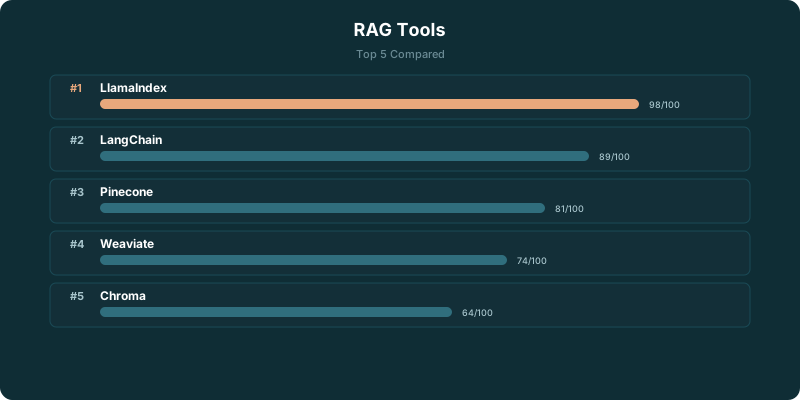
LlamaIndex
Best FrameworkLlamaIndex is the best orchestration framework for RAG, period. It handles document loading, chunking, indexing, retrieval, and response synthesis in a cohesive pipeline. The 160+ data connectors mean you can ingest from almost any source without writing custom parsers. Multiple index types (vector, keyword, tree, knowledge graph) let you pick the retrieval strategy that matches your data. LlamaCloud adds managed parsing for complex documents like PDFs with tables and charts.
Pinecone
Best Managed Vector DBPinecone is the easiest way to add vector search to your RAG pipeline. The serverless architecture means you don't configure instances, manage shards, or think about scaling. It just works. Queries return in single-digit milliseconds even at millions of vectors. The free tier gives you 100K vectors, which is enough to build a real prototype. Namespace support lets you isolate different document collections cleanly.
Weaviate
Best Open Source DBWeaviate is the strongest open-source vector database for RAG applications. Hybrid search combines vector similarity with BM25 keyword matching, which consistently improves retrieval quality for real-world documents where exact terminology matters. Built-in vectorization modules mean you can send raw text and Weaviate handles embedding generation. Multi-tenancy support makes it practical for SaaS applications where each customer needs isolated data.
Unstructured
Best for Data PrepUnstructured solves the unglamorous but critical first stage of any RAG pipeline: turning messy documents into clean, chunked text. It handles PDFs, Word docs, PowerPoints, HTML, emails, and images with OCR. The layout-aware parsing preserves document structure like tables, headers, and lists, that naive text extraction destroys. Without good parsing, your retrieval will return garbage no matter how fancy your vector database is.
Ragas
Best for RAG EvaluationRagas is the standard evaluation framework for RAG applications. It provides metrics that actually matter: faithfulness (does the answer stick to the retrieved context?), answer relevancy (does it address the question?), and context precision (did retrieval surface the right documents?). These metrics let you measure each stage of your pipeline independently, so you know whether poor answers come from bad retrieval or bad generation.
Evaluation Criteria
Compare each tool in the role it will perform: ingestion, retrieval, generation, evaluation, or observability. Use representative documents and questions to measure parsing quality, retrieval recall, factual support, latency, operating cost, integration effort, and the time required to diagnose a failed answer.
Frequently Asked Questions
Do I need all five of these tools to build a RAG application?
No. At minimum you need a framework (LlamaIndex), a vector store (Pinecone or Weaviate), and an LLM. Unstructured is only necessary if you're processing complex documents like PDFs with tables. Ragas is optional but strongly recommended once you're past the prototype stage. Start simple and add tools as you hit specific pain points.
What's the most common mistake teams make with RAG?
Focusing on the LLM and ignoring retrieval quality. Your RAG application is only as good as the documents it retrieves. Teams spend weeks tuning prompts when the real problem is that chunking destroyed table structure, or the embedding model doesn't capture domain-specific terminology. Fix retrieval first. Then optimize generation.
How much does a production RAG pipeline cost to run?
For a typical application serving 10K queries per day over 100K documents: vector database hosting runs $50-200/mo (Pinecone serverless or Weaviate Cloud), embedding generation costs $5-20/mo (OpenAI or Cohere), and LLM generation costs $100-500/mo depending on the model. Total is roughly $200-700/mo. Self-hosting the vector database can cut costs significantly if you have the ops capacity.
Should I use a managed RAG platform instead of building with individual tools?
Managed platforms like LlamaCloud, Vectara, or Azure AI Search are worth considering if your team is small and you want to ship fast. You trade flexibility for speed. For most teams with engineering capacity, assembling your own pipeline from the tools on this list gives you more control over retrieval quality, cost optimization, and data handling. The build-vs-buy breakpoint is usually around 3 dedicated engineers.