 PE Collective
Claude vs Gemini: API Pricing and Model Verdict
A comparison built for developers, researchers, and AI practitioners
Last updated: September 2, 2026
Quick Verdict
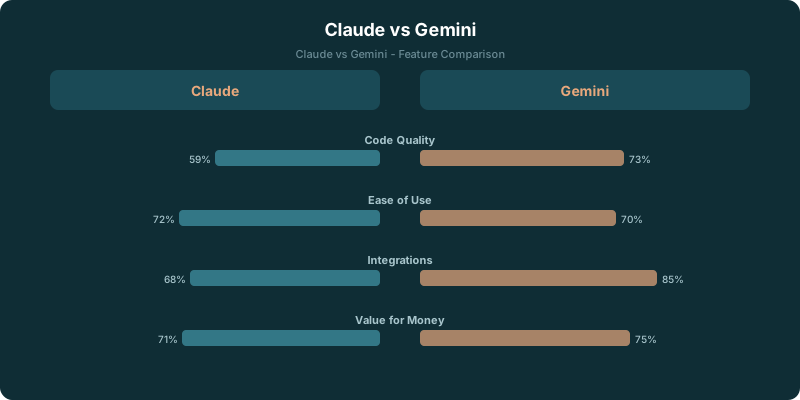
Choose Claude if: You want the stronger default for code generation, technical writing, and precise instruction following. Claude Sonnet 4.6's 1M token context, extended thinking mode, and the Claude Code terminal agent make it the top choice for serious development work.
Choose Gemini if: You want deep Google ecosystem integration, strong multimodal capabilities, and a generous free tier. Built-in Google Search grounding and Workspace integration make it powerful for research and productivity workflows.
Claude vs Gemini comes down to the work you need the model to do and the bill you're willing to run. Claude Sonnet 4.6 costs $3 / $15 per 1M input / output tokens, while Gemini 2.5 Pro costs $1.25 input and $10.00 output per 1M tokens. Related analysis Related analysis
Claude leads for code generation and instruction following. Gemini wins when Google Workspace, Google Search grounding, multimodal input, or a free tier sits at the center of the workflow.
The price gap is large enough to shape architecture, especially when output volume rises. But a cheaper token does not help much if your team spends its afternoon cleaning up code, repairing tool calls, or re-prompting a model that missed the assignment.
TLDR
Claude is the stronger pick for code generation, detailed instructions, and technical writing. Gemini costs less at the API level and fits naturally inside Google workflows. Claude Sonnet 4.6 now has a 1M context window, so Gemini no longer owns the long-context advantage.
The Verdict: Is Claude Better Than Gemini?
Claude is better than Gemini when the output must be precise, especially for code, agent tasks, technical writing, and long instructions with lots of constraints. It tends to reward careful prompting with work that needs less repair.
Gemini is the better buy when your application runs through Google's ecosystem or when price is the governing constraint. Its multimodal capabilities make it a natural fit for workflows that mix documents, images, video, search-grounded research, and Workspace data.
That leaves a less dramatic answer than most model comparisons want to offer. Claude or Gemini is usually an operating decision, not a permanent allegiance. The model that saves money on an extraction task may create more work on a coding task. The model that writes a clean implementation plan may be excessive for high-volume classification.
If I were building a developer tool that asks the model to modify repositories, interpret a messy specification, or keep track of a long chain of instructions, I'd start with Claude. If I were building a product around Google Drive, Gmail, Search, and broad multimodal input, Gemini would have the home-field advantage.
Claude's case gets stronger when the model has to make judgment calls. Coding agents are more than generating snippets. They have to read an unfamiliar codebase, notice what the request implies, make a change without breaking adjacent behavior, and explain what happened. That is where instruction following stops being a benchmark phrase and becomes the product.
Gemini's case gets stronger when the model is part of a broader Google workflow. Research, document handling, search grounding, and collaboration already live there for many teams. Pulling a separate provider into that stack can add friction without adding enough quality to justify it.
The best question is not "which model is smarter?" That framing collapses too many different jobs into one score. Ask which failures hurt your product most. Bad code hurts differently from a slow document classifier. A missed instruction hurts differently from a costly batch pipeline.
Feature Comparison
| Feature | Claude | Gemini |
|---|---|---|
| Code Generation | ✓ Best in class (SWE-bench leader) | Strong (improving fast) |
| Context Window | 1M tokens (Sonnet 4.6), 200K (Haiku 4.5) | 1M+ tokens (Gemini 2.5 Pro) |
| Multimodal Input | Images, PDFs, documents | Images, video, audio, PDFs |
| Reasoning | Extended thinking mode | Gemini 2.5 Pro (native reasoning) |
| Web Search / Grounding | Limited web access | ✓ Google Search grounding (deep) |
| Instruction Following | Very precise | Good, sometimes wordy |
| API Pricing (Fast Model) | Sonnet 4.6: $3/1M input | Flash 2.5: $0.15/1M input |
| Developer Tools | Claude Code (terminal agent) | AI Studio, Vertex AI, Colab |
Claude vs Gemini API Pricing
For a general-purpose model comparison, Gemini 2.5 Pro is cheaper than Claude Sonnet 4.6 on both input and output. Gemini 2.5 Flash is cheaper still for work where speed and volume matter more than maximum reasoning depth.
Claude offers a broader set of price points across its family. Claude Haiku 4.5 costs $1 / $5 per 1M input / output tokens, and Claude Opus 4.6 costs $5 / $25 per 1M input / output tokens. Related analysis
| Model | Input price per 1M tokens | Output price per 1M tokens | Context window |
|---|---|---|---|
| Claude Haiku 4.5 | $1 | $5 | 200K |
| Claude Sonnet 4.6 | $3 | $15 | 1M |
| Claude Opus 4.6 | $5 | $25 | n/a |
| Gemini 2.5 Flash | $0.15 | $0.60 | n/a |
| Gemini 2.5 Pro | $1.25 | $10.00 | n/a |
API pricing has a habit of looking decisive until you put it next to task quality. A model that costs less per token can still cost more per completed task if it produces weaker code, needs heavier prompting, or creates a review queue nobody planned for.
Output pricing deserves more attention than it gets. Many agent and coding workflows produce much more output than a standard chat interaction. The model is writing code, explaining decisions, calling tools, revising files, and documenting its own work. That output bill can become the larger line item fast.
Gemini 2.5 Pro is the cleaner choice for teams that need capable general reasoning at a lower listed token price. Claude Sonnet 4.6 asks for more budget, but it earns that position when better instruction following reduces retries or manual review.
Haiku and Flash create a different comparison. Both are built for high-volume work, where the unit economics can dominate. Gemini 2.5 Flash costs $0.15 input and $0.60 output per 1M tokens. Related analysis
Claude Haiku 4.5 costs $1 / $5 per 1M input / output tokens. Related analysis
That gap makes Flash hard to ignore for straightforward extraction, classification, routing, and other work where a failure is cheap to detect. If your pipeline processes large volumes of clean, repetitive inputs, the economics favor Gemini.
Claude's higher-end tier also makes its tradeoff obvious. Claude Opus 4.6 costs $5 / $25 per 1M input / output tokens. Related analysis
Opus belongs in the small set of tasks where output quality has more value than token efficiency. High-stakes technical analysis, complex code work, and difficult synthesis can justify it. Sending every ordinary task there would be a quick way to turn a sensible AI budget into a literal money pit.
Use the Anthropic API pricing page when you need the current Claude model rates in one place. For provider-level cost planning, the cross-provider LLM pricing comparison gives you the wider market view.
Context Windows Compared
The old Claude versus Gemini context-window story has changed. Claude Sonnet 4.6 has a 1M context window while Haiku 4.5 has a 200K context window. Related analysis
That matters because context is often an architecture constraint before it is a model preference. A long context window can let an agent inspect a large body of source material in one pass. It can also tempt teams to throw every available document into a prompt and hope the model sorts it out.
More context does not remove the need for retrieval, filtering, or good task design. A giant prompt full of irrelevant material can make model behavior worse, more expensive, and harder to debug. The practical advantage is flexibility: you can pass larger documents, more repository context, or a deeper work history when the task calls for it.
Claude Sonnet 4.6 now matches the 1M-context requirement that once pushed many teams toward Gemini. That removes a major reason to treat Gemini as the default for long-document work.
Haiku's 200K window still fits many production jobs. Most classification, extraction, routing, and short-form generation tasks do not need a massive working set. Paying for more context than the workload uses is another quiet way to waste money.
For large codebases, the real question is whether your system can select the right files. A model cannot infer intent from context it never received, but dumping an entire repository into the prompt is rarely an elegant answer either. Good retrieval narrows the task. A strong model handles the ambiguity that remains.
This is where Claude's coding reputation matters. Developers often need a model to read context and then obey narrow constraints: edit this file, preserve that interface, avoid this dependency, explain the test impact. The quality difference shows up in those details.
Gemini remains compelling for multimodal work. If the task begins with screenshots, scanned documents, video, Google Drive files, and live research, the surrounding Google ecosystem may carry more weight than a context-window comparison.
Code Generation and Instruction Following
Claude produces better code than Gemini for many developer workflows, especially when the request has layered constraints or the model must work across an existing project. That edge is primarily about handling the irritating parts of software work.
The irritating parts are the job. Existing conventions. Half-documented dependencies. Tests that reveal an unstated contract. A request from a teammate that sounds small until you notice the change touches authentication, billing, and a database migration.
Claude is often the better default when the model is expected to act like a careful engineering assistant. It tends to be strong at explaining its reasoning in a way developers can inspect, then producing changes that stay close to the request.
Claude Code also gives Anthropic a useful developer-facing surface. A terminal-based agent changes the relationship from "write code in a chat window" to "work inside the environment where the code already lives." That is a more serious use case, and it raises the standard for instruction following.
Gemini can still be the right model for code. Teams already committed to Google Cloud may prefer a provider they can use alongside their existing identity, data, and deployment stack. The lower token price also changes the equation for code tasks where the application can verify results automatically.
Think about how the output will be checked. If tests, compilers, schemas, or deterministic evaluators catch failures cheaply, lower-cost models become more attractive. If a human engineer has to untangle every confident mistake, paying more for better first-pass work can be the cheaper move.
Technical writing follows a similar pattern. Claude is a strong choice when the draft must reflect a detailed brief, maintain structure, and avoid wandering into generic filler. Gemini is useful when the writing workflow depends heavily on Google Docs, Drive, or Search-grounded material.
Neither model fixes a vague request. A bad specification can make an expensive model produce polished nonsense. The model choice matters after the team has decided what good output looks like.
Google Integration, Multimodal Input, and Research
Gemini wins the ecosystem comparison because Google owns the tools many knowledge workers already use. Workspace files, search, collaboration, and cloud infrastructure create a practical advantage that no benchmark chart captures.
That advantage shows up in mundane work. A team needs to review a set of documents, compare notes from Gmail, pull current web context, and turn the result into a proposal. Moving data between systems is often the least interesting part of the project, but it can be where the project stalls.
Gemini also has the stronger positioning for multimodal inputs. Applications that need to handle mixed media will care about how naturally the model fits those inputs into the rest of the workflow. For research and productivity products, the Google connection may be the deciding factor.
Claude can handle complex written reasoning and long documents well, but it does not have the same native Google ecosystem story. That is not a flaw in every architecture. It is a meaningful cost when your users already live inside Workspace.
The Anthropic vs Google AI comparison is useful when the provider decision reaches beyond a single model API. Model quality matters, but access, procurement, governance, deployment, and data location can decide the deal before anyone runs an evaluation.
Cutting Costs on Either API
The cheapest model is not always the cheapest system. Start by separating tasks by the cost of failure.
Use a lower-cost model for work that is repetitive and easy to validate. Use a stronger model where output errors create human cleanup, customer risk, or broken code. That sounds obvious, but many teams still route every task through one provider because the initial integration was easy.
Claude's Batch API cuts all token prices by 50%. Related analysis
That discount changes the Claude versus Gemini API comparison for work that does not need an immediate response. Bulk summarization, offline enrichment, backlog processing, and large evaluation runs are all candidates. A higher listed model price can look different once the workload moves into batch processing.
The operational question is whether your workload tolerates delayed completion. If it does, batch processing can turn a model-selection debate into a scheduling decision. That is often a better problem to have.
You can also reduce spend by making prompts smaller and retrieval more selective. Long context is useful when the context earns its place. It is expensive clutter when it does not. Keep system prompts disciplined, cache stable instructions where your stack supports it, and send the model only the material required for the current task.
Route work by difficulty. A fast model can handle extraction and classification. A stronger model can take the complex reasoning, code changes, and ambiguous requests. The routing logic will matter more to your costs than a single headline token rate.
Claude's batch discount is covered in the Claude pricing guide. It is worth evaluating before you conclude that Gemini's listed API rates settle the decision.
Use Case Recommendations
🟠 Use Claude For:
- → Production code generation and review
- → Technical writing with precise formatting requirements
- → Complex instruction-following tasks
- → Terminal-based autonomous coding (Claude Code)
- → System prompt engineering and testing
- → Applications where output quality matters most
🔵 Use Gemini For:
- → Research with real-time web grounding
- → Processing very long documents (1M+ tokens)
- → Video and audio analysis
- → Google Workspace integration
- → High-volume API usage on a budget
- → Multimodal applications (text + image + video)
Pricing Breakdown
| Tier | Claude | Gemini |
|---|---|---|
| Free / Trial | Free tier available | Free tier (Gemini Flash) |
| Individual | Pro: $20/month | Advanced: $20/month |
| Business | Team: $25/user/month | Included in Workspace |
| Enterprise | Custom pricing | Custom via Google Cloud |
Choose Claude If
Choose Claude if you want the stronger default for code generation, technical writing, and instruction-heavy tasks. It fits teams that care about producing work engineers and subject-matter experts can review without immediately starting over.
Choose it when long context is part of the job. Claude Sonnet 4.6 has a 1M context window, which gives it room for large documents, broad repository context, and complex work histories. Related analysis
Choose it when errors are expensive. A higher token rate can be easier to defend when the alternative is a pile of unreliable output handed to a person who already has a full-time job.
Claude is also a good fit for teams that want a clear model ladder. Haiku can serve high-volume work, Sonnet can cover the daily default, and Opus can handle the difficult tasks that justify a premium.
Choose Gemini If
Choose Gemini if Google integration is central to the product or the team. Workspace, Search, cloud infrastructure, and multimodal workflows create a practical advantage that is difficult to recreate with a provider-agnostic layer.
Choose it when token pricing drives the architecture. Gemini 2.5 Pro costs $1.25 input and $10.00 output per 1M tokens, while Gemini 2.5 Flash costs $0.15 input and $0.60 output per 1M tokens. Related analysis
Choose Gemini when you need broad multimodal input and the workflow already begins inside Google's products. The integration path can be cleaner, the data movement can be simpler, and the model can sit closer to the systems your users already trust.
Gemini's free tier also gives individual users and early teams a low-friction way to test workflows before committing to a larger API budget.
The Practical Choice
Claude wins for developers who need careful code generation, strong instruction following, and a large context window. Gemini wins for teams that need Google integration, multimodal work, and lower listed API prices.
Run both against your own tasks before standardizing. Use the same inputs, define what a good result looks like, and include the cost of human review in the comparison. A model leaderboard cannot tell you how much rework your specific workflow creates.
The bigger decision is how much of your product should depend on one provider. Claude and Gemini are both capable enough that a routing layer may beat a winner-take-all choice. Own the evaluation. Own the prompts. Own the customer experience. Then the provider can change without turning into a rewrite.
Key Takeaways
- Claude is the stronger default for code generation, technical writing, and detailed instruction following.
- Gemini fits Google-centric products, multimodal workflows, and lower-cost high-volume API tasks.
- Claude Sonnet 4.6 has a 1M context window, removing the old long-context gap.
- Gemini 2.5 Pro has lower listed API prices than Claude Sonnet 4.6.
- Claude's Batch API cuts all token prices by 50% for work that can run asynchronously.
Switching Between Claude and Gemini
What Transfers Directly
- General prompt patterns and strategies
- Business logic and application architecture
- API integration patterns (both use REST APIs)
- RAG pipeline components and vector database connections
What Needs Reconfiguration
- SDK client code (anthropic vs google-generativeai packages)
- Prompt tuning (each model responds differently to the same prompt)
- Token counting and cost estimation (different tokenizers)
- Multimodal input handling (different formats for images/documents)
Estimated Migration Time
1-2 days for API client swaps. Another 1-2 days for prompt optimization since each model has different strengths and preferences. Use LiteLLM or Vercel AI SDK to abstract provider differences if you want to support both.