 PE Collective
Anthropic vs Gemini for API Workloads
Two AI giants with very different philosophies
Last updated: May 2026
Quick Verdict
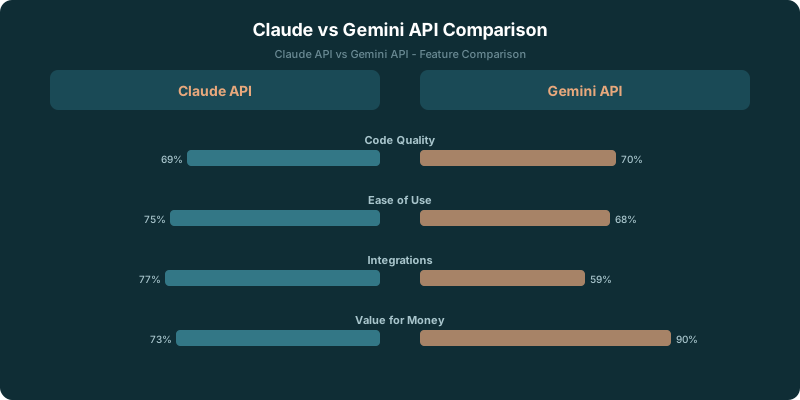
Choose Anthropic (Claude API) if: You value careful reasoning, excellent coding output, and strong safety guardrails. Claude excels at long-form writing, specific analysis, and complex code generation. Anthropic's API is clean and developer-friendly. The Messages API is straightforward and well-documented.
Choose Google AI (Gemini API) if: You need the largest context window available, native Google ecosystem integration, and aggressive pricing on high-volume workloads. Gemini's 1M token context, native multimodal processing, and Vertex AI integration make it ideal for Google Cloud shops and long-document use cases.
Anthropic vs Gemini comes down to the workload you need to run. Start with context: Claude is listed with a 200K-token context window, while Gemini is listed with a 1M-token context window. That gap should shape the first decision, before anyone gets dragged into vague arguments about which model is “better.”
A model call that needs to inspect a large archive, long video transcript, product catalog, or sprawling codebase has different constraints from a focused generation task. Gemini gives you more room to put the source material in one request. Claude offers a smaller window, which can still be plenty when your application retrieves and sends only the relevant material.
Price changes the picture too. Claude Haiku 4.5 is listed at $1 per 1M input tokens. Gemini Flash is listed at $0.075 per 1M input tokens. If your application sends a lot of input on every request, that difference compounds quickly.
The sensible choice is rarely ideological. Match the provider to the task, your cloud environment, and the cost of the context you plan to send.
TLDR
Gemini fits document-heavy and high-volume API workloads because its listed context window is larger and its listed input price is lower. Claude fits focused workloads where a Messages API and tighter context discipline suit the application. Route requests by workload instead of picking one provider for everything.
Anthropic vs Gemini API at a Glance
| Decision area | Anthropic | Gemini | Choose based on |
|---|---|---|---|
| Context capacity | 200K-token listed context window | 1M-token listed context window | How much source material belongs in one request |
| Fast-model input price | Claude Haiku 4.5 is listed at $1 per 1M input tokens | Gemini Flash is listed at $0.075 per 1M input tokens | Input volume and repeated prompt size |
| API approach | Messages API | Google AI and Google Cloud integration | Existing application architecture |
| Document work | Smaller, curated context | Larger source sets in one call | Retrieval quality and document size |
| Provider strategy | Direct Anthropic integration | Google-centered deployment | Operational ownership |
Claude’s listed context ceiling works well when your application already has good retrieval. A support assistant that pulls the relevant policy, account history, and product documentation does not need to send every file the company owns. The hard part is selecting the right evidence, not dumping an archive into the prompt.
Gemini’s larger window changes what is practical for document-heavy work. Gemini's context window is described as 5 times Claude's listed 200K window. Related analysis That gives an application more room to inspect a large set of source material before it has to summarize, chunk, or discard anything.
Neither approach removes the need for judgment. A large context window can make a lazy retrieval system look acceptable for a while. It can also make a bad prompt much more expensive. If you send irrelevant material, the model still has to work around it.
For teams already evaluating provider options, Anthropic API is worth comparing against Gemini when the 200K-token listed context window is enough for the source material your application sends. The goal is to identify the narrowest context that still gives the model what it needs.
Context Window and Document Workloads
Context size is the cleanest dividing line in this comparison.
In 2026, Claude is listed with a 200K-token context window. Related analysis That is a substantial working space for a focused coding task, a research packet, a customer conversation, or retrieved material from a knowledge base. It asks you to be deliberate about what enters the prompt.
In 2026, Gemini is listed with a 1M-token context window. Related analysis That is better suited to workloads where selecting a narrow subset before inference would be costly, fragile, or slow.
Think about an internal analyst tool reading a large collection of contracts. With Gemini, the application can often place more of the relevant corpus into the same request. With Claude, the application may need a retrieval layer that finds the clauses, sections, and counterparties most relevant to the question before making the model call.
That does not make Claude the wrong choice for document work. It makes retrieval more important. A well-built system can search, rank, and package the best evidence inside a 200K-token window. The result may be cheaper to inspect, easier to test, and less likely to bury a useful fact under irrelevant material.
Gemini is the better fit when the source itself is the product. Long meeting archives, extensive files, multimodal records, and large code repositories can punish aggressive chunking. If a user expects the system to consider a broad body of material in one pass, the listed 1M-token context window gives you more design room.
There is a catch. More context does not guarantee better answers. The application still needs clear instructions, useful metadata, and a way to verify important output. A giant prompt with no organization is still a giant prompt.
Use Claude when your product benefits from selective retrieval and focused requests. Use Gemini when preserving a larger body of source material in one request is the simpler and more reliable engineering choice. Can your retrieval system identify the right material consistently, or are you forcing it to make cuts it cannot safely make?
Model Pricing and Volume Tradeoffs
Input pricing matters most when prompts are large, repeated, or both.
Claude Haiku 4.5 is listed at $1 per 1M input tokens. Related analysis Gemini Flash is listed at $0.075 per 1M input tokens. Related analysis That makes Gemini Flash the more attractive option for workloads that feed substantial input into the model on every request.
The difference is especially important for document processing. A system that submits a large context for every user question will spend much of its budget on input, not output. Gemini’s listed input price gives teams more room to keep source material available without turning routine usage into a finance problem.
Claude Haiku can still be the right economic choice when the application sends a much smaller, better-selected prompt. Cheap tokens do not rescue an inefficient workflow. If Gemini receives a large pile of material while Claude receives only the relevant passages, the total cost depends on the architecture as much as the listed rate.
This is where teams get distracted by price sheets. The lower input price is useful only if the provider can handle the work you give it. The smaller context window is useful only if your application can reliably decide what to exclude.
Treat input cost as a design constraint. Measure how much context each request sends, how often users repeat similar questions, and whether your retrieval layer is reducing the prompt or merely adding another step. A system that sends the same long reference material with every turn needs a different architecture from a system that performs a focused lookup.
Claude’s tier decision is straightforward. Use Claude Haiku 4.5 for workload paths where speed, a focused request, and the Messages API fit the product. Keep the context disciplined because Claude Haiku 4.5 is listed at $1 per 1M input tokens. Related analysis
Gemini Flash has a stronger case when high-volume input is part of the product by design. It is listed at $0.075 per 1M input tokens. Related analysis That price is hard to ignore for ingestion, broad document review, and applications that need to keep a large amount of reference material close to the model.
Cloud and API Integration Choices
The API decision also depends on where the rest of your application lives.
Anthropic’s developer experience centers on the Messages API. That can be appealing when you want a direct model integration with a clear request and response flow. Your application owns the retrieval system, prompt assembly, routing rules, logging, and evaluation process.
Google gives Gemini a different advantage for teams already building around Google AI and Google Cloud. If your data systems, identity controls, deployment process, and operational tooling already sit in that environment, Gemini may reduce the amount of new infrastructure the team has to maintain.
That does not mean every Google Cloud team should automatically use Gemini. Provider proximity is helpful, but the workload still decides the model path. A focused assistant with good retrieval may work well with Claude even inside a Google-centered stack. A document-heavy system may favor Gemini even if the team prefers Anthropic’s API design.
Infrastructure choices get sticky fast. Credentials, observability, vendor review, data handling, and incident response all shape the real cost of adding a provider. The best technical decision on paper can become annoying if it creates a separate operational island nobody wants to own.
For a broader provider comparison, OpenAI API belongs in the evaluation when Gemini’s listed 1M-token context window changes the document workflow but your product also needs another model path. Multi-provider systems are more work, though they can prevent one vendor’s constraints from defining the entire application.
Teams using AWS should also compare deployment and commercial requirements with AWS Bedrock pricing when Claude’s listed 200K-token context window fits the workload but the surrounding infrastructure already runs there. The model call is only one part of the bill and one part of the operating model.
A Practical Routing Strategy
A production application does not need to make a permanent, company-wide declaration of loyalty. It needs a routing policy that reflects the work in front of it.
Send focused requests to Claude when retrieval can identify the best evidence and the task fits the 200K-token listed context window. This is a strong pattern for narrowly scoped drafting, code assistance, support workflows, and applications where the prompt should contain only the documents that bear on the user’s question.
Send broad document tasks to Gemini when preserving more source material improves the result. Gemini’s listed 1M-token context window gives the application room to inspect larger sets of text and multimodal material without forcing an early summarization step that may throw away the useful detail.
Route high-input-volume paths toward Gemini Flash when input cost drives the unit economics. Gemini Flash is listed at $0.075 per 1M input tokens. Related analysis Keep an eye on the inputs your system sends, because a low price can still become wasteful when every request includes material the model does not need.
Use Claude Haiku 4.5 when the application can stay selective and its API design fits your service. Claude Haiku 4.5 is listed at $1 per 1M input tokens. Related analysis That trade can make sense when a curated prompt produces a cleaner, more controllable workflow than a larger document bundle.
Build the routing logic around observable properties of the request. How much source material is available? Does the user need a synthesis across the whole set or an answer grounded in a few passages? Is the application already deployed around Google Cloud? Are you paying to send the same reference material over and over?
Keep the first version simple. Separate document-heavy requests from focused requests. Track the size of the input, the cost of the call, and whether users accept the output without correction. Then adjust based on actual traffic rather than a leaderboard argument that has little to do with your product.
Anthropic wins when your system is disciplined about context and the Messages API suits how you build. Gemini wins when long context, lower listed input pricing, and Google integration match the workload. The losing move is making every request follow the same provider path because the team did not want to write a routing rule.
Key Takeaways
- Gemini is listed with a 1M-token context window, making it the natural candidate for broad document workloads.
- Claude is listed with a 200K-token context window, which rewards selective retrieval and focused prompts.
- Gemini Flash is listed at $0.075 per 1M input tokens, while Claude Haiku 4.5 is listed at $1 per 1M input tokens.
- Cloud environment and API ownership should shape the choice alongside context and input volume.
- Route requests by workload when your application has both focused and document-heavy paths.