 PE Collective
GitHub Copilot Pricing: Free, Pro, and Enterprise
GitHub Copilot pricing starts at Free and runs through Pro, Pro+, Business, and Enterprise. Premium requests decide the practical cost once you move beyond casual use.
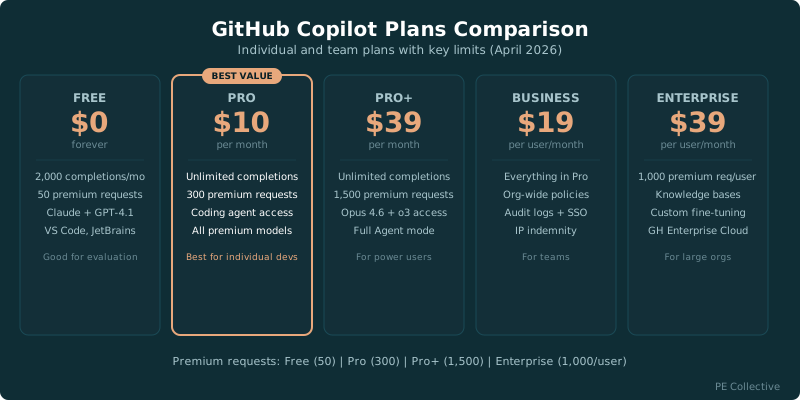
The free tier includes 50 premium requests per month PE Collective GitHub Copilot pricing. Pro costs $10/mo with 300/mo premium requests PE Collective GitHub Copilot pricing. Pro+ costs $39/mo with 1,500/mo premium requests PE Collective GitHub Copilot pricing.
Data verified by PE Collective in September 2026.
TLDR
GitHub Copilot pricing ranges from Free through Enterprise, but premium requests decide the bill after the subscription. Pro works for many individual developers. Pro+ gives frequent premium-model users more room. Enterprise buyers need to include the required GitHub Enterprise Cloud seat in their budget.
GitHub Copilot Plans and Prices
GitHub Copilot has five tiers. Free is a useful way to test the product. Pro and Pro+ are individual plans. Business adds organization-level purchasing and administration. Enterprise is for companies already operating on GitHub Enterprise Cloud.
Business costs $19/user/mo PE Collective GitHub Copilot pricing. Enterprise lists at $39/user/mo but requires GitHub Enterprise Cloud at $21 per user, so the real cost is $60 per user per month PE Collective GitHub Copilot pricing.
The visible price table is simple. The buying decision is less so.
A developer who uses Copilot for inline suggestions may barely touch premium requests. Another developer may use Chat, agent workflows, code review, and premium models throughout the workday. Both can hold the same subscription. They are not getting the same economics.
That is why The decision depends on whether Copilot costs less than another coding assistant. It is whether the included request pool matches the way you work.
For a broader product assessment beyond pricing, read our GitHub Copilot review. If you are comparing the two tools head-to-head, the Cursor vs GitHub Copilot breakdown gets into the workflow differences that a price table cannot capture.
Has the GitHub Copilot Price Changed? Increases and Plan Shifts
The headline numbers have been quiet. Free, Pro, and Pro+ list prices held flat from late 2025 through September 2026 at $0, $10, and $39. Microsoft kept the sticker prices steady and changed what sits behind them instead, which is why a "price increase" can hit your bill even when the plan name and price look identical to last quarter.
Three shifts that change your real cost without touching the list price:
- The premium-request model. In early 2026 GitHub moved Pro from a fixed-completions structure to unlimited completions plus a 300 premium-request cap. If your work leans on Chat and Agent mode, that cap is your new ceiling, and hitting it bills $0.04 per extra request. A developer who runs 200 requests over cap pays $8 on top of the $10 base.
- The Enterprise Cloud prerequisite. Since Q3 2025 the $39 Enterprise tier requires GitHub Enterprise Cloud at $21 per user. That moved real Enterprise cost from $39 to $60 per user per month. The Copilot line did not change. The total did.
- Model access expansion. Pro+ added Claude Opus 4.6 and o3 in early 2026. Those models consume more premium requests per call than GPT-4.1, so leaning on them drains your allotment faster and pushes you into overage sooner. Same price, faster burn.
Where a real increase is most likely in 2026: the Business and Enterprise tiers, tied to new features like custom fine-tuning and advanced security, not the individual plans. If you run a team and the budget allows, locking a multi-year Enterprise contract now hedges against that. The full month-by-month log sits in the Pricing Update Tracker further down this page.
Free
- ✓ 2,000 code completions per month
- ✓ 50 premium requests per month
- ✓ Access to Claude Sonnet 4.6 and GPT-4.1
- ✓ Works in VS Code, JetBrains, Neovim
- ✓ Good for evaluation, not daily use
Pro
- ✓ Unlimited code completions
- ✓ 300 premium requests per month
- ✓ Copilot coding agent access
- ✓ All premium AI models in Chat
- ✓ Best value for individual developers
Pro+
- ✓ 1,500 premium requests per month (5x Pro)
- ✓ Access to ALL models including Claude Opus 4.6 and o3
- ✓ Full Agent mode capabilities
- ✓ Priority access to new features
- ✓ For power users who hit Pro's limits
Business
- ✓ Everything in Pro for each user
- ✓ Organization-wide policy controls
- ✓ Audit logs and IP indemnity
- ✓ SSO (SAML) integration
- ✓ File exclusion controls
Enterprise
- ✓ 1,000 premium requests per user
- ✓ Knowledge bases for codebase context
- ✓ GitHub.com Chat integration
- ✓ Custom model fine-tuning options
- ✓ Requires GitHub Enterprise Cloud
Copilot Pro: What $10 a Month Actually Buys
GitHub Copilot Pro costs $10/mo with 300/mo premium requests PE Collective GitHub Copilot pricing.
That price makes Pro the natural starting point for a developer who uses Copilot regularly and wants more than the Free plan can support. It is also the tier most likely to produce disappointment when somebody sees the word “unlimited,” assumes every Copilot interaction falls into that bucket, and then discovers that premium usage has its own limit.
Copilot’s premium-request system separates ordinary completion use from work that draws on premium models and premium features. The distinction matters because the latter category includes many of the interactions that make an AI coding tool feel most useful: asking for a deeper explanation, working through a difficult refactor, using agent capabilities, or selecting a model for a task that deserves more care.
The Pro plan gives an individual developer a predictable subscription price and a meaningful premium-request allowance. For many people, that will be enough. A developer working on a typical application, asking for help when stuck, and using suggestions throughout the day can get substantial value from Pro without treating the tool as a substitute for every step of engineering judgment.
The cap bites when Copilot becomes part of the whole development loop.
If you use premium models to plan changes, generate implementation work, explain unfamiliar code, review pull requests, and iterate repeatedly on the output, premium requests become a production input. The subscription price still matters. The request pool matters more.
This is also where people make the wrong comparison. They compare Pro with Free only by asking whether the paid plan offers more capability. It does. The better comparison is between your likely premium-request use and the amount included in the plan.
Free is a test drive. Pro is a working subscription. The gap between them extends beyond access. It is how often you can rely on Copilot before the meter changes the conversation.
Developers who qualify for academic access should also check Copilot free for students. That route can make the individual-plan decision much easier.
Premium Requests: The Hidden Unit That Controls Your Bill
Premium requests are GitHub Copilot's currency for AI-powered features beyond basic code completion. Chat messages, Agent mode actions, code reviews, and manual model selection all consume premium requests.
The cost per premium request varies by feature and model. A simple Chat question using the default model costs 1 premium request. Selecting a more expensive model like Claude Opus 4.6 may cost more per request. Agent mode sessions consume multiple premium requests as the agent iterates through steps.
Your premium request quota resets on the 1st of each month. Unused requests don't roll over. If you exceed your quota, additional requests cost $0.04 each, billed to your account automatically.
Code completions (Tab autocomplete) are separate from premium requests. Free tier gets 2,000 completions per month. All paid plans get unlimited completions. This distinction matters, the core autocomplete experience works even when your premium requests are exhausted.
Premium Request Overage Math
Overage past your monthly allotment runs $0.04 per premium request on every paid plan PE Collective GitHub Copilot pricing.
That rate is the number to watch after you choose a paid plan.
A subscription price is fixed. Premium-request use is variable. The combination means your Copilot spend can move even when nobody changes plans. A team can see a higher bill because its developers started using premium models more often, because agent workflows became routine, or because a new coding project created more complex work.
This does not make premium requests a bad model. It makes them a model that needs attention.
The simplest approach is to treat premium requests like any other metered development expense. Look at who is using them, which workflows trigger the usage, and whether the higher-cost interactions are producing work that saves enough time to justify their cost.
Do not turn that review into a bureaucratic ritual. Developers should not need to defend every prompt. But an engineering manager should know whether the team is paying for hard technical work or paying for habitual use of a premium model on tasks that do not need it.
The same applies to individual developers. If you hit the Pro allowance repeatedly, you have a useful signal. You may need Pro+, you may need to change the model you select, or you may be using Copilot in a way that creates more interaction than value.
The plan change should follow the evidence.
A developer who reaches the cap once during a difficult project has not proved that Pro+ is the right tier. Someone who runs into overages as a normal part of daily work has a stronger case. The difference is whether premium demand is a spike or the baseline.
Free, Pro, and Pro+ for Individual Developers
The free tier includes 50 premium requests per month PE Collective GitHub Copilot pricing.
Free works when Copilot is an occasional helper. You are testing how it fits into your editor, using it on personal projects, or keeping it around for moments when autocomplete and lightweight assistance are enough. The plan gives you a legitimate feel for the product, but its premium-request allowance encourages selective use.
That is not a complaint. It is the point of the tier.
A free plan should answer whether Copilot improves your workflow. It should not be expected to support a developer who wants premium assistance whenever a task gets annoying. If that is your workflow, Free will feel constraining quickly because you are trying to use it as something it was not priced to be.
Pro costs $10/mo with 300/mo premium requests PE Collective GitHub Copilot pricing.
Pro is the practical individual tier. It gives regular users room to treat Copilot as part of their normal tooling rather than a scarce resource they save for special occasions. The plan price has held steady while the premium-request model changed the calculation underneath it. That is the important detail.
A subscription can stay flat while the effective cost of heavy usage moves. Developers often miss that because the price card looks familiar. The model mix and premium-request behavior tell the more useful story.
Pro+ costs $39/mo with 1,500/mo premium requests PE Collective GitHub Copilot pricing.
Pro+ is for a developer who knows premium usage will be frequent. It is not a status upgrade for someone who wants every available feature. It is a capacity purchase.
The plan also added Claude Opus and o3, which can consume premium requests faster. That can be worth it when the work is difficult enough to justify it. It is a poor trade when a cheaper or standard option would have handled the task.
The best individual plan depends on habit, not ambition. Plenty of developers like the idea of using premium models all day. Fewer have a workflow where that is the sensible use of a limited request pool.
Start with the tier that matches current behavior. Upgrade when usage creates a repeatable cost problem, not because the larger plan feels safer.
Copilot vs Cursor vs Windsurf: Which Saves You More?
The three leading AI code editors take different approaches to pricing. Here's how they compare.
Individual vs Team vs Enterprise: Which Tier Fits
Individual plans are for developers making their own purchase decision. Business and Enterprise are for organizations deciding how Copilot will be managed, funded, and deployed across a group.
A solo developer should not choose a team plan merely because it sounds more professional. The value of Business is organizational control, not a superior personal coding experience. If one person is paying, Pro or Pro+ is usually the clean comparison.
Business costs $19/user/mo PE Collective GitHub Copilot pricing.
Business makes sense when a company needs to buy seats centrally and administer access as a team. The organization is paying for more than one developer’s output. It is paying for a managed software decision: who receives access, how the product is rolled out, and how the company keeps the purchase from turning into a collection of individual expense claims.
Engineering managers should focus on that distinction. The individual tiers answer, “What does this developer need?” Business answers, “How do we provide this to a team without creating administrative clutter?”
Enterprise sits in a different bucket because it carries a platform prerequisite.
Enterprise lists at $39/user/mo but requires GitHub Enterprise Cloud at $21 per user, so the real cost is $60 per user per month PE Collective GitHub Copilot pricing.
That $60/user/mo figure is the number procurement should use. Treating the Copilot Enterprise list price as the full cost produces a budget that is wrong before the rollout begins.
Enterprise makes sense for organizations already committed to GitHub Enterprise Cloud and looking for Copilot inside that environment. It is less appealing for a buyer who starts with Copilot pricing and only later notices the required platform seat. The prerequisite is part of the product decision.
This is good news for GitHub Enterprise Cloud customers because the purchase maps cleanly onto an existing stack. It is bad news for anyone trying to evaluate Copilot Enterprise as a standalone developer-tool subscription.
Copilot alternatives may offer different packaging, different model options, or a different approach to usage limits. Our guide to Copilot alternatives is useful if the Enterprise prerequisite changes the short list.
Business vs Enterprise: What Does $20/User Extra Actually Get You?
Business ($19/user/month) and Enterprise ($39/user/month) share most features. The key differences are knowledge bases, GitHub.com Chat, custom models, and the Enterprise Cloud requirement.
Business adds organization-wide policy controls, audit logs, IP indemnity, SAML SSO, and file exclusion (prevent Copilot from accessing certain files). For most teams under 100 developers, Business has everything you need.
Enterprise adds knowledge bases, the ability to index your organization's repositories so Copilot can answer questions with full codebase context. It also includes GitHub.com Chat (use Copilot on github.com, rather than just in your IDE) and options for custom model fine-tuning.
The hidden cost: Enterprise requires GitHub Enterprise Cloud at $21/user/month. Total cost is $60/user/month ($39 + $21). This makes Enterprise 3x the cost of Business when you factor in the prerequisite. Only organizations that already have Enterprise Cloud should consider this tier.
Each Enterprise user gets 1,000 premium requests per month vs Business's standard allocation. For teams doing heavy Agent mode or code review work, this higher quota matters.
4 Ways Copilot Costs More Than the Sticker Price
- ⚠ Premium requests are consumed by Chat, Agent mode, code reviews, and model selection. A simple Chat question and a complex Agent session both use premium requests, but at different rates depending on the model.
- ⚠ Additional premium requests beyond your plan limit cost $0.04 each. A developer who blows through 300 Pro requests and uses 200 more pays $8 extra, at that point, Pro+ at $39/mo is better.
- ⚠ The free tier's 2,000 completions sound generous, but heavy users can hit that in a few days. Code completions on paid plans are unlimited.
- ⚠ Enterprise requires GitHub Enterprise Cloud ($21/user/month separately). Total cost is $60/user/month ($39 Copilot + $21 Enterprise Cloud). This catches teams off guard.
- ⚠ Premium request quotas reset on the 1st of each month regardless of when you subscribed. If you sign up on the 25th, you get 5 days of full quota, then it resets.
- ⚠ Not all models cost the same number of premium requests. Claude Opus 4.6 and o3 consume more per request than GPT-4.1. Using expensive models exclusively burns through your quota faster.
How to Choose a GitHub Copilot Plan
Choose Free if you want to test Copilot or use it occasionally. Its premium-request limit gives you enough room to learn what the product does without asking you to commit to a monthly bill.
Choose Pro if you are an individual developer who expects Copilot to be part of normal development work. The plan is priced for regular use, but the premium-request limit still deserves attention if you lean heavily on premium features.
Choose Pro+ if premium-model use is central to your workflow and the Pro allowance creates repeatable friction. More included requests are the point. Do not buy it for the label.
Choose Business if you are purchasing for a team and need the organization to own the seats. The benefit is administrative control around a shared deployment.
Choose Enterprise if your company already has GitHub Enterprise Cloud and needs Copilot in that environment. Budget from the full required seat cost, not the Copilot list price alone.
There is no universal winner because these plans solve different buying problems. Free and Pro are a developer decision. Business is a team-administration decision. Enterprise is a platform decision with a meaningful prerequisite attached.
The premium-request model cuts across all of them. A lower sticker price can still become the wrong choice if it creates recurring overages. A higher-priced tier can save money if it matches how the tool is used.
GitHub has kept the visible individual prices steady while changing the mechanics that shape real use. That is where the comparison lives now.
The question for developers is simple: how often do you need premium help?
The question for engineering leaders is more expensive: are you buying a useful coding tool, or funding a usage pattern nobody is measuring?
Key Takeaways
- Free includes 50 premium requests per month, making it best for occasional use and evaluation.
- Pro costs $10/mo with 300/mo premium requests and fits many regular individual users.
- Pro+ costs $39/mo with 1,500/mo premium requests for developers using premium models often.
- Business costs $19/user/mo, while Enterprise has a real required cost of $60 per user per month.
- Paid-plan overages run $0.04 per premium request, so request usage controls the final bill.
The Bottom Line
Pro at $10/month is the best value in AI coding tools. 300 premium requests covers daily use for most developers, and unlimited completions means the core autocomplete experience is always on. Pro+ at $39/month is worth it only if you consistently exhaust Pro's limits or need access to the most expensive models. Business at $19/user undercuts Cursor Teams ($40/user) significantly. The free tier is a genuine product now, not a trial, 2,000 completions per month is enough for light use.
Related Resources
Frequently Asked Questions
How much does GitHub Copilot cost?
Free ($0, 2,000 completions + 50 premium requests), Pro ($10/mo, 300 premium), Pro+ ($39/mo, 1,500 premium), Business ($19/user/mo), Enterprise ($39/user/mo + $21 Enterprise Cloud requirement).
Is GitHub Copilot free?
Yes, there's a free tier with 2,000 code completions and 50 premium requests per month. It works in VS Code, JetBrains, and Neovim. It's enough for light coding but not for daily professional use.
What are premium requests?
Premium requests power Chat, Agent mode, code reviews, and model selection. Each interaction consumes one or more premium requests depending on the model and feature. Free gets 50/month, Pro gets 300, Pro+ gets 1,500. Extra requests cost $0.04 each.
Is Copilot Pro worth $10/month?
For full-time developers, yes. Unlimited code completions plus 300 premium requests per month covers typical daily use. At $10/month, it's the cheapest paid AI coding tool. Cursor Pro is $20, Windsurf Pro is $15.
Should I get Pro or Pro+?
Start with Pro. If you consistently use 250+ premium requests per month, upgrade to Pro+ ($39/mo) for 1,500 requests and access to all models including Claude Opus 4.6 and o3. Most developers are fine on Pro.
GitHub Copilot Business vs Enterprise: which do I need?
Business ($19/user) for most teams. Enterprise ($39/user + $21 Enterprise Cloud) only if you need knowledge bases, GitHub.com Chat, and custom models. Enterprise's total $60/user/month cost is 3x Business.
How does Copilot compare to Cursor?
Copilot Pro ($10/mo) is half the price of Cursor Pro ($20/mo). Cursor offers deeper multi-file editing via Composer and full model selection per request. Copilot is better integrated with the GitHub ecosystem. For teams, Copilot Business ($19/user) is significantly cheaper than Cursor Teams ($40/user).
Can I use Copilot with JetBrains or Neovim?
Yes. All Copilot plans (including free) work in VS Code, JetBrains IDEs (IntelliJ, PyCharm, etc.), and Neovim. Cursor and Windsurf are VS Code forks and don't support other IDEs.
What is the price of GitHub Copilot vs VS Code?
VS Code is free. GitHub Copilot is a paid AI extension that runs inside VS Code, so the editor costs nothing and Copilot adds $10/month for Pro or $39/month for Pro+. There is also a free Copilot tier with 2,000 completions and 50 premium requests per month. The real comparison is the free editor alone versus the free editor plus a paid AI layer on top, not one product against the other.
Did GitHub Copilot raise its price in 2026?
No list price increase. Free, Pro, and Pro+ held at $0, $10, and $39 from late 2025 through May 2026. What changed is the structure behind the price: Pro moved to a 300 premium-request cap with $0.04 overage, Enterprise added a $21 Enterprise Cloud requirement (real cost $60/user), and Pro+ added Opus 4.6 and o3, which burn premium requests faster. Your bill can rise even though the sticker price did not.
What happens if I go over my premium request limit?
Every paid plan bills overage at $0.04 per premium request, charged to your account automatically. On Pro, 200 requests over the 300 cap adds $8 to your $10 base. Once your overage approaches the gap between Pro and Pro+, upgrading to Pro+ ($39, 1,500 requests) is the cheaper path. Code completions are unlimited on paid plans and never count toward this.
Has GitHub Copilot pricing changed in 2026?
List pricing in April 2026: $0 Free, $10/mo Pro, $39/mo Pro+, $19/user/mo Business, $39/user/mo Enterprise. Pro tier moved to unlimited code completions plus 300 premium requests in early 2026. Pro+ added Claude Opus 4.6 and o3 reasoning model access in March 2026. Business added GPT-4.1 across all team seats in Q1 2026 at no extra cost. The published list prices have not changed even as included models and features expanded.
What is the cheapest way to use GitHub Copilot in 2026?
The Free tier at $0/month with 2,000 completions and 50 premium requests covers casual coding under ~10 hours per week. Heavy users hit the cap in 3-5 days. For occasional agent mode use under 200 premium requests/month, Free with overflow billing ($0.04/request) is sometimes cheaper than Pro. Above 200 premium requests/month, Pro at $10 wins on math. Run your actual usage data before defaulting to Pro.
GitHub Copilot pricing plans for 2026: which one fits my use case?
By usage profile: hobby coders under 10 hrs/week use Free ($0). Full-time individual developers use Pro ($10/mo). Heavy AI users running agent mode continuously use Pro+ ($39/mo). Small to mid teams under 50 devs use Business ($19/user/mo) for SSO and IP indemnification. Large enterprises needing custom models and knowledge bases use Enterprise ($39/user + $21 Enterprise Cloud, $60 total). Pick by profile, not feature-checkbox shopping.
Is GitHub Copilot Pro+ worth $39/month in 2026?
Worth it if you exceed ~325 premium requests/month or specifically need Claude Opus 4.6 and o3 access. Break-even math: Pro+ at $39 includes 1,500 premium requests. Pro at $10 plus 1,200 overflow at $0.04/request costs $58. So Pro+ wins above ~325 requests/month. Below that, Pro is cheaper. Track usage for one month before upgrading.
Is GitHub Copilot pricing likely to increase in 2026?
List pricing has held steady through 2025 and into 2026 even as model costs increased. Microsoft used included-features rather than price increases to differentiate tiers. Realistic 2026 forecast: Free and Pro hold at $0 and $10 with potential cap reductions. Pro+ holds at $39 with model access expansion. Business and Enterprise most likely to see incremental increases tied to feature additions (custom fine-tuning, advanced security). Lock multi-year Enterprise contracts now if budget approves.
Pricing Update Tracker (2026)
GitHub Copilot pricing and included features change throughout the year. We track every update so this page stays the most current source. Last reviewed: September 2026.
- September 2026: No list price changes. Free $0, Pro $10, Pro+ $39, Business $19/user, Enterprise $39/user plus the required $21 Enterprise Cloud seat. Overage held at $0.04 per premium request.
- May 2026: No list price changes. Free $0, Pro $10, Pro+ $39, Business $19/user, Enterprise $39/user. Premium-request overage held at $0.04/request across paid plans.
- April 2026: No list price changes. Premium request overflow rate held at $0.04/request. Pro+ added Claude Opus 4.6 access for all subscribers.
- March 2026: Pro+ gained access to o3 reasoning model. Business tier added GPT-4.1 across all team seats at no extra cost.
- February 2026: Pro tier restructured to unlimited code completions plus 300 premium requests, replacing the prior fixed-completions structure.
- Q4 2025: Free tier added 50 premium requests per month, up from 0. Pro+ launched at $39/month with 1,500 premium requests.
- Q3 2025: Enterprise tier began requiring GitHub Enterprise Cloud ($21/user) as a prerequisite, raising real Enterprise cost from $39 to $60/user/month total.