 PE Collective
GPT 4o Mini Pricing: $0.15/$0.60 per 1M Tokens
GPT 4o mini pricing is $0.15 for input and $0.60 for output per million tokens at standard rates. That is the rate to use when estimating an ordinary API workload, before caching or batch processing changes the math.
GPT-4o Mini is still a sensible budget model when you need vision support, function calling, structured outputs, and a large context window. But the cheapest choice depends on the job. GPT-4.1 Nano costs less for simple classification and routing, while full GPT-4o is where costs jump when requests need more capability.
For the larger model's rates and capabilities, see GPT-4o pricing. If you are comparing providers as well as OpenAI models, start with our LLM API pricing comparison. For all OpenAI models including GPT-4.1, see OpenAI API Pricing.
TLDR
GPT-4o Mini pricing is $0.15/$0.60 per 1M tokens at standard rates. Cached input and Batch API work lower input cost, while GPT-4.1 Nano is cheaper for simple routing. Use Mini for structured multimodal triage, then send difficult requests to a larger model.
GPT-4o Mini
- ✓ Cheapest GPT-4 family model from OpenAI
- ✓ 128K context window
- ✓ Function calling and structured outputs
- ✓ Vision support for image inputs
GPT-4o Mini (Cached)
- ✓ 50% discount on input tokens with prompt caching
- ✓ Output tokens remain at standard rate
- ✓ Best for apps with repeated system prompts
- ✓ Cache hits automatic, no code changes needed
GPT-4o Mini (Batch)
- ✓ 50% off both input and output tokens
- ✓ 24-hour turnaround SLA
- ✓ Same quality as synchronous API
- ✓ Best for bulk classification and labeling
GPT-4o Mini (Fine-tuned)
- ✓ Double base price for custom fine-tuned models
- ✓ Training costs $0.30 per 1M tokens on top of inference
- ✓ Best for domain-specific classification tasks
- ✓ Requires at least 10 training examples
GPT-4o Mini Price at a Glance
GPT-4o Mini costs $0.15/$0.60 per 1M input and output tokens at standard rates Related analysis. The input side is cheap enough that most teams will focus on output discipline first, since output costs four times as much as input.
Prompt caching lowers the input rate when requests share a repeated prefix. With prompt caching, input drops to $0.075/1M Related analysis. That discount applies to cached input only. Your model output still uses the standard output rate.
The Batch API offers the same lower input rate for work that can wait. Batch API pricing is $0.075 input and $0.30 output per million tokens Related analysis. It makes the most sense for evaluation runs, content backfills, document processing, and any other job where a live response is unnecessary.
There is a simple way to think about these options. Standard pricing is for interactive requests. Prompt caching is for interactive requests with repeated context. Batch is for asynchronous volume.
The wrong move is optimizing the cheapest line item while your application generates long answers it does not need. A routing prompt that produces a paragraph when it should return a label will cost more than any clever caching strategy saves. Put tight output limits around narrow tasks, ask for structured responses where possible, and inspect the actual token mix before choosing a model.
Fine-tuning changes the arithmetic again. Inference on fine-tuned Mini costs $0.30 input and $1.20 output per million tokens, double the base rate Related analysis. Fine-tuning can still earn its keep when it shortens prompts, produces more reliable formats, or avoids a more expensive model. It should not be treated as a free accuracy upgrade.
GPT-4o Mini Pricing Table
Every GPT-4o Mini pricing variant in one table. All prices are per 1 million tokens.
GPT-4o Mini vs GPT-4.1 Nano and Mini
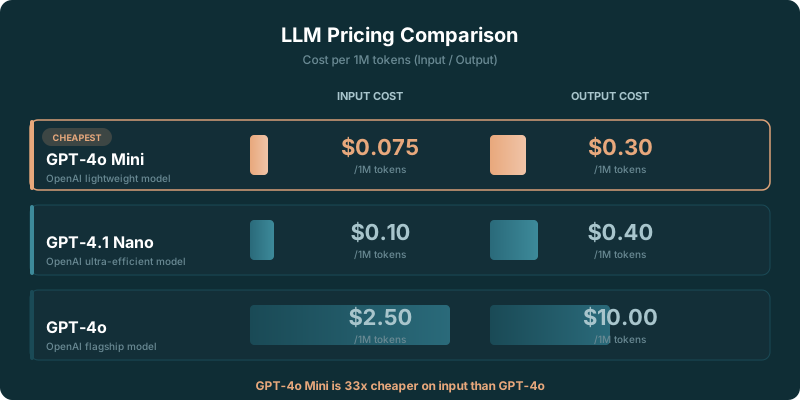
GPT-4.1 Nano is the cheaper budget pick for straightforward classification, extraction, moderation, tagging, and routing. GPT-4.1 Nano costs $0.10/$0.40 per million tokens, 33% cheaper than Mini on both input and output Related analysis.
That price gap is meaningful when the task is mechanical. If you are sorting support tickets, assigning a document type, checking whether a request meets a rule, or selecting a downstream workflow, Nano has the cleaner economic case. The model only needs to make a narrow decision. Paying more for capability you are not using is how small per-request costs become an annoying monthly bill.
Mini earns its place when the request needs more than a label. It supports image inputs, so a workflow that reads screenshots, product images, receipts, or visual documents has a reason to choose it. It is also useful when a request needs structured outputs or function calling but does not justify the cost of GPT-4o.
GPT-4.1 Mini sits in the middle of the budget-model conversation. Developers often evaluate it beside GPT-4o Mini because both target production workloads that need more judgment than a simple router. The decision should come from your own evaluation set. Feed both models the actual prompts, the ugly edge cases, and the formats your application must parse. A benchmark that does not resemble your production traffic is decoration.
Cost is only one side of the decision. Failure mode matters more. A weak classification can be caught with a fallback rule. A weak answer in a customer-facing workflow can create support work, lost trust, or a bad recommendation that quietly spreads through the product. Those are different jobs, even if they both arrive as API calls.
The useful architecture is usually a ladder. Nano handles cheap, narrow decisions. Mini handles triage, structured extraction, and multimodal work. A larger model receives the requests that are complex enough to deserve it. Routing only complex requests to larger models while Mini handles triage cuts costs by 70-80% Related analysis.
That setup also gives you a better way to improve quality. Instead of moving every request to an expensive model after one bad evaluation, identify the requests that fail. Add a confidence threshold, a rule-based check, or a second-stage model call. The expensive model should be the exception your system can explain.
GPT-4.1 Nano launched as OpenAI's new ultra-cheap option and directly competes with GPT-4o Mini. Nano is 33% cheaper on both input and output tokens. Both models target the same use cases: classification, extraction, routing, and simple generation. The key differences are context window size (Nano supports 1M tokens versus Mini's 128K) and recency (Nano benefits from newer training data and architecture improvements). For most simple tasks, Nano is the better default. Mini still wins if you have fine-tuned models you do not want to retrain, or if your specific task benchmarks higher on Mini.
GPT-4o Mini vs GPT-4o: When to Upgrade
GPT-4o costs $2.50/$10.00 per million tokens, roughly 17x more than Mini on input and output. The quality gap matters most on complex reasoning, specific writing, multi-step tool use, and long-form content generation. Mini matches GPT-4o closely on simple classification (90%+ agreement on binary tasks) but falls behind on anything requiring chain-of-thought reasoning or subtle distinctions. A common architecture uses Mini for initial triage and routes only complex requests to GPT-4o or GPT-4.1, cutting costs by 70-80%.
Mini vs Nano vs GPT-4o Compared
GPT-4o Mini is much cheaper than the full GPT-4o model. Mini costs 94% less than the full GPT-4o at $2.50/$10 per million tokens Related analysis.
The table makes the price relationship plain, but capability should decide the final model assignment. Nano wins when the model's job is narrow and predictable. Mini wins when your workflow needs vision, more involved tool use, or stronger handling of mixed inputs. GPT-4o belongs behind a gate, reserved for requests where the improvement is worth paying for.
A good triage prompt does more than classify. It can identify missing details, flag ambiguous requests, choose the correct downstream tool, and send the few difficult cases upward. Mini is well suited to that middle layer because it can handle richer context without turning every request into a full-model bill.
Do not build the architecture around a model name alone. Build it around request types. A receipt parser, an email router, a visual inspection workflow, and a customer-facing analyst assistant may all use OpenAI models, but they should not share a default simply because one model performed well in an unrelated test.
Batch API Pricing for GPT-4o Mini
The Batch API processes requests asynchronously at 50% off both input and output tokens. GPT-4o Mini Batch pricing is $0.075 input and $0.30 output per million tokens. Jobs complete within 24 hours. Submit a JSONL file of Chat Completions requests and poll for results. Best for: dataset labeling, content classification, bulk extraction, and evaluation pipelines where latency is not critical.
Fine-Tuning Costs for GPT-4o Mini
Fine-tuning GPT-4o Mini costs $0.30 per 1M training tokens. Once trained, inference costs double: $0.30 input and $1.20 output per million tokens. A typical fine-tuning job on 100K training tokens costs about $0.03 for training alone. The real cost is inference, if you run 1M requests per month, the 2x inference premium adds up fast. Consider whether prompt engineering or few-shot examples can achieve the same quality before committing to fine-tuning. Fine-tuned Mini models still cannot match the reasoning ability of base GPT-4.1 or GPT-4o.
What Real Workloads Cost on Mini
A small workload is cheap enough that model choice may not be the bottleneck. 1,000 requests with 500 input and 200 output tokens each costs about $0.20 on Mini Related analysis.
That example is useful because it separates two problems developers often blend together. Token pricing determines the cost of a request. Request volume determines whether the total deserves engineering attention. A low-cost request becomes material when it sits in a loop, runs against every document in a backlog, or fires repeatedly because an application retries without control.
The output side deserves particular scrutiny. GPT-4o Mini's standard output price is four times its input price. A concise JSON object, a category label, or a short extraction has different economics from an open-ended assistant response. If your product only needs a machine-readable result, do not invite the model to write an essay.
Prompt design can make a practical difference without turning into prompt folklore. Keep system prompts focused. Reuse stable instructions so caching can apply. Move reference material out of every request when retrieval can supply only the relevant passage. Ask for a defined schema. Cap output where a longer answer does not improve the outcome.
Batch processing is the other large lever when latency is irrelevant. Batch API pricing is $0.075 input and $0.30 output per million tokens Related analysis. A nightly enrichment job, historical ticket classification project, or large evaluation suite does not need to pay interactive rates simply because the application was built around them.
There is a trap here. Teams sometimes move a workflow to batch and call the cost problem solved, then leave duplicate records, unnecessary source text, and excessive output untouched. Batch pricing helps. Sending the model a clean task helps more. The best cost control is usually upstream: fewer redundant calls, smaller relevant context, and outputs designed for the next software step.
Fine-tuning needs the same skepticism. Inference on fine-tuned Mini costs $0.30 input and $1.20 output per million tokens, double the base rate Related analysis. The rate can be justified if the fine-tuned model replaces bulky examples in every prompt or improves adherence enough to avoid retries. If it merely makes a demo feel smoother, the extra rate is hard to defend.
Measure the full workflow, not the clean request in isolation. Include retries, fallback calls, malformed outputs, human review, and the cost of a wrong answer. That is where one model can lose despite having a lower listed rate.
Real-World Cost Examples
What GPT-4o Mini actually costs for common workloads at different scales. All estimates assume average token counts per request.
Rate Limits for GPT-4o Mini
OpenAI sets rate limits based on your cumulative API spending. GPT-4o Mini shares the same tier system as other models but typically has higher token-per-minute allowances due to its lower cost. New accounts start at the free tier.
When GPT-4o Mini Is NOT Enough
GPT-4o Mini fails or underperforms on several task categories. Complex multi-step reasoning consistently produces errors that GPT-4.1 or GPT-4o handle correctly. specific writing tasks (tone matching, persuasive copy, creative fiction) show a clear quality gap. Long-context retrieval degrades past 32K tokens even though the 128K window technically accepts more. Multi-turn agent workflows with tool use produce more hallucinated function calls. Code generation for non-trivial tasks (refactoring, architecture changes, multi-file edits) misses edge cases. If your application falls into any of these categories, budget for a bigger model and use Mini only for the simple subtasks.
Hidden Costs & Gotchas
- ⚠ {'title': 'GPT-4.1 Nano is now cheaper', 'detail': "GPT-4.1 Nano costs $0.10/$0.40 per million tokens versus Mini's $0.15/$0.60. That is 33% cheaper on input and output. For simple classification and routing, Nano may be the better budget pick, benchmark your specific task before choosing."}
- ⚠ {'title': 'Output tokens cost 4x input tokens', 'detail': 'GPT-4o Mini charges $0.15 per 1M input tokens but $0.60 per 1M output tokens. Generation-heavy tasks like summarization, content writing, or code generation cost more than you expect if you budget only on input. Always estimate your output-to-input ratio.'}
- ⚠ {'title': 'Fine-tuning training costs add up', 'detail': 'Fine-tuning training costs $0.30 per 1M tokens, and inference on fine-tuned models is 2x the base rate ($0.30/$1.20). A training run on 10M tokens costs $3.00 before you make a single inference call. Multiple training iterations multiply that cost.'}
- ⚠ {'title': '128K context does not mean 128K quality', 'detail': 'GPT-4o Mini accepts 128K tokens of context, but quality degrades noticeably past 32K tokens. Long-context tasks like document Q&A over large files may produce worse results than splitting into smaller chunks. Test with your actual data before relying on full context length.'}
- ⚠ {'title': 'Vision adds image token costs', 'detail': 'Sending images to GPT-4o Mini converts them to tokens based on resolution. A low-res image costs roughly $0.002 and a high-res image costs $0.004-0.006 depending on dimensions. If you process thousands of images, these costs add up fast even at Mini pricing.'}
- ⚠ {'title': 'Rate limits start low on free tier', 'detail': 'Free tier accounts get 500 RPM for GPT-4o Mini. Tier 1 ($5+ spent) stays at 500 RPM with 30K TPM. You need to reach Tier 2 ($50+ spent) for 5K RPM. Production applications often hit rate limits before they hit cost ceilings.'}
Which Plan Do You Need?
Prototyping and hobby projects
GPT-4o Mini at standard rates ($0.15/$0.60). Cheap enough to iterate without worrying about cost. 1,000 requests with 500 input and 200 output tokens each costs about $0.20.
Classification and routing at scale
GPT-4o Mini Batch at $0.075/$0.30. If latency does not matter, the Batch API cuts costs in half. Ideal for labeling datasets, content moderation, and intent classification on bulk data.
Production with quality requirements
Upgrade to GPT-4.1 ($2/$8) or GPT-4o ($2.50/$10). Mini struggles with complex reasoning, specific writing, and multi-step tool use. If accuracy matters more than cost, step up to a full-size model.
Budget production workloads
Compare GPT-4.1 Nano ($0.10/$0.40) versus GPT-4o Mini ($0.15/$0.60). Nano is 33% cheaper. Run both on your actual prompts and pick whichever scores higher, the cost difference is small but compounds at scale.
Where GPT-4o Mini Fits
GPT-4o Mini is a practical default for applications that need more than cheap text classification but do not need full GPT-4o on every call. It works well when the application needs reliable structured output, tool selection, visual input, or a first pass over a request before escalation.
The biggest savings often come from refusing to treat every user request as equally difficult. A short, clean question with enough context can go to Mini. A messy question involving uncertainty, competing constraints, or a high-cost failure can go to a larger model. That is not glamorous infrastructure. It is the difference between an AI feature with sane unit economics and a literal money pit.
The model can also act as a guardrail before expensive work begins. It can extract fields from an incoming message, decide whether an image is usable, select a knowledge base route, or identify whether a request should be handled by software rather than another model call. Those jobs are easier to evaluate than open-ended generation because you can define the expected output.
For a broader view of model economics across vendors, compare Mini with Anthropic API pricing and our LLM pricing comparison 2026. The lowest listed rate is only useful when it can complete the work you give it.
Your production logs should answer a few hard questions. Which request types consume the most output tokens? Which ones retry? Which ones are immediately escalated? Which ones could be solved with a classifier, a rule, or a smaller context window? Those are the places where pricing becomes product design.
GPT-4o Mini remains compelling when it lets you keep a useful amount of capability in the cheap part of that design. GPT-4.1 Nano can undercut it for narrow work. GPT-4o can take the hard cases. The opportunity is in deciding where each request belongs before the request reaches a model.
The Bottom Line
GPT-4o Mini at $0.15/$0.60 is excellent for simple tasks but now faces competition from GPT-4.1 Nano ($0.10/$0.40). For classification and routing, both are fine, pick based on benchmark performance for your specific task. For anything requiring reasoning or nuance, step up to GPT-4.1 or GPT-4o.
Key Takeaways
- GPT-4o Mini costs $0.15/$0.60 per 1M input and output tokens at standard rates.
- Cached input costs $0.075 per 1M tokens, while Batch API lowers both input and output rates.
- GPT-4.1 Nano costs less for simple classification and routing.
- Mini is a better fit for structured, visual, and triage-oriented workflows.
- Fine-tuned Mini inference costs double the base rate, so it needs a measurable payoff.
Sources
Related Resources
Frequently Asked Questions
How much does GPT-4o Mini cost?
GPT-4o Mini costs $0.15 per 1 million input tokens and $0.60 per 1 million output tokens. With prompt caching, input drops to $0.075/1M. Batch API pricing is $0.075 input and $0.30 output per million tokens.
Is GPT-4o Mini free?
No. GPT-4o Mini is not free through the API. New OpenAI accounts get $5 in credits which can be used for Mini. ChatGPT Free includes limited Mini access in the consumer product, but API usage always costs money.
GPT-4o Mini vs GPT-4.1 Nano, which is cheaper?
GPT-4.1 Nano is cheaper at $0.10/$0.40 per million tokens versus Mini's $0.15/$0.60. Nano is 33% less on both input and output. For new projects, benchmark both on your task. Nano is the better default unless Mini specifically outperforms.
Can I fine-tune GPT-4o Mini?
Yes. Fine-tuning GPT-4o Mini costs $0.30 per 1M training tokens. Inference on fine-tuned models costs $0.30 input and $1.20 output per million tokens, double the base rate. You need at least 10 training examples, though 50-100 examples typically produce better results.
What is GPT-4o Mini good for?
GPT-4o Mini excels at classification, entity extraction, content routing, simple Q&A, and any task where the output is short and structured. It matches GPT-4o closely on binary classification tasks while costing 94% less.
What is the GPT-4o Mini context window?
GPT-4o Mini supports 128K tokens of context (roughly 96K words). However, quality degrades past 32K tokens for most tasks. If you need reliable long-context performance, GPT-4.1 Nano offers 1M tokens.
Is GPT-4o Mini good for coding?
GPT-4o Mini handles simple code tasks like boilerplate generation, syntax fixes, and code explanation. It struggles with complex refactoring, multi-file changes, and architectural decisions. For serious coding, use GPT-4.1 or Claude Sonnet 4.6.
How does GPT-4o Mini compare to Claude Haiku?
Claude Haiku 4.5 costs $0.80/$4.00 per million tokens, significantly more expensive than GPT-4o Mini at $0.15/$0.60. Mini is roughly 5x cheaper on input and 7x cheaper on output. Haiku offers a 200K context window and is generally stronger on specific text tasks, but Mini wins on price for simple workloads.