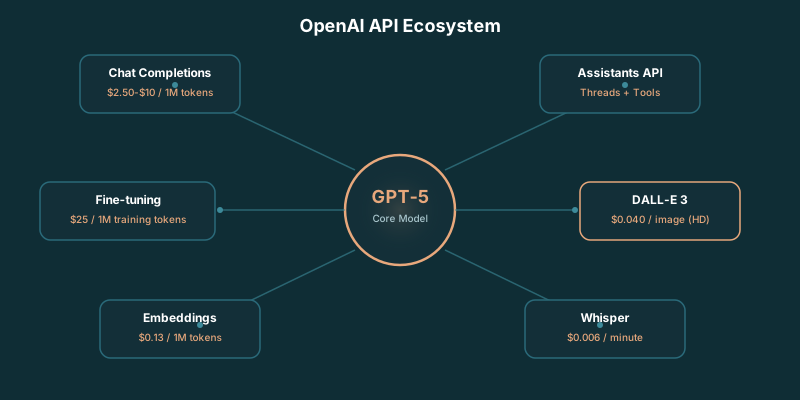
The OpenAI API is a developer platform for building applications with text, images, audio, embeddings, and fine-tuned models. Its strongest case is breadth: one vendor can cover a product assistant, document extraction, image generation, and speech transcription without forcing your team to stitch together a pile of unrelated services.
For teams evaluating a multimodal application, audio cost is often the cleanest place to start. In 2026, Whisper transcription is listed at $0.006 per minute of audio. Related analysis That makes the OpenAI API worth a close look when recorded calls, interviews, support conversations, or media files sit near the center of the product.
The platform does not remove the need for judgment. You still need to choose a model that fits the job, set limits around output, and watch where requests become expensive. But it gives developers a broad menu without making every new capability a procurement project.
TLDR
The OpenAI API gives developers one platform for text, image, audio, embedding, and fine-tuning workloads. Whisper transcription is listed at $0.006 per minute of audio. Related analysis Choose the model by workload, then keep expensive output and generation calls on a short leash.
What the OpenAI API Is
The OpenAI API lets an application send structured input to a model and receive generated text, analysis, transcriptions, image output, or vector representations for search and retrieval. The practical value is not that every product needs every modality. Most do not. The value is that the options are available when the product expands.
A customer support tool may begin with written replies, then add call transcription. A knowledge product may start with semantic search, then add a conversational interface. A creative product may need both generated copy and generated visuals. Building across those surfaces gets easier when the underlying platform already covers them.
Text models handle tasks such as drafting, extraction, classification, summarization, reasoning, and structured output. They are useful when an application needs language as an interface or needs to turn messy human input into something software can act on.
Image generation fits products where visual output is part of the deliverable. That can include concept art, product mockups, marketing assets, educational visuals, or internal creative workflows. DALL-E pricing is listed as $0.04 to $0.12 per image. Related analysis The Anthropic API becomes a useful comparison when that image capability is less important than choosing a text-first provider.
Audio covers transcription and voice-oriented application flows. Whisper can turn recorded speech into text that other systems can search, summarize, classify, or route. In 2026, Whisper transcription is listed at $0.006 per minute of audio. Related analysis That rate also makes the OpenAI API a reasonable fit for teams whose product begins with conversations rather than documents.
Embeddings convert text into numerical representations that help an application find related material. They are common in semantic search, retrieval systems, recommendations, clustering, and document matching. Fine-tuning offers another route for teams with repeatable patterns, specialized language, or output requirements that prompt design alone does not handle well.
That breadth is the platform’s main advantage. A team can keep more of its AI application inside one technical and billing relationship. The tradeoff is that breadth can tempt people to use a general-purpose model for every task. That gets expensive fast.
Choosing a Model for the Job
Model selection should begin with the workload, not the latest model name. A simple classification task, a large-scale extraction workflow, and a high-stakes customer-facing assistant have different needs. Treating them as the same job is how an AI bill turns into a literal money pit.
GPT-4.1 is the middle-ground choice when output quality and dependable instruction following matter. It is suited to application features where generated responses are visible to users, where structured output must be consistent, or where a weak answer creates cleanup work for someone else.
GPT-4.1 Nano is for high-volume, lower-complexity work. Think lightweight routing, tagging, basic extraction, filtering, or other tasks where the application needs a fast judgment rather than a long response. It is also a useful way to keep trivial work away from a more expensive model.
GPT-5 belongs in workflows where the work itself is harder and the model’s output has enough value to justify the higher output cost. That might include complex analysis, difficult coding work, detailed research synthesis, or application paths where a weak answer would damage the product experience.
| Workload | Recommended starting point | Why |
|---|---|---|
| Customer-facing writing and structured output | GPT-4.1 | Strong general-purpose fit |
| Routing, tagging, and high-volume extraction | GPT-4.1 Nano | Lower-cost option for simpler work |
| Complex analysis and demanding generation | GPT-5 | Better fit when the task needs more capability |
| Image creation | DALL-E | Built for generated visual output |
| Speech transcription | Whisper | Converts recorded audio into usable text |
| Semantic retrieval | Embeddings | Finds related content across a corpus |
| Specialized recurring outputs | Fine-tuning | Fits stable patterns and domain language |
The right workflow often uses more than one model. A lower-cost model can classify an incoming request, pull out the relevant fields, and decide whether the request deserves escalation. The more capable model only sees work that needs it. That is usually better product design than sending every request to the most expensive option and hoping usage stays polite.
Output length deserves the same discipline. Long answers cost more, take longer, and often create more room for the model to wander. If the product needs a short result, ask for a short result. If it needs a structured result, define the structure. Applications get better when model behavior is treated as a product surface, not a magic trick.
Testing should happen with real application inputs. A demo prompt rarely looks like production. Real users provide incomplete context, attached files, contradictory instructions, and requests written at odd hours with no patience for your clever architecture. Tools such as this Promptfoo review are worth considering alongside the platform when GPT-5 is listed at $1.25 input and $10 output per million tokens. Related analysis
OpenAI API Pricing at a Glance
OpenAI API pricing is typically tied to the model and the type of work being performed. Text models use input and output tokens, image generation uses a per-image price, and transcription uses audio duration. Those units are different enough that a single “cheap” or “expensive” label does not tell you much.
In 2026, GPT-4.1 is listed at $2 input and $8 output per million tokens. Related analysis GPT-4.1 Nano is listed at $0.10 input and $0.40 output per million tokens. Related analysis The gap tells you where the economics sit: reserve the larger model for work that benefits from it, and let lower-cost workloads stay lower-cost.
GPT-5 is listed at $1.25 input and $10 output per million tokens. Related analysis Input pricing alone can mislead buyers. A workflow that produces long responses, repeated revisions, or verbose intermediate output can spend more on output than expected. Product constraints matter as much as model choice.
DALL-E 3 pricing is listed as $0.04 to $0.12 per image. Related analysis Image generation cost is easier to understand at the request level, but it still needs guardrails. A product that lets users retry image generation freely can rack up requests without producing a better final result. Limit retries, make the prompt experience better, and save outputs people intend to revisit.
Text applications have their own version of the same problem. A chat interface can create a large context window when every prior message is sent back with each new request. Retrieval, summarization, and careful session design help reduce that drag. The model should receive the context it needs, not every word anyone has ever typed.
Pricing also changes the architecture conversation. If your application needs several model providers, an abstraction layer may help. If it only needs one provider and one family of tasks, abstraction can become expensive ceremony. Developers have enough to maintain already.
The broad OpenAI feature set can reduce vendor sprawl for teams that need both text and media. But a stack built around a different cloud ecosystem may have a separate cost logic. Compare it with AWS Bedrock pricing when GPT-4.1 Nano is listed at $0.10 input and $0.40 output per million tokens. Related analysis
Whisper API Transcription Costs
Whisper is one of the simpler OpenAI API products to price because the unit is time. In 2026, Whisper transcription is listed at $0.006 per minute of audio. Related analysis You can estimate a transcription request by taking the audio duration and applying that cited per-minute rate.
A support platform processing a short recorded message has a predictable transcription cost. A research team processing a long interview uses the same rate, just across more audio. The calculation is direct enough to build into product planning, customer pricing, or usage alerts without pretending that audio is free.
The transcription cost is only one part of the workflow. Once audio becomes text, many teams pass that text into a model for summarization, action-item extraction, redaction, translation, or search. Those later calls may cost more than the transcription itself, especially when the transcript is long and the output is unconstrained.
That is where a clean pipeline helps. Transcribe first. Store the transcript. Extract only the parts needed for the next task. Route simple follow-up work to a lower-cost model. Keep the original audio and transcript available when the user needs to verify what the system heard.
Whisper also changes what products can reasonably support. A team that once treated calls as unsearchable dead space can make them part of the knowledge base. Sales calls, user interviews, lectures, podcasts, meetings, and support recordings become usable input. The hard part is no longer getting text. It is deciding what should happen after the text exists.
Privacy and retention belong in that decision. Audio often contains more sensitive information than the tidy text fields developers are used to handling. Before wiring transcription into a workflow, decide who can upload files, what gets stored, what gets deleted, and whether transcripts can appear in downstream search or generation features. The API call is the easy part.
When to Use a Second API Provider
OpenAI is a strong default when one application needs text, image, and audio capabilities under one roof. It is less compelling when a team needs a narrow specialty that another provider handles better, or when the product needs redundancy across providers.
Anthropic is the most obvious comparison for teams focused primarily on text and reasoning workloads. The choice should rest on your own evaluation set, implementation needs, model behavior, contractual requirements, and cost profile. Do not choose based on a leaderboard screenshot from someone else’s workflow. Their prompts, context, and failure tolerance are not yours.
A second provider can also give you a fallback for important product paths. That does add operational work. Your prompts may need provider-specific versions. Output formats may differ. Monitoring gets harder. But a product that depends on a single external model for a critical workflow should be honest about that dependency.
There is a competitive angle here. OpenAI wins when platform breadth simplifies the build and lets a team add modalities without reopening the vendor decision. A specialist provider wins when its narrow focus produces better results for the exact workload the customer pays for. The loser is usually the team paying for several platforms without a clear reason any of them are there.
Use a second API provider when the product has evidence that the added complexity earns its keep. That evidence can come from evaluation quality, latency requirements, enterprise requirements, availability needs, or a pricing difference that holds up under production usage. It should not come from fear of missing out.
The OpenAI API is most useful when it gives your team fewer separate systems to manage while still meeting the actual job. Its text models, image generation, audio transcription, embeddings, and fine-tuning options cover a wide range of product needs. The question is whether your product needs that range, or whether a smaller stack gets you to a better answer.
Key Takeaways
- The OpenAI API covers text, image, audio, embeddings, and fine-tuning in one developer platform.
- In 2026, Whisper transcription is listed at $0.006 per minute of audio. Related analysis
- GPT-4.1 Nano fits simpler, high-volume work, while GPT-4.1 and GPT-5 fit more demanding output.
- DALL-E 3 pricing is listed as $0.04 to $0.12 per image. Related analysis
- A second provider earns its place when testing or operational needs justify the extra maintenance.
Sources
- PE Collective OpenAI API review with $2 input and $8 output per million tokens
- PE Collective OpenAI API review with $0.10 input and $0.40 output per million tokens
- PE Collective OpenAI API review with $1.25 input and $10 output per million tokens
- PE Collective OpenAI API review with $0.04 to $0.12 per image
- PE Collective OpenAI API review with $0.006 per minute of audio