 PE Collective
Gemini API vs OpenAI API Pricing and Context Guide
Comparing the two largest LLM API platforms for developers
Last updated: February 20, 2026
Quick Verdict
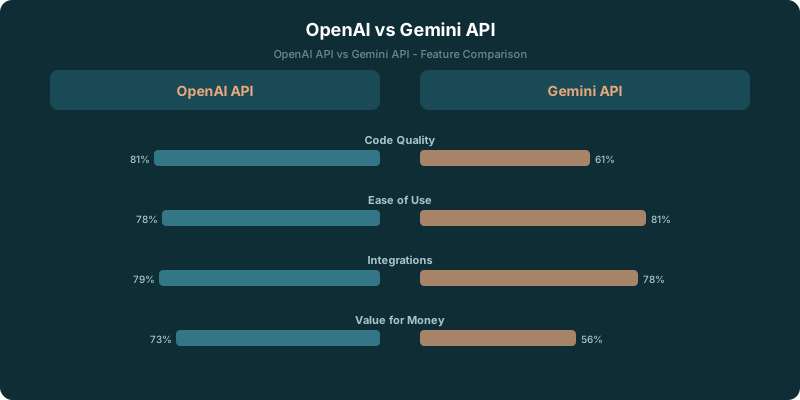
Choose OpenAI API if: You want the most battle-tested API with the largest ecosystem of tools, tutorials, and community support. GPT-4.1 and GPT-5 set the standard. The Assistants API and function calling are mature. If your team already knows OpenAI, there's little reason to switch.
Choose Google Gemini API if: You want a larger context window, competitive pricing on the Flash tier, and native integration with Google Cloud services. Gemini 2.5 Pro offers a 1M token context window. Flash models give you speed at a fraction of the cost. For high-volume or long-context applications, the math often favors Google.
Gemini API vs OpenAI API comes down to a tradeoff most teams can describe in a sentence: Gemini offers more room for long documents, while OpenAI has a deeper developer ecosystem. Gemini 2.5 Pro is listed with a 1M token context window. PE Collective API comparison
Input cost sharpens that choice. GPT-4.1 Mini input is listed at $0.15 per 1M tokens. PE Collective API comparison Gemini Flash input is listed at $0.075 per 1M tokens. PE Collective API comparison
Neither figure decides every production architecture. A small support assistant, a retrieval workflow, and a document-heavy research product all put different pressure on context, latency, tooling, governance, and engineering time. Pick the provider that fits the workload you have, then leave enough room to change your mind when the workload grows teeth.
TLDR
Gemini suits workloads that need broad document context and lower listed Flash input pricing. OpenAI suits teams that value a mature API ecosystem and familiar tooling. Keep prompts portable, measure production behavior, and choose based on the work your application must perform.
Context Window and Document Fit
Context windows shape the architecture before they shape the bill. They determine how much material you can present to a model in one request, including instructions, user input, retrieved documents, tool results, and the model’s response.
GPT-4 Turbo is listed with a 128K token context window. PE Collective API comparison That is ample for many product features. A customer-support agent can receive a conversation, account history, selected knowledge-base passages, and a clear system prompt without carrying an entire company archive into every request.
Gemini’s listed context capacity changes the design options for products built around larger source material. Gemini 2.5 Pro is listed with a 1M token context window. PE Collective API comparison That can make a difference when the useful unit of work is a long contract collection, a codebase segment, a research corpus, or a detailed record with important dependencies spread far apart.
Long context does not remove the need for retrieval. It changes when retrieval becomes necessary and how aggressively you need to compress. Sending every available document to a model can produce irrelevant context, higher cost, harder debugging, and a fuzzy answer that sounds more certain than it deserves. A well-run retrieval layer still decides what evidence belongs in the prompt.
The practical question is simple: does your application need a model to reason across a large body of material in the same request? If the answer is yes, Gemini deserves a serious look. If your system usually works from narrow, well-selected context, OpenAI’s listed window may be more than enough.
This is where developers sometimes overcorrect. They see a larger context window and rebuild the product around it. Then a prompt that was supposed to be a compact research packet turns into a landfill of policy documents, logs, and stale notes. Context is useful when it improves the model’s view of the task. It is not a substitute for judgment.
A production workflow should also separate document fit from document storage. Your source system can retain the full record while the application sends a focused subset for ordinary requests. The larger context option remains available for exceptions: complex investigations, full-document review, or a user who needs a model to trace a decision through a long chain of source material.
For teams building retrieval-heavy products, LlamaIndex can sit beside a Gemini 2.5 Pro workflow where the listed 1M token context window supports broader source review. The point is not to stuff the prompt. The point is to give the model enough relevant evidence when the task calls for it.
Input Token Pricing
Input pricing matters most when your application repeatedly sends substantial context. A short interactive prompt may barely move the bill. A product that attaches long records, retrieved passages, or detailed system instructions to every request will feel the difference quickly.
GPT-4.1 Mini input is listed at $0.15 per 1M tokens. PE Collective API comparison Gemini Flash input is listed at $0.075 per 1M tokens. PE Collective API comparison
Those listed rates make Gemini Flash attractive for high-volume intake work where input dominates the request. Think classification, extraction, routing, summarization, or an internal assistant that reads a lot before it writes a little. Lower input pricing gives teams more room to test richer prompts without immediately turning every product decision into a finance meeting.
The model choice still needs to fit the task. Cheap input does not compensate for weak task performance, unreliable structured output, or a tool-calling pattern that creates operational headaches. Cost is one part of the operating model. Engineering time has a cost too, and it tends to arrive disguised as a backlog.
OpenAI may be the better economic choice when its tooling shortens the path from prototype to a stable feature. Teams already invested in its SDKs, evaluation habits, observability, and prompt conventions can avoid migration work. That is especially true when the product sends modest context and the larger window would sit mostly unused.
Gemini may be the better economic choice when the application reads large inputs frequently. The listed Gemini Flash rate is lower, and the larger-context family gives document-heavy teams a different set of options. A legal research product, a technical due-diligence workflow, or an internal knowledge tool may care more about what can enter the prompt than about the familiarity of the surrounding ecosystem.
Treat published rates as a starting point for a real workload test. Capture representative prompts, include the same system instructions and retrieved material, and compare output quality against the standard your users will notice. A pricing spreadsheet with synthetic prompts is fine for planning. It is not a production decision.
New OpenAI accounts are listed with a $5 credit. PE Collective API comparison That makes it easier to test an OpenAI integration early, but the useful comparison comes from running your own prompt set through both providers and reviewing the failures.
For rate-sensitive systems, LLM rate limits belong in the same planning conversation as Gemini Flash input listed at $0.075 per 1M tokens. Cost only helps if the provider can support the request pattern your product needs.
| Developer situation | OpenAI API fit | Gemini API fit |
|---|---|---|
| Early-career developer | Familiar examples and a broad tool ecosystem can reduce setup friction | A good fit when the product begins with long documents |
| Product engineer | Useful for focused prompts, structured outputs, and established integrations | Useful when broad source context is central to the feature |
| Staff or principal engineer | Useful when portability, evaluations, and operational conventions already exist | Useful when context architecture drives the system design |
| Platform team | Useful for shared patterns across teams and mature provider knowledge | Useful for workloads where large inputs are a core platform requirement |
| Procurement-led evaluation | Test listed input pricing against actual prompt traffic | Test listed input pricing against actual prompt traffic |
Feature and Migration Checklist
Feature checklists are less glamorous than model demos. They also prevent expensive surprises.
Start with the request and response shapes your application needs. If the product depends on structured output, tool calls, streaming responses, image input, batch processing, or a particular authentication pattern, build a small working version with each provider. Documentation can tell you what is offered. Your integration tells you how it behaves in the narrow, annoying corners where products live.
OpenAI has a mature ecosystem around its API. Developers can find more examples, wrappers, tutorials, and community discussion for common implementation problems. That matters when a team needs to ship without inventing its own conventions for every integration detail.
Gemini fits naturally for teams already operating inside Google Cloud. Existing identity practices, data systems, and cloud governance can reduce organizational friction. A provider decision often starts as a model decision and ends as an infrastructure decision. The model gets the attention. The surrounding work gets the calendar.
Migration deserves its own plan because models are not drop-in replacements, even when the request looks similar. Prompts have hidden assumptions. System instructions, JSON schemas, tool definitions, safety handling, output parsing, and retry behavior all contain provider-specific choices.
Keep an application-owned interface between your product and the model provider. That interface can normalize request construction, tool definitions, logging, and result parsing. It will not erase every difference, but it keeps provider-specific code from spreading through the product like a bad rumor.
Store prompts outside hard-coded application logic where possible. Version them. Record the context that accompanied each prompt. When a result fails, you need to know whether the problem came from the model, retrieved evidence, tool output, parsing rules, or a system prompt edited by someone who was trying to be helpful.
Build an evaluation set from real user tasks. Include easy cases, edge cases, ambiguous cases, and cases that should refuse or ask for clarification. Review outputs for factual grounding, instruction following, formatting, safety behavior, and the specific failure modes that would damage your product.
Do not make migration a religious argument. You may choose OpenAI for a customer-facing workflow and Gemini for long-document processing. Provider flexibility can be worthwhile when the product has distinct workloads with distinct requirements. It can also create needless complexity if the team has no clear reason to operate more than one stack.
The useful checkpoint is whether a second provider solves a concrete problem: context capacity, price, cloud fit, availability, or a capability your first choice lacks. If it does, run the test. If it does not, keep the architecture boring.
Choosing a Provider by Workload
Choose OpenAI when your main advantage comes from ecosystem maturity. A team that needs familiar API patterns, a large pool of implementation knowledge, and practical tooling may move faster with OpenAI. That advantage compounds when the workload uses focused context rather than huge document sets.
Choose Gemini when long-context document work sits at the center of the product. Gemini 2.5 Pro is listed with a 1M token context window. PE Collective API comparison That matters for applications where breaking the source material into small pieces loses useful relationships.
Choose Gemini Flash when input-heavy workloads make price a central constraint. Gemini Flash input is listed at $0.075 per 1M tokens. PE Collective API comparison A broad set of low-stakes processing tasks may benefit from that listed rate, provided the model meets the output standard.
Choose OpenAI when your team already has working prompts, evaluations, integrations, and operational habits built around the platform. GPT-4.1 Mini input is listed at $0.15 per 1M tokens. PE Collective API comparison That rate may be acceptable when it avoids a migration that produces little user-facing benefit.
Choose both when the workloads are materially different and the engineering team can support the added complexity. A document-analysis path may favor Gemini’s listed context capacity, while a customer-facing tool-calling workflow may fit OpenAI’s ecosystem. The architecture should reflect the work, not a vendor loyalty test.
The strongest decision framework remains concrete. Write down the documents each request needs, the output users rely on, the systems you already operate, and the failure modes you cannot accept. Then make each provider prove itself against that list.
A small prototype can create false confidence because every provider looks good on a clean demo prompt. Production is where prompts become messy, documents conflict, users ask incomplete questions, and a helpful-looking answer creates downstream work. Build the comparison around those moments.
The winner is the provider that lets your team deliver a reliable feature at a cost and operational burden you can live with. For long-context work, Gemini has the listed advantage. For ecosystem maturity and familiar developer workflows, OpenAI remains a strong default. The question is whether your product needs more document capacity or more certainty in the path from API call to shipped feature.
Key Takeaways
- Gemini 2.5 Pro is listed with a 1M token context window, which suits document-heavy workloads.
- GPT-4 Turbo is listed with a 128K token context window, which fits many focused retrieval and application workflows.
- Gemini Flash input is listed at $0.075 per 1M tokens, while GPT-4.1 Mini input is listed at $0.15 per 1M tokens.
- OpenAI often fits teams that value ecosystem maturity, while Gemini fits teams where long context or Google Cloud alignment drives the decision.
- A portable provider layer and real workload evaluations make migration far less painful.
Sources
- PE Collective API comparison, Gemini 2.5 Pro 1M token context window
- PE Collective API comparison, GPT-4 Turbo 128K token context window
- PE Collective API comparison, GPT-4.1 Mini $0.15 per 1M tokens
- PE Collective API comparison, Gemini Flash $0.075 per 1M tokens
- PE Collective API comparison, OpenAI $5 credit