 PE Collective
LLM Orchestration Frameworks for 2026
Choose LLM orchestration frameworks by architecture, comparing LangChain, LlamaIndex, CrewAI, AutoGen, and Haystack for RAG, agents, and production.
Last updated: April 2026
LLM orchestration frameworks connect prompts, tools, data, and multi-step workflows into an application that can do more than return a single completion. The right choice starts with architecture: are you building retrieval, an agent workflow, or a production service with strict operational requirements?
Teams often start by asking which framework has the most integrations. That’s understandable. It’s also usually the wrong question.
A framework is infrastructure that shapes how your application retrieves context, calls tools, stores state, handles failures, traces decisions, and changes over time. Pick a stack built for autonomous collaborators when you need a focused retrieval system and you’ve bought yourself a lot of ceremony. Pick a lightweight retrieval layer for a tool-heavy agent and you’ll end up writing the missing orchestration yourself.
The landscape has matured significantly since 2024, according to the PE Collective orchestration frameworks roundup. That maturity has made the tradeoffs clearer. The frameworks no longer all compete for the same job.
TLDR
Choose LLM orchestration frameworks by the architecture you need to run. LlamaIndex fits retrieval-heavy applications, CrewAI and AutoGen fit coordinated agents, while LangChain and Haystack cover broader application workflows. Production teams should value observability, predictable control flow, and debugging before feature breadth.
Key Takeaways
- LlamaIndex is the clearest fit when retrieval and document context drive the product.
- CrewAI and AutoGen fit systems where specialized agents hand work to one another.
- LangChain offers broad building blocks, though its abstraction layers can complicate debugging.
- Haystack is a practical option for production-oriented retrieval and pipeline work.
- Traceability matters more once an application can call tools, retrieve data, and make decisions across steps.
What LLM Orchestration Frameworks Handle
An LLM call is simple. You send input, receive output, and decide what to do with it. Most useful applications get complicated immediately.
They need prompt templates that adapt to user context. They need a way to retrieve relevant records without stuffing an entire database into a prompt. They need external tools, perhaps a search endpoint, a CRM lookup, a calculator, or an internal service. They need memory, retries, validation, guardrails, and a record of why the system took a particular path.
That’s the plumbing orchestration frameworks handle.
A good orchestration layer gives your application a shared language for these pieces. Instead of building a custom connector every time a model calls a tool or a retriever returns a document, your team works with repeatable components and an execution flow that can be inspected later.
The value is obvious when workflows have dependencies. A support assistant may retrieve account information, classify an issue, search internal documentation, draft a response, and ask for human approval before taking action. Each step has different failure modes. A tool might time out. Retrieval might return irrelevant context. A model might select the wrong action. The useful work happens in how the application handles those moments.
Frameworks also make it easier to swap model providers, test prompts, and keep application logic from becoming one long tangle of API calls. That benefit has limits. Every abstraction layer hides some behavior, and hidden behavior makes debugging harder when a workflow produces a bad answer or starts taking an unexpected route.
That caution matters most when teams adopt a framework because it promises speed. You can build a compelling demo quickly with a chain of prebuilt components. Then a customer asks why the system used one document instead of another, why it called a tool twice, or why a retry changed the outcome. At that point, the framework’s internal model becomes part of your engineering problem.
The decision depends on whether orchestration is useful. It is. The question is how much of your application’s behavior you want the framework to own.
Choose a Framework by Architecture
Start with the workload, not the brand name.
A retrieval-augmented generation application has a different center of gravity than a multi-agent workflow. Retrieval systems live or die on ingestion, indexing, metadata, chunking choices, retrieval quality, and how context reaches the model. Agent systems need role definitions, task delegation, shared state, tool permissions, stop conditions, and enough control to prevent a clever loop from becoming an expensive one.
Production services add another layer. They need observability, testing, cost controls, access policies, predictable latency, and a way for engineers to understand failures without replaying the entire system from memory.
| Architecture | Best starting point | Why it fits | Watch for |
|---|---|---|---|
| Retrieval-heavy application | LlamaIndex | Its core focus is connecting models to external data and retrieval workflows | Weak source data and vague metadata |
| Broad LLM application | LangChain | It offers general building blocks for prompts, tools, chains, and agents | Complexity across abstraction layers |
| Role-based agent workflow | CrewAI | It organizes agents around defined roles and collaborative tasks | Agents that hand work around without a clear stopping point |
| Conversational agent system | AutoGen | It supports interactions among agents and model-driven participants | Hard-to-follow execution paths |
| Production retrieval pipeline | Haystack | It is suited to pipeline-oriented search and retrieval services | Treating pipeline design as an afterthought |
| Application tracing | LangSmith | It helps teams inspect and evaluate workflow behavior | Observability added after the workflow is already opaque |
| Managed retrieval operations | LlamaCloud | It supports data and retrieval infrastructure around LlamaIndex work | Dependency on a service without clear operating boundaries |
If you are building RAG, begin with the data path. Where does content enter the system? How is it parsed? Which metadata can distinguish similar documents? What does the retriever return when the answer is missing? How will you evaluate whether the system cited the right source?
LlamaIndex is built around that set of questions. It is the natural starting point for teams whose product depends on documents, databases, knowledge stores, or other external context. The framework’s vocabulary maps to the work: connectors bring in data, indexes structure it, retrievers select context, and query engines give that context to a model.
LangChain is broader. That breadth makes it attractive when you need retrieval alongside tool calling, custom prompt flows, model switching, or agent behavior. It is often the familiar choice because it can reach into many parts of an LLM application. But familiarity does not remove the cost of complexity. A framework that can express many workflow patterns can make it harder to see which pattern your application is actually using.
For teams comparing more tool comparisons, LangSmith is listed from $39/mo in the PE Collective orchestration frameworks roundup. That figure matters because production tracing is not a decorative extra once model behavior affects customers. It is part of operating the product.
Agent systems call for a different selection path. Ask what each agent owns, what information it can access, what actions it can take, and what event ends the workflow. If those answers remain fuzzy, adding more agents will not create a clearer system. It will create more places for uncertainty to hide.
Frameworks for RAG and Multi-Agent Workflows
LlamaIndex for RAG
RAG applications are often described as a model plus a vector database. That description skips the difficult part.
Retrieval quality depends on the source material and the rules used to prepare it. A document can be well written for a human reader and still be miserable to retrieve from. Tables get flattened. Headings disappear. Similar policies have nearly identical language. Fresh information competes with older material that has more repeated phrases.
LlamaIndex gives teams a framework for treating those details as application logic rather than cleanup work. It is especially useful when the product needs to ingest varied data sources and expose a consistent retrieval layer to the model.
The architecture should make source handling visible. Keep enough metadata to identify document ownership, recency, permission boundaries, and the source location. Decide whether users need citations, excerpts, or an explanation of why the system selected a result. Test the cases where retrieval should decline to answer.
That last one is easy to skip. It is also where many RAG products earn or lose trust. A system that retrieves weak context and writes a confident answer has failed before the model started generating text.
LlamaCloud is listed from $35/mo in the PE Collective orchestration frameworks roundup, which makes it relevant for teams evaluating managed support around LlamaIndex-based data work. The cost is only one piece of the decision. You still need to know where data is processed, how changes are indexed, and how the application behaves when a source is unavailable.
A RAG stack should be boring in the best way. Inputs arrive predictably. Retrieval is testable. The model receives context that is attributable and current. When the system cannot find support for an answer, it says so.
CrewAI and AutoGen for Multi-Agent Workflows
Multi-agent frameworks are useful when the work can be divided into meaningful responsibilities.
CrewAI centers on that framing. You define agents with roles, give them tasks, and let the workflow coordinate their work. It can fit a research process where one agent gathers sources, another evaluates them, and another prepares a final output under explicit constraints.
AutoGen also focuses on agent interaction, often through conversations between participants with different tools or responsibilities. It can be a good fit when the application needs collaborative reasoning patterns rather than a fixed retrieval pipeline.
The temptation is to build a small digital office. A researcher, a writer, an editor, a manager. It looks impressive in a diagram. The customer does not care about the diagram. They care whether the result is correct, prompt, and explainable.
Give every agent a narrow job. Make tool permissions explicit. Keep shared state small enough to inspect. Define a stop condition before agents begin exchanging messages. Add human review where the workflow can change records, spend money, or communicate outside the system.
CrewAI and AutoGen win when the decomposition is real. A workflow with distinct skills and handoffs can benefit from structured collaboration. A workflow that is simply one model thinking aloud in several personas will produce more logs and not much more value.
Teams considering OpenAI API vs Anthropic API should note that LangSmith starts at $39/mo in the PE Collective orchestration frameworks roundup. Model choice and orchestration choice are connected because different providers may change tool calling behavior, context handling, latency, and evaluation methods.
Production Tradeoffs
The framework that gets a prototype running is not automatically the framework that makes production easier.
Production changes the criteria. You need to trace execution through prompts, retrieval calls, tools, and model responses. You need tests that cover known failures rather than a collection of successful demos. You need a way to inspect versions as prompts, models, data sources, and workflow logic change.
LangChain can support a broad range of production applications, especially when a team needs to combine retrieval, tool use, and custom control flow. It has an expansive ecosystem and a common mental model for LLM application development. The tradeoff is that its layers can make debugging difficult, particularly when chains, agents, callbacks, and integrations stack on top of each other.
That does not make LangChain a bad choice. It means the team should decide where to use its abstractions and where to keep the code direct. A simple explicit function that calls a retriever and validates output may be easier to own than a generalized chain that hides the same behavior behind configuration.
Haystack is worth considering when the application looks more like a production pipeline than an open-ended agent environment. Its approach suits teams that want defined components and a clearer path through retrieval and generation work. It is less interested in turning every use case into an agent conversation, which can be a feature.
Observability belongs in the architecture from the beginning. LangSmith is listed from $39/mo in the PE Collective orchestration frameworks roundup, and that starting point puts an operational cost beside the framework decision. The more autonomy you give a workflow, the less optional tracing becomes.
Evaluation should also match the application. RAG systems need retrieval tests and grounded-answer checks. Tool-using agents need tests for correct tool selection, arguments, permissions, and termination. Production services need latency, error, and fallback behavior measured under realistic load.
Avoid evaluating only final prose. A response can sound polished while the system took the wrong steps to produce it. Trace the route. Inspect retrieved context. Verify tool inputs. Check whether the workflow did what it was supposed to do when the answer was uncertain.
The best LLM orchestration tools reduce accidental complexity. They should help your team make the workflow more legible, rather than merely more elaborate.
How to Make the Final Choice
Choose LlamaIndex when retrieval is the product’s center of gravity. Its data and indexing orientation gives RAG teams a cleaner place to begin.
Choose CrewAI or AutoGen when your workflow contains real specialization, handoffs, and collaboration between agents. Treat agents as bounded workers with defined responsibilities, not a substitute for process design.
Choose LangChain when you need a broad set of primitives across models, prompts, tools, retrieval, and agent-like workflows. Go in with discipline. Its flexibility can become a problem when every new requirement adds another abstraction.
Choose Haystack when your priority is a production-oriented pipeline that keeps retrieval and generation work structured. It is a strong option for teams that prefer an explicit route through the system.
The page’s 2026 framing comes from the PE Collective orchestration frameworks roundup. In that environment, the winners will not be the teams with the most elaborate diagrams. They will be the teams that can explain what their application does, inspect why it did it, and change it without breaking the parts customers rely on.
Can your team debug the workflow when it gets weird, or are you about to discover that the framework has been making decisions you cannot see?
Sources
Our Top Picks
Detailed Reviews
LangChain
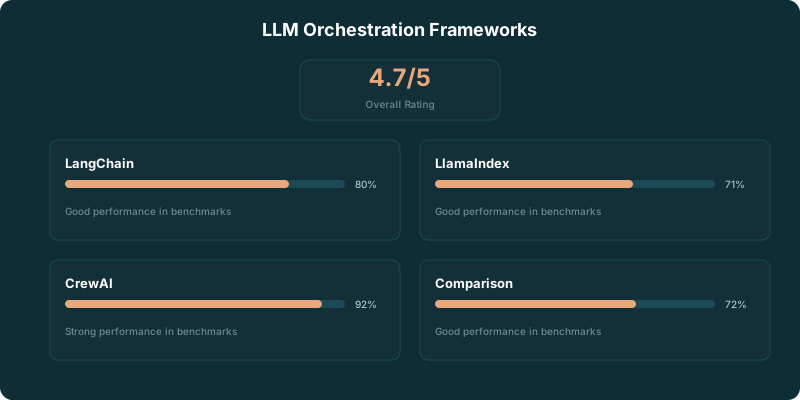
Most CompleteThe most feature-rich framework with the largest ecosystem. Supports every model provider, has hundreds of integrations, and LangSmith provides observability. The tradeoff is complexity, the abstraction layers can make debugging hard.
LlamaIndex
Best for RAGPurpose-built for retrieval-augmented generation. The best indexing, chunking, and retrieval primitives available. LlamaCloud adds managed ingestion and retrieval. Less suited for general orchestration but unmatched for data-heavy applications.
CrewAI
Best for Multi-AgentThe simplest way to build multi-agent systems. Define agents with roles, give them tools, and let them collaborate. The role-based abstraction is intuitive and the agent coordination works well for structured workflows.
Microsoft AutoGen
Best for ResearchMicrosoft's multi-agent framework with strong support for complex conversations between agents. Excellent for research and experimentation. The conversable agent pattern is powerful but requires more setup than CrewAI. Microsoft has since folded AutoGen's agent patterns into the broader Microsoft Agent Framework, its unified agent stack that also absorbs Semantic Kernel, so teams already on the Microsoft stack should evaluate that direction too.
Haystack
Best for ProductionClean, pipeline-based architecture that's easier to debug than LangChain. Strong typing, clear data flow, and good production tooling through deepset Cloud. The pipeline paradigm makes complex workflows predictable.
LangGraph
Best for Stateful AgentsLangGraph is LangChain's graph-based framework for stateful, multi-step agent workflows. You model the agent as nodes and edges, which gives explicit control over loops, branching, and human-in-the-loop checkpoints that plain LangChain chains handle awkwardly. It is the natural choice when you have outgrown a linear chain and need an agent that can revisit steps, hold state across turns, and recover from a failed tool call. It pairs with LangSmith for tracing and replay.
Evaluation Criteria
Compare frameworks with representative retrieval, tool-use, and API workflows. Review implementation effort, documentation, debugging, observability, model portability, deployment requirements, and how failures are surfaced to operators.
Frequently Asked Questions
What is the best LLM framework in 2026?
It depends on your use case. LangChain for breadth, LlamaIndex for RAG, CrewAI for multi-agent, LangGraph for stateful agents, Haystack for clean production pipelines.
LangGraph vs CrewAI vs AutoGen: which should I use?
All three build agents, but they fit different shapes of problem. LangGraph gives you a stateful graph with explicit control over loops and branching, which suits complex single agents that need to revisit steps. CrewAI is the fastest way to stand up a team of role-based agents with minimal code. AutoGen, now part of the Microsoft Agent Framework, leans toward research and free-form agent-to-agent conversation. Start with CrewAI if you want results quickly, reach for LangGraph when you need precise control over the flow, and look at the Microsoft Agent Framework if your team already lives on the Microsoft stack.
Is LangChain still worth using?
Yes, if you need its ecosystem. LangChain has the most integrations and LangSmith is excellent for observability. The complexity is real but manageable for experienced teams.
What is LLM orchestration?
LLM orchestration is the process of coordinating multiple LLM calls, tools, and data sources into a coherent application. Frameworks handle prompt management, chain execution, memory, and tool use.
Do I need a framework to build with LLMs?
Not always. For simple chat applications or single API calls, the provider SDKs (OpenAI, Anthropic) are sufficient. Frameworks add value when you need RAG, multi-step workflows, or tool use.
LangChain vs LlamaIndex, which should I use?
Use LangChain for general orchestration and tool-heavy agents. Use LlamaIndex for RAG and document-heavy applications. Many teams use both. LlamaIndex for retrieval within a LangChain pipeline.