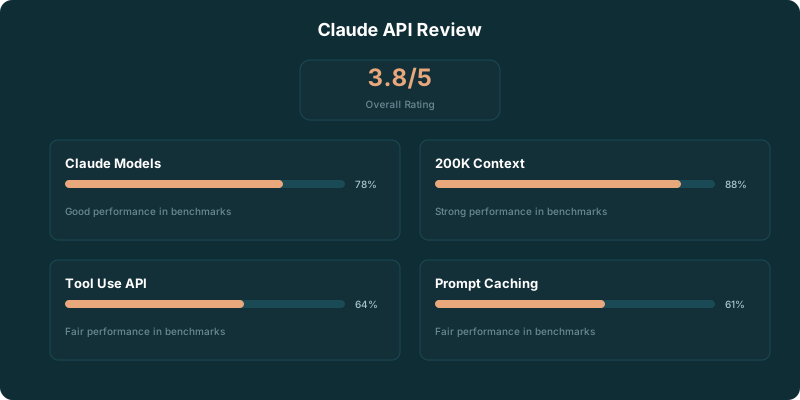
The Anthropic API gives developers access to Claude models for text, image, tool-use, streaming, and multi-turn applications. Start with the model economics. Haiku 4.5 is listed at $1 input and $5 output per 1M tokens, Sonnet 4.6 at $3 input and $15 output, and Opus 4.6 at $5 input and $25 output. Claude also supports up to 200,000 tokens of context.
That makes the Anthropic API a practical option when your product needs to keep a large working set in view without treating every request like a premium reasoning problem. The model choice does most of the work here. Pick the expensive model for work that earns it. Let the cheaper one handle the rest.
TLDR
The Anthropic API lets developers build with Claude through messages, streaming, tool use, system prompts, and multi-turn conversations. Haiku suits fast, cost-sensitive tasks. Sonnet fits most production work. Opus belongs on demanding reasoning and coding jobs with enough value to justify its higher output cost.
What the Anthropic API Is
The Anthropic API is the developer interface for Claude. Your application sends Claude a request, supplies instructions and conversation history where needed, and receives a generated response.
That sounds ordinary because it is. A useful API should not force developers into a ceremony just to ask a model a question. The interesting decisions sit around the request: which model gets the work, how much context you pass, whether Claude can call a tool, and whether the user should see the response appear as it is generated.
A basic interaction has a user message and a response. Production applications tend to add more structure. A system prompt sets the role, constraints, and tone. Multi-turn conversations let the application provide prior messages so Claude can respond with the relevant history. Streaming sends generated text back incrementally, which makes a chat interface feel responsive instead of frozen while it waits for a complete answer.
Tool use gives Claude a defined way to ask your application for information or take an approved action. The model can request a database lookup, search an internal knowledge base, check inventory, create a draft, or trigger a workflow. Your application still owns execution. That boundary matters. Claude proposes the call; your code decides what is allowed and returns the result.
Images can also be part of the request. That opens up document review, screenshot analysis, visual support workflows, and applications where a user has more to show than type. The decision depends on whether a model can inspect an image. It is whether the rest of the product has a clear next action after it does.
The API’s interaction patterns fit together:
- A system prompt establishes the operating rules.
- Messages provide the immediate task and relevant conversation.
- Streaming improves the interface for responses that take time to generate.
- Tool use connects Claude to data and actions outside the model.
- Multi-turn state makes the application feel coherent across a session.
Those capabilities make the Claude API suitable for more than a chatbot. It can sit inside an internal research assistant, a support agent, a document-review workflow, a coding environment, or a product feature that needs to reason over a large amount of supplied material.
The hard part is not wiring up a request. The hard part is deciding where model judgment helps and where deterministic software should stay in charge. Good implementations leave authorization, validation, and business rules in the application. Claude handles language, classification, synthesis, and ambiguous inputs.
Claude API Model Tiers
Anthropic groups its Claude models into Haiku, Sonnet, and Opus. That tiering gives developers a clean routing decision instead of a single default model that gets pressed into every job.
Haiku is the fast, lower-cost option. Sonnet is the general production choice for work that needs stronger reasoning and writing quality. Opus is for the difficult jobs: complex analysis, demanding code work, and tasks where a weaker answer creates enough rework to cost more than the model choice saved.
| Model | Input price per 1M tokens | Output price per 1M tokens | Best fit |
|---|---|---|---|
| Haiku 4.5 | $1 | $5 | Fast classification, extraction, routing, and high-volume product tasks |
| Sonnet 4.6 | $3 | $15 | General production reasoning, writing, analysis, and agent workflows |
| Opus 4.6 | $5 | $25 | Complex reasoning, difficult coding, and high-stakes synthesis |
Haiku 4.5 is listed at $1 input and $5 output per 1M tokens. Related analysis That price profile makes it the obvious first stop for narrow tasks with clear success criteria: categorizing incoming requests, extracting fields, rewriting structured text, checking content against a rubric, or handling the first pass in a routing system.
Haiku can also be a useful guardrail against a familiar AI budget problem. Teams often prototype with the smartest available model because the first demo needs to look good. Then the demo becomes production, volume arrives, and every low-value task inherits the premium model bill. Haiku gives you a way to separate speed-sensitive and repetitive work from the requests that need deeper judgment.
Sonnet 4.6 is listed at $3 input and $15 output per 1M tokens. Related analysis For most teams, Sonnet is the model to evaluate first for customer-facing features and internal workflows that must produce consistently useful work without paying Opus rates by default.
Use Sonnet when the task requires a model to read context, follow layered instructions, write in a defined voice, compare options, or make a reasoned recommendation that your application can validate. It is also a sensible default for tool-using workflows where the work is varied. A request may begin as a simple question, pull in data through a tool, and turn into a summary or decision memo.
Opus 4.6 is listed at $5 input and $25 output per 1M tokens. Related analysis The higher output rate is the part to watch. Applications that generate long responses, code patches, detailed analyses, or multi-step plans should be deliberate about when they send work to Opus.
Opus earns its place when failure is expensive. That can mean an engineering workflow where the model needs to understand a complicated codebase, a research task that demands careful synthesis, or a decision-support product where superficial reasoning will send users back to the drawing board. If the output still needs heavy editing every time, the premium tier did not solve the actual product problem.
The clean routing approach is simple. Start work on Haiku when the task is bounded and volume is high. Send standard production reasoning to Sonnet. Escalate to Opus when the request has enough ambiguity, technical complexity, or consequence to justify it.
Do not route by ego. A model tier is not a status symbol. It is a cost and quality decision attached to a specific task.
Anthropic API Pricing
Anthropic API pricing is token-based. You pay separately for what goes into the model and what comes out. That distinction shapes architecture more than most pricing pages let on.
Input cost is affected by the system prompt, user request, conversation history, retrieved documents, tool results, and any other context included with the call. Output cost is affected by how much Claude generates. Long prompts can make input the main cost driver. Long reports, code generation, and verbose agent behavior can make output the bigger issue.
The listed pricing gives you a straightforward starting point:
- Haiku 4.5 is listed at $1 input and $5 output per 1M tokens. Related analysis
- Sonnet 4.6 is listed at $3 input and $15 output per 1M tokens. Related analysis
- Opus 4.6 is listed at $5 input and $25 output per 1M tokens. Related analysis
The visible price gap between tiers is useful because it rewards basic product discipline. Make prompts concise. Store durable user preferences outside the conversation where possible. Retrieve the relevant document section instead of stuffing every related file into every request. Put clear limits on output length when the user needs an answer, not a small novel.
That does not mean starve the model of context. It means give it the context that changes the answer.
A support assistant that has the customer’s account history, current plan, and the relevant product documentation can resolve more requests in one pass. A coding assistant that sees the affected files and project conventions can make fewer imaginary assumptions. A review workflow that receives the full agreement and the internal policy can identify the clause that matters instead of producing a generic warning.
Cost control comes from task design. A lower-cost model with the right context can beat a premium model working from scraps. A premium model forced to read irrelevant material is still wasting money.
If you are comparing providers, price alone will not settle the choice. The OpenAI API is worth evaluating alongside Claude when your workload includes the same $3 input and $15 output per 1M tokens range cited for Sonnet 4.6, but the product decision should also account for the modalities and platform services your application needs.
The right comparison is workload-specific. A document-heavy application may care most about context capacity. A voice product may care about audio tooling. A team building a general AI platform may care about the breadth of adjacent services. A team embedding a focused reasoning workflow may care more about Claude’s model behavior and the price of the exact requests it expects to run.
Long-Context and Tool-Use Workloads
Claude supports up to 200,000 tokens of context. Related analysis The cited review equates 200,000 tokens to roughly 150,000 words or about 500 pages. Related analysis
That is enough room for workloads that become awkward when an application has to chop source material into tiny pieces and hope the model reconstructs the whole picture. Contracts, policy libraries, technical documentation, research collections, customer histories, code context, and lengthy transcripts all fit the general shape.
Long context is most useful when relationships between distant parts of a source change the answer. A contract review assistant may need to compare an indemnity clause with a limitation-of-liability section far away in the document. A research assistant may need to spot where one report contradicts another. A coding assistant may need to see how a small change affects a type definition, a test suite, and a downstream integration.
The temptation is to send everything. Resist it.
Context is useful only when it gives the model evidence it can apply. A huge prompt packed with redundant documents can bury the relevant signal and make debugging harder. Strong long-context systems usually have a selection layer: retrieve the relevant sources, preserve important surrounding material, and state what Claude should do with it.
Tool use makes this more flexible. Instead of attaching every possible record to the prompt, let Claude request focused information from an approved tool. The application can return the customer record, policy section, repository file, or current order status that the task needs. That keeps data fresher and makes permission boundaries clearer.
A good tool description is part of the product. Claude needs to know what information the tool returns, when it should call it, and which inputs are valid. Vague tools invite vague behavior. A tool named `get_data` tells the model almost nothing. A tool that clearly describes a customer-account lookup, its accepted identifier, and its returned fields gives the model a useful decision surface.
Streaming matters in these workflows as well. Long-context analysis and tool-using tasks may take longer than a simple response. Streaming can show the user that the system is working and present the final answer as it arrives. The interface should still distinguish between a partial generation and an action that has been confirmed by your application. Those are different events, and users notice when a product blurs them.
The AWS Bedrock pricing comparison is relevant for teams weighing deployment options around a 200,000-token context workload. The API price is only part of the bill when the broader stack includes cloud controls, retrieval, observability, and data access patterns.
Anthropic API vs a Broader Platform API
The Anthropic API is centered on building with Claude. That focus can be attractive when the product has a clear language or reasoning workload and you want a model interface built around messages, prompts, streaming, tools, and context.
A broader platform API may offer more adjacent capabilities under one vendor: image generation, voice features, fine-tuning options, or a larger family of developer services. That can reduce integration work for an application that needs several modalities at once. It can also create a lot of surface area that a focused product never uses.
Your architecture should follow the product’s job.
Choose Claude when the main job is reading, reasoning, writing, coding, or using tools against supplied context. The 200,000-token context option is especially relevant when the user expects the system to work across long documents or a large body of application state.
Choose a broader platform when the product’s core experience depends on services beyond that workflow. A multimedia assistant, for example, may need image, voice, and text capabilities that belong in the same stack. The Anthropic vs Google AI comparison can help frame that decision around the 200,000-token context figure rather than treating every provider as interchangeable.
The API layer should be boring in the best sense. Requests should be understandable, tool calls should be constrained, costs should map to the user value being delivered, and a model change should not require rebuilding the product.
Claude gives developers a usable set of interaction patterns. The model-tier decision is where the economics become real. Haiku handles the high-volume plumbing. Sonnet carries the ordinary work that must be good. Opus gets the difficult assignments.
Can your application tell the difference before it pays for the answer?
Key Takeaways
- The Anthropic API supports messages, system prompts, streaming, tool use, images, and multi-turn conversations.
- Haiku 4.5 is listed at $1 input and $5 output per 1M tokens, making it a strong fit for fast, bounded work.
- Sonnet 4.6 is listed at $3 input and $15 output per 1M tokens for general production reasoning and writing.
- Opus 4.6 is listed at $5 input and $25 output per 1M tokens for demanding reasoning and coding tasks.
- Claude supports up to 200,000 tokens of context for document-heavy and tool-connected workflows.
Sources
- PE Collective Anthropic API review: Haiku 4.5 at $1 input and $5 output per 1M tokens
- PE Collective Anthropic API review: Sonnet 4.6 at $3 input and $15 output per 1M tokens
- PE Collective Anthropic API review: Opus 4.6 at $5 input and $25 output per 1M tokens
- PE Collective Anthropic API review: 200,000 tokens of context