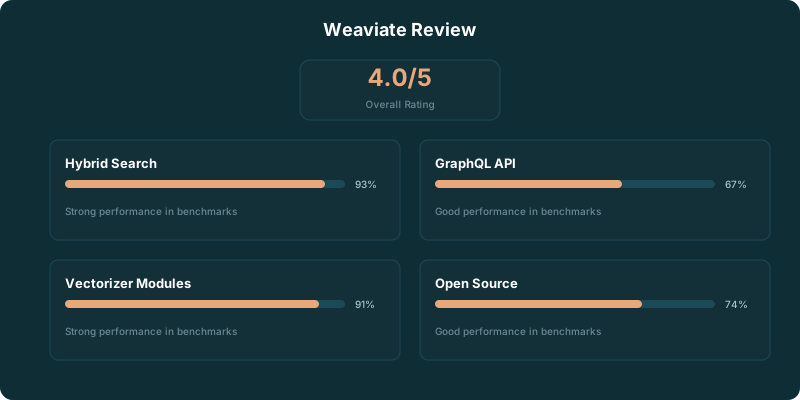
The Weaviate vector database is open source under the BSD-3-Clause license. You can run it yourself, modify the code, and use it commercially without paying a database license fee.
Cloud costs depend on scale. A small 100K-vector deployment runs about $25/mo on Weaviate Cloud Related analysis. At 1M vectors, Weaviate costs roughly $100-200/mo on cloud or $30-60/mo self-hosted Related analysis.
That makes Weaviate a strong option for engineering teams building RAG, AI search, recommendation systems, or retrieval layers that need more control than a managed vector service offers. Its advantage is the module system: Weaviate can create embeddings during ingestion, rather than forcing you to build and maintain a separate embedding pipeline.
TLDR
Weaviate is a BSD-3-Clause open-source vector database with built-in vectorization and hybrid search. Self-hosting costs less but creates operational work. Cloud removes that work, while Pinecone remains the easier managed choice for teams that want fewer infrastructure decisions.
Weaviate’s Open Source License, Answered
Weaviate uses the BSD-3-Clause license for its open-source database. The license permits commercial use, modification, redistribution, and private use.
For an engineering team, that means you can deploy Weaviate in your own infrastructure, alter the source code if needed, and ship a product that depends on it. You do need to retain the copyright notice and license terms when redistributing the software. You cannot use the names of Weaviate contributors to endorse your product without permission.
The practical answer is simple: BSD-3-Clause is permissive. Legal review still belongs in any production procurement process, especially when your company redistributes software or has a strict open-source policy. But Weaviate does not put the database behind a source-available license or a commercial production license.
That distinction affects architecture choices. A self-hosted deployment can become part of your stack without creating a recurring database license line item. Your bill comes from compute, storage, backups, observability, and the people responsible when an index needs attention at an inconvenient hour.
Weaviate Cloud changes the operational trade. You pay for managed infrastructure and spend less time operating it. The underlying open-source option remains available if the managed service becomes too expensive or too limiting.
This is where Weaviate has an edge over vendors whose managed product is the only serious path. You can start on cloud, move to your own environment later, or standardize on self-hosting from day one. The migration still requires planning. Portability is useful only if your schema, embedding models, and retrieval behavior stay under control.
What Weaviate Costs
Weaviate has two cost profiles: infrastructure costs for self-hosting and usage-based cloud costs for managed deployments.
Weaviate Cloud serverless pricing runs about $0.095/1M dims stored Related analysis. That metric matters because vector count alone hides a major variable: embedding dimensionality. A collection using larger embeddings stores more dimensions per object, which changes the bill even if the document count stays flat.
A small 100K-vector deployment runs about $25/mo on Weaviate Cloud Related analysis. This is the range where managed cloud is often worth it. The bill stays comprehensible, and your team avoids spending time on cluster sizing, upgrades, monitoring, backups, and recovery drills.
At 1M vectors, Weaviate costs roughly $100-200/mo on cloud or $30-60/mo self-hosted Related analysis. The self-hosted figure is lower because you are taking on the operating work. That gap can be worth paying when vector search is an important product dependency but not where your team wants to spend engineering hours.
Self-hosted does not mean free in the useful sense. The software license is free. Production infrastructure is not. You need capacity for the database, persistent storage, backups, network traffic, metrics, alerting, access control, and someone who can diagnose a degraded query path. A team with established Kubernetes and database operations may treat that as ordinary work. A small application team may find it becomes a money pit fast.
Pinecone’s paid tiers start from $50/mo Standard and $500/mo Enterprise for comparison Related analysis. Pinecone charges for managed simplicity. Weaviate gives you more room to decide where that simplicity belongs: in a cloud bill or inside your own infrastructure.
Costs also depend on ingestion patterns. If your source data changes constantly, you will care about updates, deletes, re-vectorization, and backup retention. A static knowledge base has a very different profile from a product catalog or a support corpus that changes every day.
The useful question is not “Which database has the cheapest sticker price?” It is whether your retrieval workload is important enough to warrant owning the operational layer. If the answer is no, managed cloud is usually the sane choice. If the answer is yes, Weaviate gives you a credible self-hosted exit.
Deployment Options Side by Side
| Deployment option | Cost | Ops burden | Best for |
|---|---|---|---|
| Self-hosted | At 1M vectors, roughly $30-60/mo | High | Teams with infrastructure ownership and a need for control |
| Serverless Cloud | A small 100K-vector deployment runs about $25/mo | Low | RAG and search teams that want managed operations |
| Dedicated | Contact sales | Medium | Larger workloads with managed infrastructure requirements |
Self-hosting gives you control over network placement, data residency, upgrades, authentication, and surrounding infrastructure. It also makes you responsible for every one of those choices. Weaviate supports common deployment patterns such as Docker and Kubernetes, which will feel familiar if your team already runs stateful services.
Serverless Cloud is the simpler path for teams evaluating retrieval quality before making a long-term infrastructure commitment. You can focus on data preparation, embedding selection, chunking strategy, filters, and evaluation. Those decisions usually have more impact on a RAG application than the database logo in the architecture diagram.
Dedicated deployments fit buyers who want managed operations but need more predictable infrastructure arrangements. The right fit depends on security requirements, workload shape, and whether shared serverless infrastructure is acceptable.
The deployment choice can change over time. An early product may need managed speed. A mature product with steady scale may decide the operational trade has flipped. BSD-3-Clause gives you that option.
What Weaviate Does
Weaviate stores objects and their embedding vectors together. An object might be a document chunk, product, image, customer record, support ticket, or any other item you want to retrieve by meaning rather than exact keywords.
A query becomes an embedding vector. Weaviate finds nearby vectors, then returns the associated objects and metadata. Filters narrow results by ordinary fields such as category, customer, language, access level, or document source.
That base capability is table stakes in vector databases. Weaviate becomes more interesting through the parts around it.
Built-in vectorization
Weaviate’s modules can vectorize content during ingestion. Send raw text to the database, configure a supported vectorizer, and the object can receive an embedding as part of the write process.
This removes a separate ingestion step for teams that do not need custom embedding orchestration. You do not have to build a worker that fetches a document, calls an embedding provider, stores the vector, retries failed requests, and keeps vector metadata aligned with the original object.
That convenience has a boundary. Teams with specialized embedding models, complex preprocessing, model routing, or strict control over each vector may prefer to generate embeddings outside the database. Weaviate supports that approach too. You can bring vectors you created elsewhere.
The module system wins when it reduces needless plumbing. It loses when the database becomes the place where too much application-specific logic hides.
Hybrid search
Weaviate can combine dense vector similarity with BM25 keyword matching in one query. Dense vectors are good at semantic similarity. BM25 is useful when exact terms matter, including part numbers, uncommon names, error strings, legal language, and product terminology.
The alpha parameter controls the blend between vector and BM25 signals. A higher vector weight favors semantic similarity. A higher keyword weight favors literal matches.
Hybrid search is often the right default for enterprise search and RAG retrieval. Users mix natural-language questions with exact language from their own domain. A search for a specific policy code should not lose to a semantically adjacent document just because the adjacent document sounds more similar.
The quality work happens after the feature is switched on. Test representative searches. Look at where the right result ranks. Separate semantic queries from exact-match queries. Then tune the blend based on observed failures rather than an aesthetic preference for semantic search.
Multi-tenancy
Weaviate supports multi-tenancy for applications that store isolated customer data in the same system. That is useful for SaaS products where each account has its own documents, knowledge base, or indexed records.
Tenant separation can simplify application design and reduce the need to create a separate database deployment for every customer. It does not remove the need for application-level authorization. Retrieval systems are especially unforgiving here. Returning the wrong customer’s document is a security incident, not a slightly bad search result.
GraphQL API and modules
Weaviate offers a GraphQL API alongside other client interfaces. GraphQL can be convenient when you want queries that retrieve objects, filters, metadata, and vector search results through one structured interface.
The modules system extends beyond vectorization. It gives teams a place to configure vectorizers, ranking behavior, and generative integrations. That makes the platform more feature-rich than a bare vector index, though it also means more configuration choices.
Feature depth is useful when it maps to a real requirement. If your project only needs a small embedding store beside an existing database, a more compact option may be easier to run.
What Changed in 2026
Weaviate released version 1.26 in early 2026 with a restructured per-dimension cloud pricing model Related analysis.
The per-dimension model makes embedding choice part of infrastructure planning. Teams often choose embeddings based on retrieval quality, latency, language support, and provider availability. Storage cost now belongs in that decision too.
That does not mean you should choose an embedding model by price alone. Retrieval quality affects the answers your product gives customers. Cheap vectors that pull weak context will cost more than they save. But the pricing model gives engineering and finance a clearer reason to track embedding dimensions from the start.
Weaviate benchmarked its database against rivals using 1536 dimension embeddings Related analysis. That benchmark setup is a useful reminder that database comparisons need comparable embedding assumptions. A result from one vector size does not automatically transfer to another.
Version changes also create an operational question for self-hosters: when do you upgrade? Database upgrades deserve a staging environment, a restore plan, and a realistic workload test. The database might start cleanly while an application query, backup process, or module configuration breaks later.
Managed cloud buyers trade some of that work for vendor operations. Self-hosters get more control over timing. Neither option is automatically better. The winner is the one that fits how your team already handles production dependencies.
Weaviate vs Pinecone
Pinecone is the easier managed choice. It is built for teams that want a vector database service without operating the database layer themselves.
Weaviate gives you more control, more deployment flexibility, hybrid search, and built-in vectorization through modules. That can reduce the amount of surrounding ingestion infrastructure you need to maintain.
Pinecone makes sense when the managed experience is the priority and you want the fewest moving parts. Weaviate makes sense when you want cloud flexibility, self-hosting, or the ability to keep vectorization and retrieval features closer to the database.
Read the full Pinecone vs Weaviate comparison if this is your final shortlist.
The more important distinction is operational ownership. Pinecone owns more of the boring work. Weaviate lets you decide how much of it you want to own. For a small team shipping a first RAG feature, Pinecone may be the faster path. For a platform team building shared retrieval infrastructure, Weaviate has more room to grow.
Weaviate vs Chroma and pgvector
Chroma is a good fit for prototypes, local development, and lightweight experiments. It is easy to start with, which matters when the larger question is whether the retrieval experience works at all.
Weaviate is the stronger production choice when you need hybrid search, multi-tenancy, filters, cloud deployment options, and a more complete operational story. Chroma is lighter. Weaviate is broader.
pgvector is a sensible choice when you already run Postgres and your vector workload is modest. Keeping relational data and vectors in one system can simplify the application. It also avoids introducing another production dependency.
Weaviate becomes more appealing when vector retrieval becomes its own serious workload. Its indexing, search features, and module system give you more options than a Postgres extension. See the pgvector review for the cases where staying inside Postgres is still the better call.
For a wider evaluation, our best vector databases guide compares the main options engineers are putting into production.
Key Takeaways
- Weaviate is open source under the BSD-3-Clause license, which permits commercial self-hosting and modification.
- Built-in vectorization can remove a separate embedding pipeline for straightforward ingestion workflows.
- Hybrid search blends vector and BM25 signals through the
alphaparameter. - Self-hosting reduces infrastructure spend but shifts operational responsibility to your team.
- Pinecone is the simpler managed option; Weaviate offers more control and deployment choice.
Weaviate is a good fit when retrieval is becoming a product capability rather than a small feature bolted onto an application. Its module system can keep the ingestion path compact, and its open-source license gives your team an exit from managed cloud if the economics change.
The harder question is whether you want to operate a database. If your team already owns that work, self-hosting can make sense. If it does not, serverless cloud keeps the focus where it belongs: getting the right documents into the context window.
Sources
- PE Collective Weaviate review: version 1.26
- PE Collective Pinecone vs Weaviate: $0.095/1M dims stored
- PE Collective vector database tests: 1536 dimension embeddings